 Most people research a slate backwards. They start with rankings — somebody's conclusion — and work outward, which means every decision they make is downstream of a judgement they never checked.
The order below runs the other way. It starts with the things that are knowable and ends with the opinion, and it takes about twenty minutes.
1. Who Is Actually Playing
Everything else on this site is a lagging indicator of one thing: who is on the field. So it goes first, always.
The injury report runs to a rhythm worth knowing. Wednesday the practice reports land — the earliest signal a role is changing, days before a box score shows it. Friday the designations get ruled. Sunday morning inactives drop, and that's the last free information before lock.
Read it beside depth charts for all 32, because a limited practice means something entirely different for a committee back than an established workhorse. And the player wire carries player items only — no team marketing, no ticket promos.
Half of all fantasy busts were never getting the volume. That's diagnosable here, before kickoff.
2. The Collision
The Mismatch Machine crosses every game against 51 team stat ranks and floats the biggest gaps up. A #3 rushing offense against a #30 run defense is a gap of 27 — a number, not a hunch.
Then the position sheets underneath it, because you never start a defense: vs QB, vs RB, vs WR, vs TE — all three seasons deep on the team sheets.
3. The Situation
Schedule Spots reads rest edges, short weeks, letdowns after a war and lookahead traps against 25 years of games — with the sample size printed on every split and a plain "no edge here" when there genuinely isn't one.
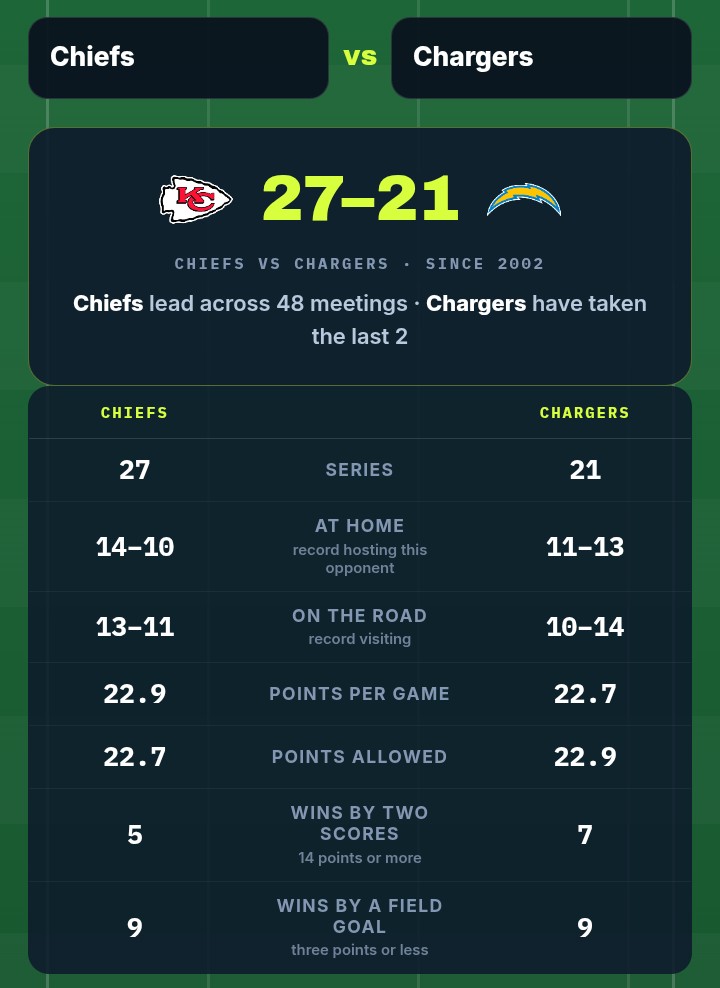
Every game has its own page carrying the series since 2002 and the average combined score to hold against tonight's total. The head-to-head book goes back to 2002 for any pair.
4. The Conditions
Knowable days ahead and checked by almost nobody.
The Weather Book holds 6,511 games joined to hourly stadium weather — and wind wrecks passing production harder than cold ever does. A split only publishes if it survives ten-plus games and sits twenty points off that team's own win rate, which is the test that kills the fake weather stat.
The Surface Book splits every player by turf and grass, sample size attached.
5. The Shape Of The Player
Player cards carry completion zones, run gaps, the air-yards-versus-YAC split and — the one that beats everything — snap share. Opportunity beats talent every time and it isn't close.
Boom or Bust shows the shape of a range rather than its midpoint. Consistency shows who actually clears his line week to week. Two players with the same average are frequently two completely different bets.
6. Then, And Only Then, The Call
Start or Sit compares any two players with the reasoning shown. Or skip the work entirely — import your team from Yahoo, ESPN or Sleeper and the Roster Doctor grades every man you own off exactly these inputs and builds the optimal lineup out of what you already have.
If You're Betting It Instead
Same first four steps, then a different back half.
The Projection Board puts our number on every prop next to the best price at nine-plus books, with the edge between them. The Line Checker counts how many times a player has cleared any number you type. The hit-rate board shows the last 5, 10 and 20 in colour.
The unders board catches the shaded lines — books lean toward the over because the public loves the over. The ATS board and team streaks for the trends, and turnover stats for the regression nobody prices.
Then price it honestly: devig to find the fair line, the +EV finder for books paying past it, the heat map so you never take a worse number, Kelly to size it, and the Parlay Doctor to grade the slip A through F before you fire. Everything else is in the Money Room.
Afterwards, log it in CLV. Winning bets can be luck. Beating the close is skill.
And We Run The Same Routine In Public
Every game gets three calls from us — moneyline, spread, total. They stay live all week against the current number, sit on the verdict slate, lock twenty minutes before kickoff, and get graded the next morning against the number they were locked at.
Win, loss or push, on the public ledger, with nothing quietly removed after a bad week.
The Rest Of The Week
Tuesday is the wire — the Free Agent Wire and sleepers, because championships get built in Weeks 2 through 5 by whoever notices a role change first.
Still drafting? The 2026 Guide runs 335 deep, the Big Board prices off the live market, and the December Board grades everyone on the weeks that actually decide your league.
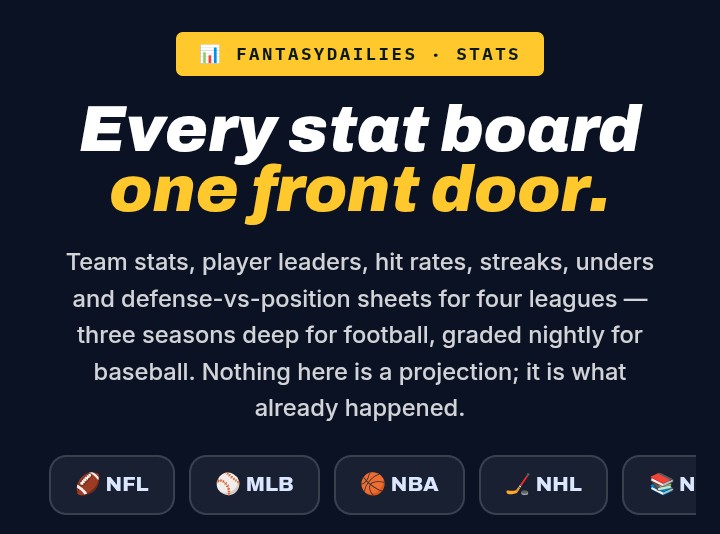
Other sports: the stats hub covers all four, with NBA and NHL vaults of their own.
The Honest Part
Twenty minutes of the right work beats two hours of the wrong work, and most people spend their two hours reading conclusions rather than inputs.
None of this makes a Sunday certain. What it does is stop you losing to things that were knowable on Friday.