 Here is a question almost no sports betting site can answer, and almost none are asked:
When you say you're 70% confident, are you right 70% of the time?
Not "do you win more than you lose." Not "what was your record last month." The specific question — does your stated confidence mean anything at all?
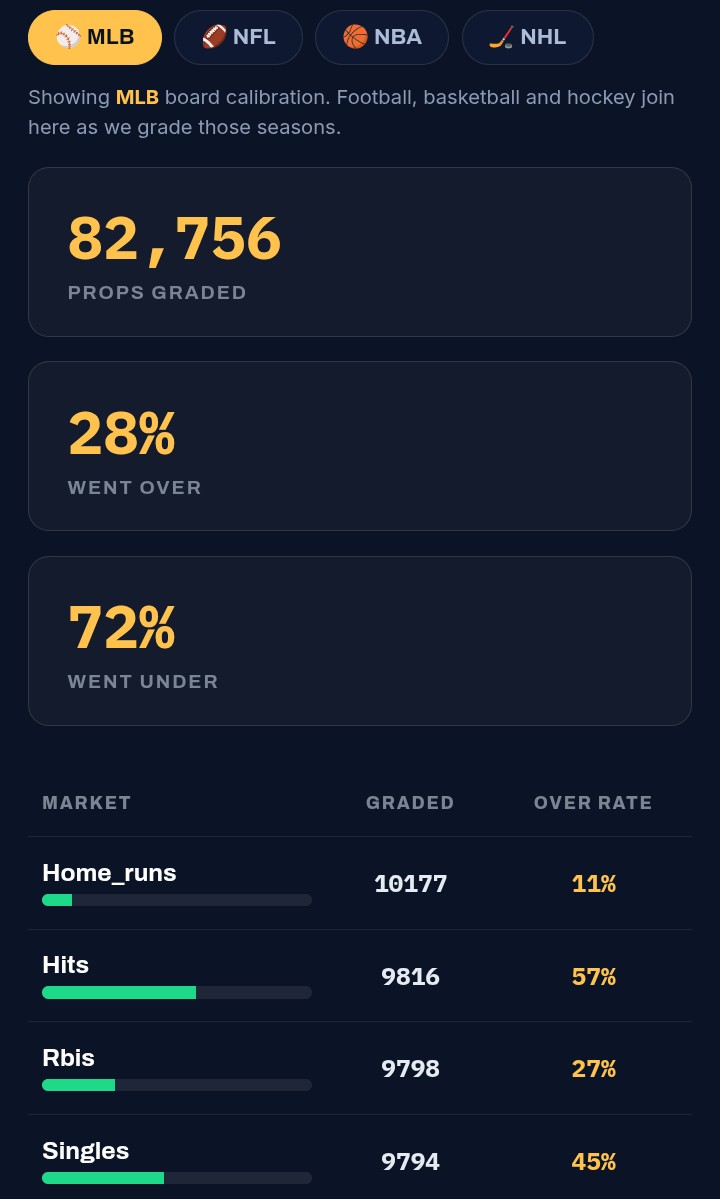
Most places can't answer it because they never wrote the confidence down. Some can't because the answer is embarrassing. Our calibration page answers it in public, and it describes itself more honestly than any marketing copy would:
It is the least flattering page on the site and the most useful one.
What Calibration Actually Means
The definition is short and it's unforgiving.
A model that says seventy percent should be right about seven times in ten. When it is, it's calibrated, and its numbers can be used to size bets. When it isn't, the numbers are decoration.
That's the whole idea, and notice what it isn't. It isn't a win rate. A model can be profitable and badly calibrated — hitting 60% while claiming 85% means you're winning money and lying about why, and the moment you size a bet off that 85% you get hurt.
It also isn't a record. A 12-4 month tells you what happened; calibration tells you whether the number that produced it can be trusted next month.
How The Page Works
Every graded call gets bucketed by the confidence it carried, then measured against how often those calls actually landed.
Say fifty calls went out at 65-70% confidence. Calibration asks how many of those fifty won. If it's about 33, the number is honest. If it's 45, we're underselling. If it's 22, the number is worse than useless — because a bettor sized a stake off it.
Every prop we post is graded against the real result — win or loss, no quiet deletions. Which is the only condition under which any of this means anything.
Why It Matters More Than A Record
Because of what a probability is for.
You don't bet a probability, you bet a stake — and every honest staking method takes your win probability as its input. Kelly is the clearest example: feed it 70% when the truth is 55% and it will tell you to bet an amount that destroys a bankroll over a season. The formula isn't wrong. The input was.
Which means an uncalibrated model is more dangerous than no model, because it produces confident numbers that feel like information.
Same reason expected value falls apart on a bad input: EV is your probability times the payout minus the stake. Get the probability wrong and you've computed a precise answer to the wrong question.
The Machinery Behind It
Calibration only works if the inputs can't be massaged after the fact, so three rules hold across everything:
Calls lock before the event. Every game gets three — moneyline, spread or run line, and total. They stay live all week against the current number, then lock twenty minutes before first pitch or kickoff, by a scheduled job rather than a page view. So it happens whether or not anybody is on the site, which means a bad week can't be quietly skipped.
They're graded against the number they were locked at. Not the closing number. Grading a call against a line that moved is a lie that flatters us — if we called a team at −3 and it closed at −6, only one of those numbers is the one we actually committed to.
Projections are written once. On the projection board, every number is logged on first sighting and graded afterwards. Because a projection that moves all afternoon is not a projection — if you can revise as news breaks and then grade whichever version happened to be right, you're keeping books in reverse.
All of it lands on the public ledger, and the losses stay on the page next to the wins.
Do The Same Thing To Yourself
The uncomfortable version of this is turning it on your own betting.
The CLV tracker is the closest personal equivalent. Did you beat the number the market closed at? Winning bets can be luck. Beating the close is skill — and over a hundred bets it tells you a truth your bankroll can hide for months.
Then Units and ROI, which produces the number that ends arguments: your actual win rate against the break-even your average price demanded. At −110 the bar is 52.38%, and plenty of people who "had a good year" discover they were running behind it the whole time.
Worth knowing before you check: sustainable ROI in sides markets is roughly 2-5%. A double-digit figure almost always means a small sample flattering you.
Where To Use A Trusted Number
Once a probability is worth something, the rest of the toolkit works:
Devig the market to find the fair line — a standard −110 market implies 104.8% total probability, and that 4.8% is the house's cut in plain sight. The odds converter gives the break-even any price demands. The +EV finder flags every book paying past fair, and the heat map puts nine side by side.
Then Kelly for the stake — and half-Kelly keeps roughly 75% of the growth with half the swings, which is where professionals live precisely because they don't fully trust their own inputs.
The Parlay Doctor grades any slip A through F. Everything else is in the Money Room.
See It On A Slate
The calls themselves live on the verdict slates — MLB, NFL, NBA, NHL — each with the running record attached.
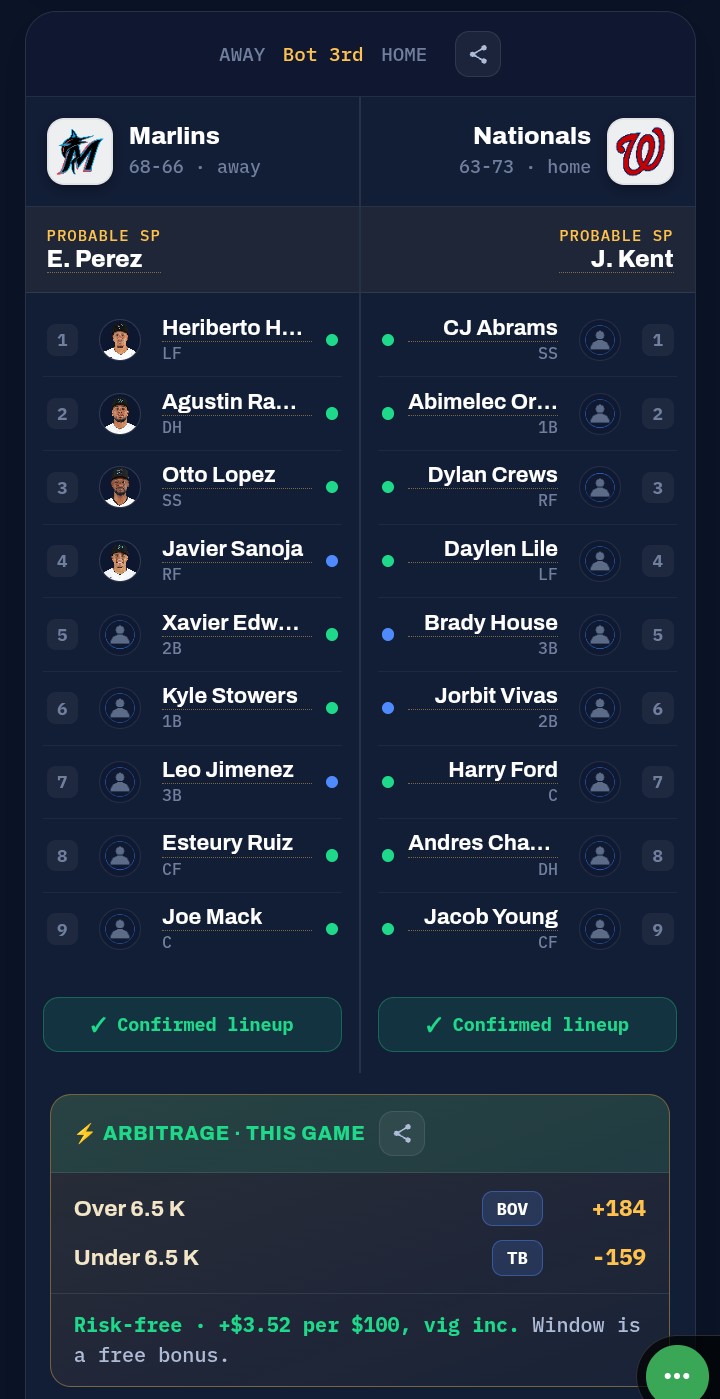
And MLB Tonight pulls a night together: lineups, ballpark weather, projections and the calls in one place.
The Honest Part
A calibration page can go badly. That's not a risk of publishing one — it's the entire point. A measurement that can only return good news isn't a measurement.
And calibration isn't accuracy. A perfectly calibrated model that says 52% on everything is honest and nearly useless. You want honest and sharp, and the page only proves the first half.
But the first half is the one nobody else shows you.
See the calibration page → · The full ledger →
21+. If it stops being fun, 1-800-GAMBLER.