Sportsbooks are exceptionally good at showing you one number. The payout.
They are considerably less enthusiastic about the others. What that bet is worth against the fair price. What your "free" bet converts to in actual cash. Whether the 30% boost is generous or bait. Whether the half point you just bought was a bargain or a tax. And the one that stings — what your record actually says once you hold it against the rate you needed.
Every one of those is a calculation, not an opinion. Every one of them takes about fifteen seconds. And almost nobody does any of them, which is precisely why the industry is built the way it is.
This is the full shelf, what each tool is for, and — more usefully — the specific moment it changes a decision. All of it lives in the Money Room.
Part One: What Is This Bet Actually Worth?
Start here. Everything downstream depends on it.
The Devig Calculator — find the fair line
Every two-sided market implies more than 100% of probability. That overage is the vig, and it's sitting in plain sight if you know to look.
At a standard -110 both ways, each side implies 52.4%. Add them: 104.8%. That extra 4.8% is the house's cut, baked into the price before anyone picks a side.
Scale both sides back to 100% and you have the fair line — what the bet is genuinely worth with the margin removed.
When it changes your bet: you think a number looks good. Devig it, discover the fair price is actually better than what you're being offered, and you've just talked yourself out of a bet that felt fine. That's the tool doing its job.
The Odds Converter — the break-even nobody knows
American, decimal, fractional, implied probability. Type in any box, the rest follow.
But the number worth carrying around in your head is the break-even beneath it. -110 demands a 52.38% win rate. Not 50%. Not "just over half."
That 2.38 percentage points is the entire game. Beat it consistently and you win. Miss it and no amount of feeling sharp saves you.
The EV Calculator — the honest verdict
Your true win probability, the odds, your stake. Out comes expected value in dollars and percent, your edge over the implied line, and a plain verdict.
There's a hidden benefit here that people miss: if you can't put a number in the win-probability box, you've learned something important. You're betting on feel, and feel doesn't have an expected value.
The Appraiser — a verdict on the price
Slide any bet under the glass and the house grades what you're paying against the market's fair number. Not a prediction about the game. A verdict on the price.
Part Two: The NFL Spread Tools
These four share a foundation, and it's the single most useful fact in football betting:
NFL margins are not evenly distributed. They pile up on the field goal and the touchdown. Roughly 9.5% of all games land exactly on 3. Another 5.7% land exactly on 7. Six, ten and fourteen form a second shelf. Numbers like 5 are nearly empty.
Every spread edge in football flows out of that distribution.
The Half Point Calculator — the hook, priced honestly
Books sell half points as though they're interchangeable. They are wildly not.
Buying a hook converts pushes into wins exactly as often as the game lands on the number you crossed. That's the whole mechanism.
- -3 to -2.5 buys every game landing on 3 — about one in ten. Enormous.
- -5 to -4.5 buys games landing on 5 — which barely happens. You paid for a souvenir.
When it changes your bet: the book charges roughly the same juice for both. This page tells you the fair cost in cents for the exact hook you're crossing, so you know when they're overcharging and when they're handing you a bargain.
The Teaser Calculator — and the Wong flag
Tease 2-4 legs by 6, 6.5 or 7 points. You get the payout, the true win probability per teased leg from the margin model, and the combined EV.
The important part is the Wong flag, which fires when a leg crosses both key numbers:
- A favorite at -7.5 teased to -1.5
- A dog at +2.5 teased to +8.5
Those spans swallow 3 and 7 whole — roughly 15% of all outcomes in one move. Historically that pushes a leg past the 73.9% a two-team -120 teaser demands.
Tease through dead numbers instead and you're paying parlay juice for coin flips dressed as locks.
Cover Probability — turn a hunch into a number
This one deserves more attention than it gets, because it fixes a specific error almost everybody makes.
Every honest projection is the center of a cloud, not a point. You think they win by 7. Fine — but final margins scatter around a true projection with a standard deviation near 13.45 points, mined from decades of results.
Thirteen points of scatter. That's why a game you're "sure" about still loses constantly, and it's why "I have them by a touchdown" and "they cover -3" are not the same claim.
Enter your projected margin and the posted spread, and it draws the bell curve, plants the market's line in it, shades the cover region, and prices it: cover probability, push probability, break-even and EV per $100.
Spread to Moneyline Converter
Any NFL spread to its fair moneyline and win probability, and any moneyline back to the spread it implies — built on the real margin distribution rather than a smooth curve that pretends 5 is as common as 3.
When it changes your bet: you like a team but hate laying the points. This tells you whether the moneyline is fairly priced against the spread, or whether the book is charging you for the convenience.
Part Three: Where The Math Pays By Itself
No prediction required. Just arithmetic.
The Arbitrage Calculator
Two or three odds across books plus your total stake. It splits the stakes for equal locked profit and shows the arb percentage. Win or win.
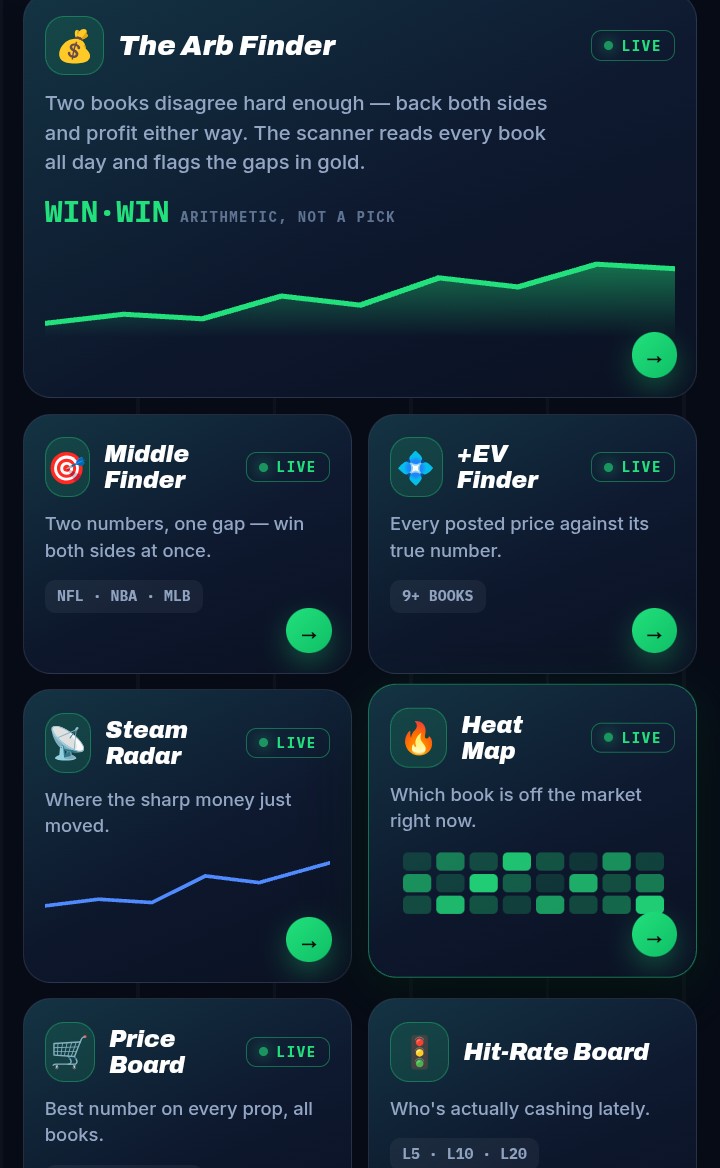
Pair it with the live arb finder, which reads the wall all day and flags disagreements in gold.
The Bonus Bet Converter — the most underused tool here
Read this one carefully, because there's real money in it.
A free bet is not cash. On a win, the stake vanishes — you keep only the profit. So its entire value lives in the odds you put it on.
The mechanics: $100 riding at +300 wins $300 cash. Hedge the other side at a second book with real money, and the worst outcome still pays north of $70 guaranteed. Both outcomes land the same.
The science is short: longer bonus legs with fair hedge prices convert better. Two juiced prices convert worse. Which is exactly backwards from what most people do — they stick the free bet on a short favorite because it "feels safer."
Standard conversion done right is 70%+ of face value. Most people fire it on a longshot and call it house money.
The Profit Boost Calculator
"30% MORE WINNINGS" in a shiny wrapper. This unwraps it.
The key mechanic people miss: a boost multiplies winnings, not stake. So 30% on +100 makes it effectively +130. That same 30% on -150 makes it roughly -115.
Longer odds gain far more from the same percentage — which is precisely why books cap boost stakes on dogs. They know.
Boosts shrink the hold, sometimes past zero. But a boost only clears that hold when the boosted price beats the truth. So the play is: devig the market first, put the true probability in the box, and let the EV cell speak.
The Hedge Lab
One leg from a parlay, or up big on a futures ticket. This computes the exact opposite-side stake that locks profit on every outcome. Turns sweating into already-paid.
The Middle Finder
Book 1 hangs 44.5, Book 2 hangs 47.5. Take both sides — if the game lands on 45, 46 or 47 you cash both tickets. Miss the window and you're out roughly the vig. Tiny risk, jackpot ceiling.
Part Four: Bankroll — The Part That Actually Kills People
The Kelly Calculator
You found an edge. Now: how much?
Kelly answers it mathematically. But almost nobody should bet full Kelly, and the reason is honest — your win probability is an estimate, and full Kelly punishes optimism brutally.
Half-Kelly keeps roughly 75% of the growth with half the swings. That's where professionals actually live. Quarter-Kelly is right there too.
And when it reads NO BET, believe it. That answer has saved more bankrolls than any winning pick ever has.
Units & ROI — your record on the register tape
Wins, losses, pushes, average odds, unit size. Out comes units won, ROI, and the number that ends arguments: your actual win rate against the break-even your average price demanded.
Two reference points worth knowing before you run it:
- At -110 the bar is 52.38%. Every point above it, times your volume, is your profit.
- Sharp, sustainable ROI in sides markets is 2-5%. A double-digit ROI almost always means a small sample flattering you.
Plenty of people who "had a good year" discover they were running behind the number the whole time.
The Losing Streak Calculator
Even winning bettors eat long losing runs. Enter your win rate and bet count to see the streaks you will face — then size the bankroll for those rather than for hope.
The Long Run
Your win rate, unit size and volume, run across thousands of simulated seasons. See the futures where you compound and the ones where you bust — before living one of them.
The CLV Tracker
The professional's scoreboard. Did you beat the number the market closed at?
Winning bets can be luck. Beating the close is skill. Over a hundred bets, CLV tells you a truth your bankroll can hide for months.
Part Five: Parlays, Priced Honestly
The Parlay Calculator gives the true combined price of any stack before you build it.
The Parlay Truth Machine shows what it should pay against what the book is offering, and names the gap in dollars. That gap is what the convenience costs you.
The Round Robin Calculator maps every combination and stake before a dollar moves — a robin isn't one bet, it's a stack of them, and the total outlay surprises people constantly.
Then the Parlay Doctor grades any slip A through F: the true break-even, the buried juice, the correlated legs, and which single leg is carrying the ticket. Nothing you paste is stored anywhere.
Correlation is the quiet killer. A quarterback over on passing yards plus his own receiver over on receptions is one event wearing two hats, and books cheerfully price it as though it isn't.
Part Six: The Specialists
The Poisson Calculator
For anything that arrives as a count — goals, touchdowns, saves, corners. Enter an expected rate and a line, get the exact-count table, over/under probabilities and fair odds.
This is the correct model for hockey and soccer totals, and most people reach for a normal curve that genuinely doesn't fit the data.
The Passer Rating Calculator
The official NFL formula with a live gauge and all four components shown as bars — completions, yards, touchdowns, interceptions. Useful for understanding why the formula behaves the way it does, which is more than most people who quote it can say.
Where The Bets Actually Come From
A calculator prices a bet. It doesn't find one. That's a different set of rooms:
The +EV finder scans nine-plus books and flags every price paying past fair. The Hit-Rate Board shows real prop hit rates over the last 5, 10 and 20 games in traffic-light color, graded off our own nightly ledger. The Line Checker counts how many times a player has cleared any number you type, with the game log underneath.
The heat map puts nine books side by side so you never take a worse number. The steam radar shows where the money went in the last hour. The props board prices everything.
On the football side: the Mismatch Machine crosses every game against 51 team stat ranks, the ATS board ranks all 32 with the rank right next to the team, Schedule Spots reads rest edges and traps against 25 years, and every game has its own page with the series since 2002.
Plus the Weather Book (6,511 games joined to hourly stadium weather), turf and grass splits, the player news wire, and the graded ledger where every call gets stamped the next morning, win or lose.
What This Costs You
Most of our competitors put this entire shelf behind a subscription. You want a devig calculator, you're buying a package.
We'd rather you got the answer. So everything here runs on a daily allowance instead of a paywall — a generous number of uses every single day, no account, no email address, no card. Come back tomorrow and the counter resets.
That's deliberate, and it's honest: a handful of taps a day covers what almost anybody actually needs. If you're running numbers all afternoon and the counter starts getting in your way, a Velvet seat is $9.99 a month and lifts it. No tiers, no upsells, no "contact us for pricing."
We'd rather be the site you keep than the one you signed up for once.
The Honest Part
None of these tools predict a game. They price one. That distinction is the whole point, and anyone blurring it is selling you something.
Arbs and middles depend on live prices that move fast and can vanish before you fire — always confirm at the book. Limits, voided bets and books restricting winning accounts are real behavior you should expect rather than be surprised by. And margin frequencies are long-run averages, not promises about Sunday.
21+. If it stops being fun, 1-800-GAMBLER.