NFL Week 3 | Sunday, September 27, 2026
If you're building DFS lineups or betting player props this Sunday, there is one piece of information you absolutely cannot ignore:
The weather.
And not just what it was forecast to do on Thursday. What it's actually doing this morning.
Here's the thing: earlier this week, the story was a nor'easter bearing down on the Northeast, with  Giants-
 Titans and
  Seahawks-
 Commanders both getting flagged as the games to build around. That forecast was real — heavy rain, wind advisories, gusts into the 40s.
But as of this morning, both of those forecasts have eased considerably. That's not a small update. It's the entire lesson of this article, happening in real time: the forecast isn't the bet, and neither is Thursday's forecast. The live weather report carries the actual current reading for every stadium today, refreshed hourly rather than left at whatever it said when this was written.
WHAT'S ACTUALLY HAPPENING RIGHT NOW
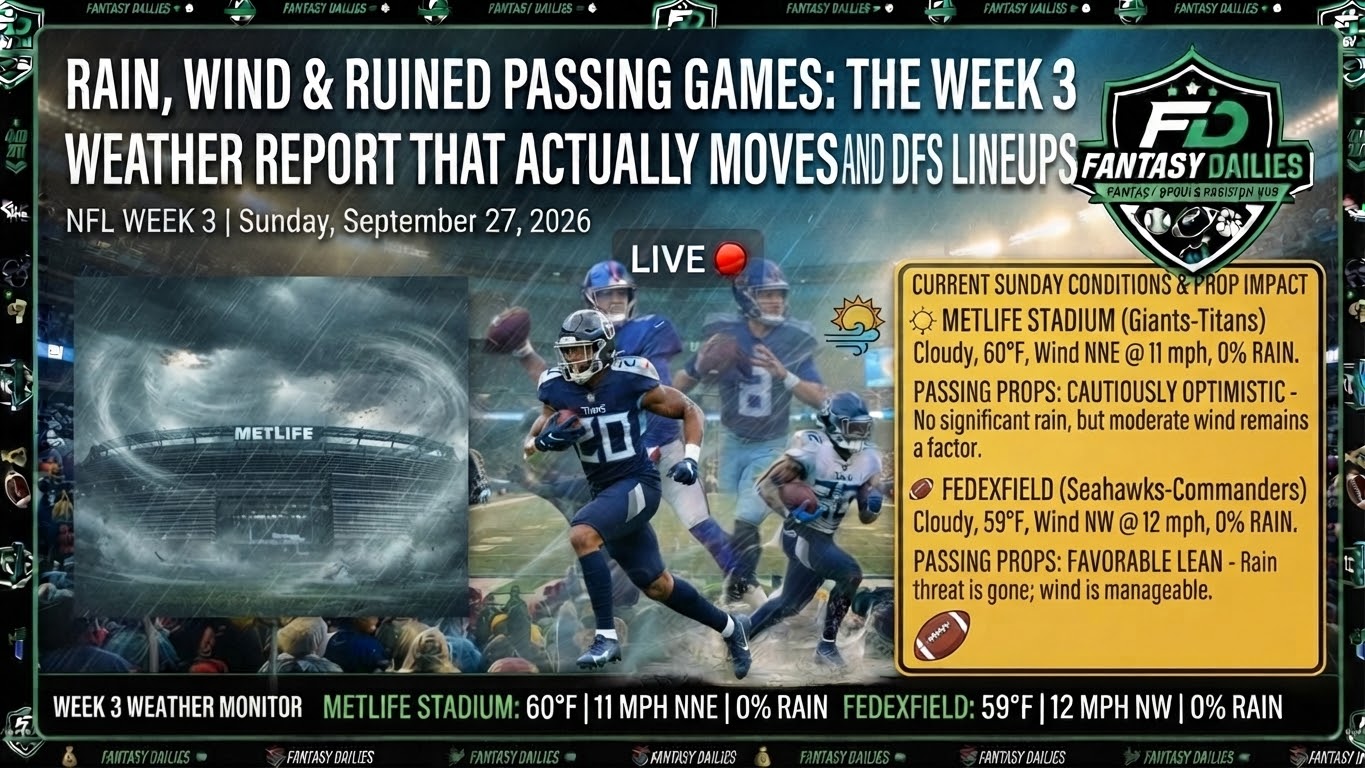
Titans at Giants — METLIFE STADIUM
This was supposed to be the disaster game. A wind advisory ran until 6 a.m. this morning, with forecasts calling for an 83-90% chance of rain and gusts up to 41 mph.
As of this morning's reading, conditions at MetLife are cloudy, 60°F, wind out of the NNE at 11 mph, and 0% chance of precipitation at kickoff.
That is a massive swing from the forecast that had this game circled as the week's biggest weather story.
Does that mean ignore it entirely? No — this is still an outdoor September game in the Northeast and conditions can shift again before and during the 1 p.m. kickoff. But it does mean anyone who built today's props or DFS lineups off Thursday's nor'easter warnings without rechecking this morning is working off a stale read. Check the live number before you lock anything on this game.
Seahawks at Commanders — FEDEXFIELD
Same story here, smaller scale. Earlier forecasts had rain and winds in the mid-teens penciled in.
This morning's reading: cloudy, 59°F, wind NW at 12 mph, 0% chance of precipitation.
That doesn't mean the wind won't matter at all — 12 mph is still enough to affect a 40-yard-plus attempt — but the rain threat that had this game on the "caution" list appears to have not materialized as of this morning.
 Chargers at
  Bills
Bills
Buffalo was never the disaster game to begin with, and that holds. Almost no chance of rain at kickoff in Orchard Park, with wind in the mid-teens worth knowing about for anyone leaning on a deep-ball prop or a long field goal, but nothing close to what's being described at the two games above.
 Panthers at
  Browns
Relatively dry, with noticeable but unremarkable wind. This is exactly the kind of game where "Northeast weather" headlines shouldn't automatically get you downgrading every skill player on the slate.
 Bengals at
  Steelers
Acrisure Stadium this morning: 68°F, clear, wind NNW at 13 mph, 0% precipitation. About as clean as an outdoor September game gets. Weather shouldn't materially dictate anything here.
 Patriots at
  Jaguars
EverBank Stadium: 83°F, clear, wind out of the WSW at 7 mph. Warm, calm, no weather story at all.
 Chiefs at
  Dolphins
Warm, relatively calm conditions expected. Same as above — this is a game to build around matchup, not meteorology.
THE DOME GAMES ARE YOUR WEATHER ESCAPE
 Jets at
  Lions
Lions
Ford Field. No weather problem. Full stop.
 Texans at
  Colts
Colts
Lucas Oil Stadium. No meaningful weather problem as long as the roof stays closed.
Both games give DFS players access to a clean passing environment without an outdoor weather system attached. If two players are similarly priced and similarly projected, but one plays indoors while the other is in an outdoor game with real wind or rain, the indoor player becomes the safer lean — not because the outdoor player is bad, but because variance is the thing you're actually managing in a DFS lineup. DFS Edge prices exactly that kind of salary-versus-certainty tradeoff.
WHAT DOES THE HISTORY ACTUALLY TELL US?
This is where the weather conversation gets useful instead of superstitious.
A historical analysis using NFL play-by-play data back to 2015 found rain produces a measurable, consistent deterioration in passing production:
Completion percentage drops by nearly 3 percentage points. Combined passing yards fall by about 45 per game. Passing touchdowns drop by roughly 0.6 per game.
Rushing goes the other way, though more modestly: about 15 more combined rushing yards per game, 1.5 more rush attempts, and a slight bump in rushing touchdowns.
That makes sense. Coaches don't forget how to throw a football in the rain. They simply have more incentive to run it, throw shorter, protect the quarterback and avoid unnecessary risk.
The Weather Book runs this exact analysis against FantasyDailies' own historical games table rather than a single external study — every effect size on that page is measured from real logged games, not typed in as an assumption.
WHERE DFS PLAYERS MAKE A MISTAKE
The biggest mistake is saying: "It's raining. I'm benching every receiver."
No. That's lazy analysis.
A star receiver can still have 10 catches in the rain. What changes is how those catches happen. A receiver getting 11 targets on slants and underneath routes can actually become more valuable in bad weather, not less. A receiver whose ceiling depends on three deep shots becomes considerably more volatile.
That's the entire distinction, and it's exactly what Defense vs WR and Splits are built to show — not just whether a guy is good, but what kind of production he's actually built on.
THE RUNNING BACK ANGLE
This is probably the most obvious place to look.
If weather becomes a legitimate factor, rushing attempts can become more valuable than rushing efficiency. A running back doesn't need perfect conditions to get 20 carries. A quarterback may need decent conditions to throw 35 times efficiently.
That's why I like rush attempts over rushing yards specifically in questionable weather — a player can post a mediocre yards-per-carry number and still smash an attempts prop if his team commits to the run. The goal-line board and the volume board are the two to check for exactly this.
RECEPTIONS CAN BE MORE INTERESTING THAN RECEIVING YARDS
Suppose a receiver has 6.5 receptions and 72.5 receiving yards on the board in a windy, wet environment.
Those are two very different propositions. Weather can hurt explosive gains while simultaneously encouraging shorter, higher-percentage throws — which means an under on receiving yards doesn't automatically mean an under on receptions. Eight catches for 55 yards is a completely normal outcome in exactly this kind of game, and it clears one number while missing the other by a mile.
The Line Checker lets you type either number and see how often it's actually cleared, rather than guessing.
THE QUARTERBACK PROBLEM
Quarterbacks are where weather gets genuinely dangerous for DFS.
A quarterback can still throw for 250 yards in the rain. But the ceiling gets much harder to project once deep throws stop being reliable, the ball gets slippery, and the coaching staff turns conservative.
For cash games, that makes a weather-exposed quarterback less attractive relative to an indoor option. For tournaments, it's the opposite — if the field runs away from a quarterback because of a forecast that turns out to be overstated, that quarterback becomes a genuine contrarian play.
KICKERS: DON'T FORGET THEM
Wind matters enormously for kickers specifically. A 45-yard field goal in calm air isn't the same proposition as the identical attempt with sustained 20-plus mph gusts, and a coach who knows it may go for it on fourth down, take the shorter kick, or avoid the attempt entirely.
Before comparing kickers, check where the game is being played, what the wind is actually doing, and how aggressive that specific coaching staff tends to be on fourth down. The weather report has wind called by stadium, and season-long field goal percentage alone won't tell you any of this.
THE PROP-BETTING ANGLE
Weather doesn't automatically mean bet the under on everything. That's how sportsbooks make money off people who overreact to a forecast.
Instead, look for a specific mismatch between the actual conditions and the specific prop.
Potential weather-sensitive props: quarterback passing yards, longest completion, longest reception, longest field goal, receiving yards, passing touchdowns.
Potential weather-supported props: running back rushing attempts, running back receptions, short-area receiving props, checkdown-heavy running backs, team rushing attempts.
The word is potential. The number still has to make sense — devig it first to see the fair line underneath, and the +EV finder flags anything that's already paying past fair.
DON'T IGNORE THE GAME SCRIPT
Weather can also change how a game is played, and not always in the direction you'd assume.
A team with an early lead in heavy rain may lean on the run even harder. A team trailing by 14 has no choice but to throw regardless of conditions. That means a bad-weather game doesn't automatically mean low passing volume — it can mean more volume with worse efficiency for whichever team falls behind. Weather and game script have to be read together, not separately.
WHAT TO WATCH BEFORE LOCK
If you're playing DFS or betting props today, don't stop researching now. Watch the conditions immediately before kickoff — today is the clearest possible example of why.
1. Wind. The biggest variable. Rain is annoying; wind fundamentally changes the passing and kicking game.
2. Rain intensity. A 20% chance of drizzle is not a nor'easter, even when the headline from three days ago said otherwise.
3. Field conditions. A wet field affects footing for both sides of the ball independent of whether it's still raining at kickoff.
4. Last-minute line movement. If a forecast eases and the book hasn't fully repriced a passing prop yet, that's exactly when the number gets interesting. Line movement shows whether the market has actually caught up, and the heat map shows whether every book has caught up equally — they usually haven't.
The weather itself was never the bet. The relationship between the weather and the number is the bet — and today, the weather already moved once. Make sure your numbers did too.
THE FANTASYDAILIES WEATHER FORMULA
Bad weather + high passing prop → caution
Bad weather + long reception prop → caution
Bad weather + long field-goal prop → caution
Bad weather + RB rush attempts → interesting
Bad weather + RB receptions → interesting
Bad weather + short-area WR targets → don't automatically fade
Dome + high-total game → weather removed from the equation entirely
That last line matters most today. Sometimes the best weather play isn't betting the ugly game — it's finding the game where weather was never going to be a factor and building there instead.
TODAY'S WEATHER BOARD, RANKED
Titans at Giants — was the week's biggest concern; conditions have eased sharply as of this morning, recheck before lock.Seahawks at Commanders — same story, smaller scale; rain threat has not materialized as of this morning.Chargers at Bills — wind worth knowing, rain never a real factor.Panthers at Browns — wind noticeable, precipitation minimal.Bengals at Steelers — clean, weather shouldn't dictate your lineup.Jets at Lions — indoor.Texans at Colts — indoor/retractable roof.Patriots at Jaguars — warm, minimal concern.Chiefs at Dolphins — warm, calm, minimal concern.
THE BOTTOM LINE
Weather is one of the easiest things for fantasy players and bettors to misuse. People see a forecast from three days ago and start hammering unders as if nothing between now and kickoff could possibly change.
Today is the proof that it can. The two games that were supposed to be this week's weather disaster both look considerably calmer as of this morning than they did when the nor'easter warnings first went out.
The strategy was never "see rain, bet under." It's understanding what weather actually changes when it's real — rain reduces passing efficiency and modestly boosts the run, wind hurts deep balls and long field goals more than short throws, and certain player types benefit from the exact conditions that hurt others.
Ask who the rain actually helps. Ask who the wind actually hurts. Ask which prop hasn't adjusted to what the forecast is doing right now, rather than what it said on Thursday.
Sportsbooks and DFS sites know it might rain too. The edge was never in knowing there's bad weather in the forecast. It's in knowing whether the number in front of you has actually caught up to what's happening outside right now.
The live weather report refreshes hourly for every stadium today, and the Weather Book has the full historical effect sizes behind everything above, measured from real logged games rather than assumed. Every prop at the best price, BetScore sorting them 1 to 100, the hit-rate board and Splits for how often a number's actually been cleared, and the unders board for lines that haven't moved with the forecast.
Implied probability and the odds converter turn any price into a plain number, devig strips the vig, Kelly sizes the stake, and the Parlay Doctor grades any ticket A through F before you fire it — or build one straight off today's card with the parlay generator.
Playing DFS instead? DFS Edge prices salary against real production and the lineup optimizer builds around it. Setting a fantasy lineup? Import your team, let the Roster Doctor grade everyone you own, and settle the close calls in Start or Sit.
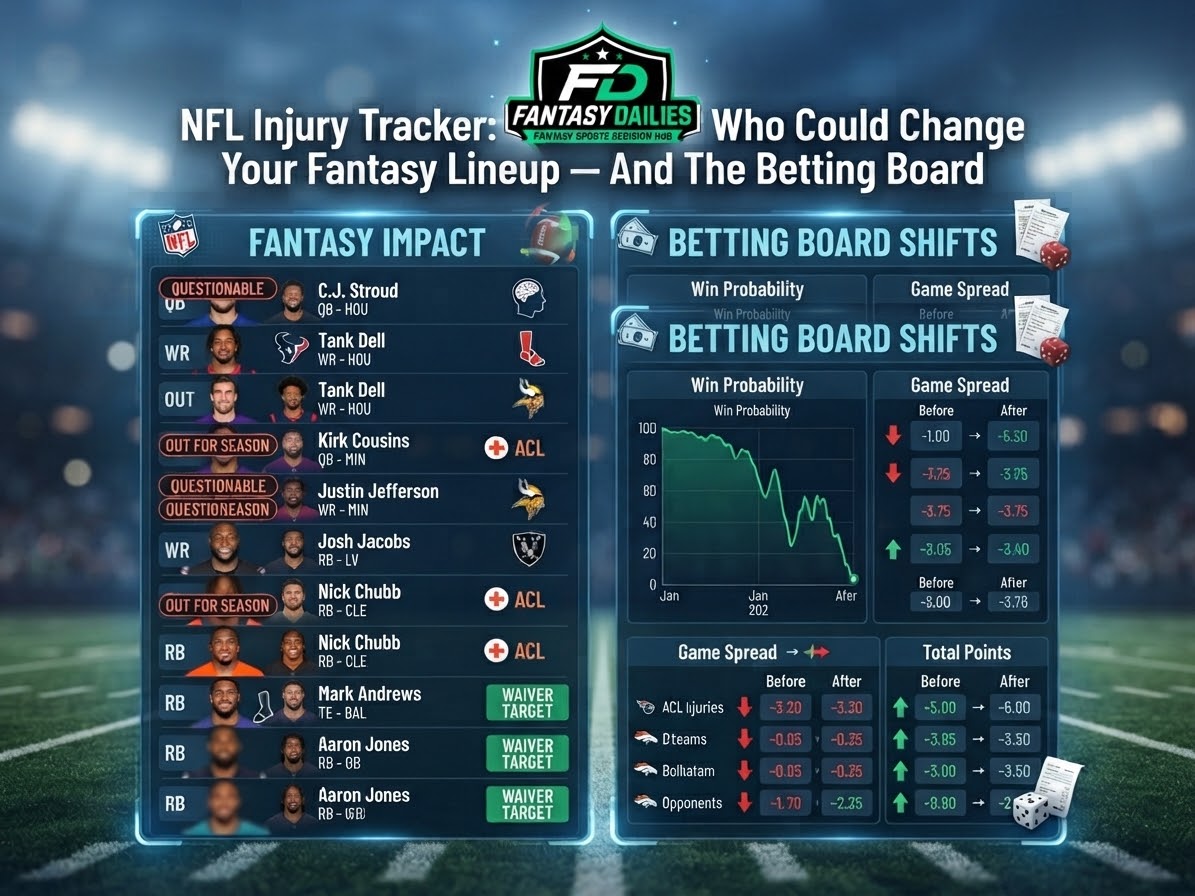
Our own call on every game today is on the verdict slate, locked twenty minutes before kickoff and graded the next morning on the public ledger — the calibration page tracks whether that confidence has actually meant anything. The full Week 3 board has every game today, and the injury report is worth checking alongside all of this — a banged-up receiver in bad weather is a very different lineup decision than a healthy one.
Weather conditions current as of Sunday morning, September 27, 2026 and can change before kickoff. Prop lines move — always confirm at the book. 21+. 1-800-GAMBLER.