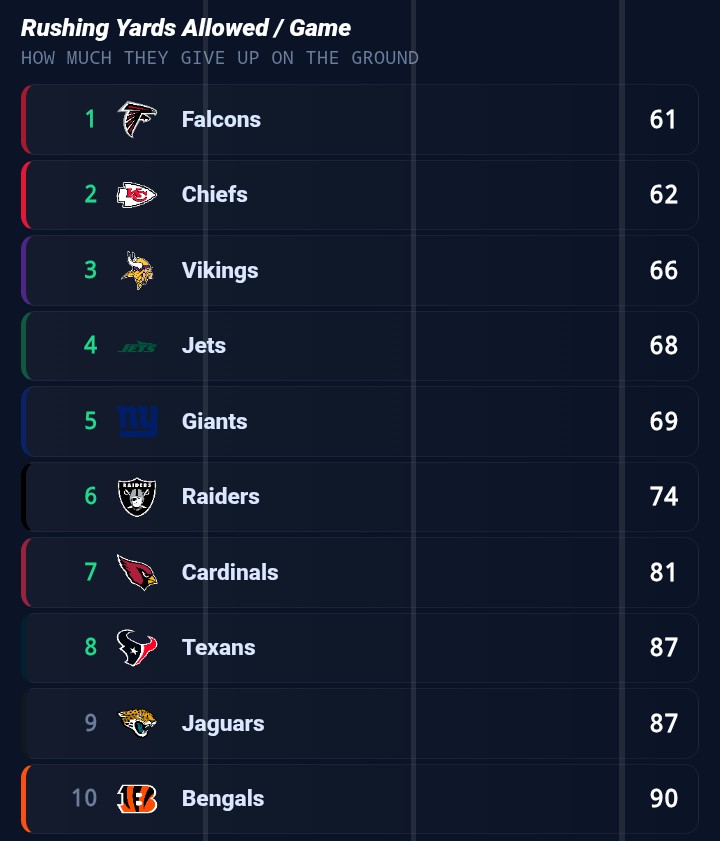
Every team, ranked 1 to 32, on two boards: offense and defense. That part isn't new — what's new is how the numbers got there this time.
Checked, Not Assumed
Both boards were verified field-by-field against the season's actual play-by-play file rather than trusted at face value. That distinction matters more than it sounds. A stat board that's merely plausible is worse than one that admits a gap, because a wrong number that looks right is the one that costs you a bet or a lineup call, and you don't find out until after.
Same standard as everything else on the site: nothing gets printed as fact unless it's been checked against the actual data behind it.
Offense: What's On The Board
Passing and rushing yards per game, pass rate, third-down and red-zone conversion, sacks allowed, turnover differential — every team, ranked 1 to 32, green for league-best and red for worst.
Pass rate is the column that does the most work here. It tells you whether a team throws when it's ahead, which is the entire difference between a receiver who keeps eating in a blowout and one who vanishes the moment the lead hits two scores. A team that leans run once it's up 14 is a completely different fantasy environment from one that keeps throwing regardless of the score.
Defense: What's On The Board
Passing and rushing yards allowed, sacks, and — the board most sites skip — explosive plays allowed, split into 20-plus and 40-plus yard runs and passes. Stingiest defense sits at No. 1.
Total yards allowed is one number describing what's actually four separate jobs, and it hides more than it reveals. A defense that's elite against the run and porous against tight ends reads as merely average in the yardage column — and that's exactly the defense you want to know about before you set a lineup or take a number.
Defense vs QB, vs RB, vs WR and vs TE break exactly that open — because you never start a defense, you start a position, and a single overall rank can't tell you which one a given unit is actually bad against.
Three Seasons, Because One Doesn't Tell You Who A Team Is
The board carries a season switcher built right in — 2026, 2025, 2024, 2023, all one tap apart.
The reason depth matters: one season tells you what happened. Three tell you whether it's structural. A defense that's been shredded by tight ends for three straight years has a real scheme problem that didn't get fixed over an offseason. A defense having one bad year is often just two injuries and a rough month — a completely different situation that a single-season snapshot can't distinguish from the first one.
How To Actually Use It
Setting a matchup? The Mismatch Machine crosses every game against 51 stat ranks pulled straight from these boards, and floats the biggest gaps to the top so you're not hunting for the mismatch yourself.
Checking a specific rivalry? The Head-to-Head board pairs current team identity with the full series history back to 2002.
Betting a total? Explosive plays allowed is the sharpest read available for it. Two defenses can allow identical total yardage while one bleeds six yards a play across long, sustainable drives and the other holds firm before surrendering two fifty-yard bombs — only the second one actually wrecks an under, and total yardage alone can't tell them apart. This board can.
Betting the spread instead? Turnover stats is the cleanest regression signal in football, because turnover margin is close to the least stable thing a team can post. A club sitting on a big positive differential is very likely winning games it won't keep winning at that rate — and the market has usually already priced the record, not the underlying instability.
Setting a fantasy lineup? The goal-line board and the volume board sit on the same verified data, and the depth chart confirms who's actually getting the touches these numbers describe.
Where This Feeds The Rest Of The Site
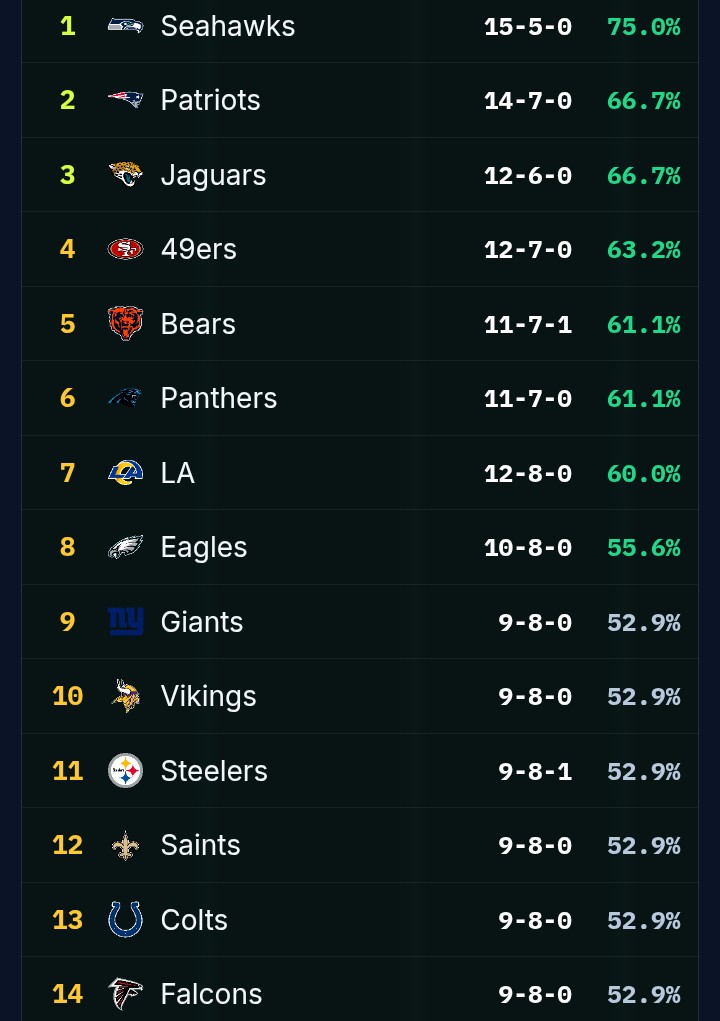
These two boards are the foundation underneath most of the other NFL tools. The verdict slate carries our call on every game, locked before kickoff and graded the next morning on the public ledger. The ATS board ranks all 32 against the spread with the rank printed right next to the team. Power rankings for where teams actually stand rather than where the record says they stand.
Betting it? BetScore rates every prop 1 to 100 against the best available price, the unders board catches lines hung too high, and the teaser generator scans the slate for legs crossing both key numbers. Devig and Kelly price and size it, the Parlay Doctor grades any slip A through F, and everything else lives in the Money Room.
Setting a lineup? Import your team, let the Roster Doctor grade every man you own, and settle the close calls in Start or Sit.
The Honest Part
Verified doesn't mean permanent. A stat board is a photograph of a season in progress, and it updates every week because the underlying football keeps happening. What field-by-field verification actually buys you is confidence that this week's photograph is accurate — not a guarantee about next week's.
Open offense → · Open defense →
21+. 1-800-GAMBLER.