There are two types of fantasy football managers in August.
The first one says, “Running backs are replaceable. I’m loading up on receivers.”
The second one drafts four running backs in the first five rounds because he once got burned by a committee in 2019 and still hasn't emotionally recovered.
Both can be wrong.
The running back position is one of the biggest sources of fantasy value in 2026, but this year's landscape is especially interesting because several backfields have been completely rearranged. Veterans changed teams, established touchdown vultures disappeared, new coaching staffs arrived and several young backs are suddenly sitting in much better situations.
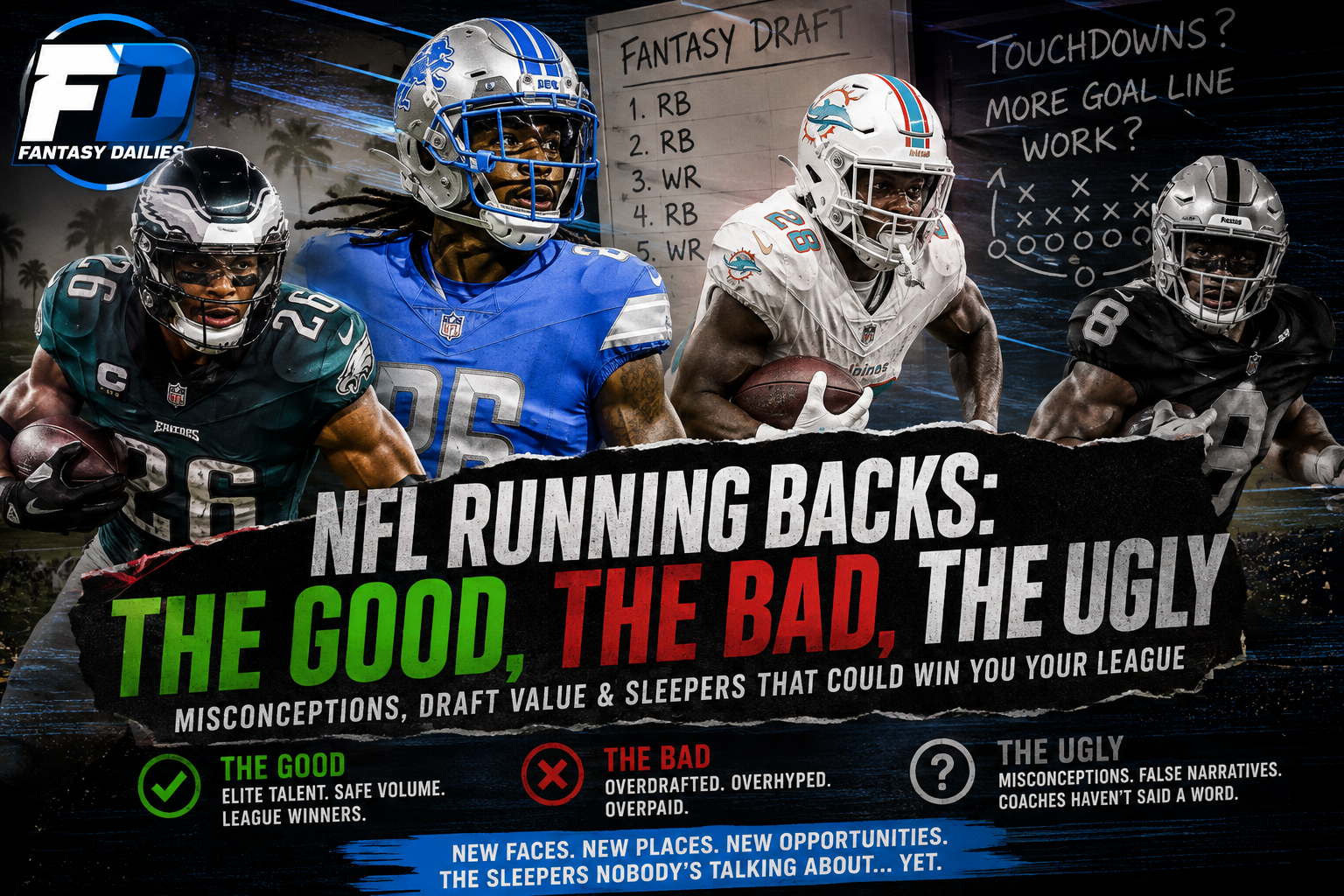
And then there is the great Bijan Robinson/Jahmyr Gibbs touchdown argument.
Everybody assumes both are about to explode because the guys who stole goal-line work from them are gone.
But here's the question nobody seems to be asking:
Have their coaches actually said that?
THE BIJAN ROBINSON TOUCHDOWN THEORY
Let's start with Bijan.
The fantasy community has been practically engraving his name onto the 2026 RB1 trophy.
And there is plenty of reason for optimism.
Robinson is coming off a monster 2025 season in which he produced 2,298 yards from scrimmage and 11 total touchdowns, earned first-team All-Pro honors and then became the highest-paid running back in NFL history after signing a three-year extension worth up to $75 million.
More importantly for fantasy managers, Tyler Allgeier is gone.
Allgeier left Atlanta for Arizona after spending the previous three seasons siphoning carries — including valuable scoring opportunities — from Robinson. Atlanta replaced him with Brian Robinson Jr. and Tyler Goodson.
So naturally:
BIJAN TD EXPLOSION!
Except... slow down.
I cannot find a current statement from Falcons head coach Kevin Stefanski or offensive coordinator Tommy Rees that says, essentially, “Bijan is now our designated goal-line back and we're giving him the touchdowns Allgeier used to get.”
That's an important distinction.
What we do know is that Atlanta has changed coaches, changed offensive philosophy and lost Allgeier.
What we don't have is a public declaration that every short-yardage and goal-line opportunity is automatically going to Robinson.
And that matters.
In 2025, Allgeier scored eight rushing touchdowns while Robinson scored seven on the ground. Robinson also caught four touchdown passes.
So yes, there is obvious touchdown upside.
But don't draft Bijan based on a fantasy narrative that coaches haven't actually confirmed.
Draft him because he is already an elite-volume player who can score from anywhere on the field.
That's much safer.
AND THEN THERE'S GIBBS
Jahmyr Gibbs may have the strongest argument of any running back for an expanded workload.
David Montgomery is gone.
He was traded to Houston, leaving Gibbs without the veteran back who had shared the Detroit backfield with him throughout his career.
Gibbs responded by signing a three-year, $67.5 million extension that can reach $75.75 million with incentives. He is now under contract through 2030.
And the production was already ridiculous.
Gibbs finished 2025 with:
- 1,223 rushing yards
- 18 rushing touchdowns
- 616 receiving yards
- 5 receiving touchdowns
That's 23 total touchdowns.
He was already a fantasy monster while sharing a backfield.
Now Montgomery is gone.
Here's where things get interesting.
Detroit's new offensive coordinator is Drew Petzing, and the organization has been talking extensively about Gibbs' importance to the offense. Petzing has specifically highlighted ways Gibbs can be used as a weapon in the passing game.
But again, be careful with the touchdown assumption.
I have not found a definitive current statement from Petzing or Dan Campbell saying:
“Jahmyr Gibbs is getting every goal-line carry.”
That's not the same thing as saying Gibbs won't get them.
In fact, the situation is arguably better than that.
Nobody on Detroit's current roster has David Montgomery's established role as the short-yardage hammer.
That is why Gibbs is so dangerous.
He's not simply inheriting Montgomery's carries.
He's potentially inheriting opportunities that previously belonged to Montgomery while remaining one of the league's best receiving backs.
That's a much bigger deal in PPR.
THE BIGGEST RUNNING BACK MISCONCEPTION
Here's the biggest mistake fantasy managers make:
They confuse opportunity with guaranteed production.
A player can inherit 200 available touches and still disappoint.
Another player can inherit 100 touches and become a league winner if those touches are high-value.
That's why I'm much more interested in:
Goal-line touches
Targets
Routes
Red-zone usage
Snap percentage
Two-minute offense
Third-down work
Team scoring environment
than I am in simply looking at who left town.
Fantasy managers see:
Montgomery gone → Gibbs gets touchdowns.
I see:
Montgomery gone → Gibbs gets the opportunity to prove he can handle the entire workload.
Those aren't the same thing.
THE GOOD: DON'T BE AFRAID OF RUNNING BACKS
There has been a growing fantasy trend toward avoiding running backs early and hammering wide receivers.
That's not automatically wrong.
But it has become its own form of groupthink.
The 2026 fantasy landscape has enough uncertainty at running back that elite workload certainty is extremely valuable. Current draft analysis continues to emphasize building around different RB tiers rather than blindly avoiding the position.
If you draft Bijan, Gibbs, Christian McCaffrey or another elite three-down back, you're not merely buying carries.
You're buying insulation against the chaos that happens after Round 6.
The mistake isn't drafting a running back early.
The mistake is drafting a running back early because you think every running back is interchangeable.
They aren't.
THE BAD: DON'T PAY FOR A ROLE THAT DOESN'T EXIST YET
This is where I get nervous.
A player gets hyped because:
“His competition left.”
Okay.
Who replaced the competition?
How much did that player cost the team?
What does the coaching staff say?
What did the player actually do in camp?
Is he getting first-team reps?
Is he playing third downs?
Is he involved near the goal line?
This is especially important with ambiguous backfields.
The Broncos are a perfect example.
Jonah Coleman has generated legitimate buzz, and current reports say he has impressed Denver coaches with his vision, quickness and power. But he's still dealing with J.K. Dobbins and RJ Harvey in the backfield.
That's exactly the type of player I want to draft later, rather than pretending he's already guaranteed 250 touches.
THE UGLY: THE “SLEEPER” EVERYBODY KNOWS ABOUT
Here's another fantasy rule:
If 14 fantasy analysts are calling somebody a sleeper...
He's not a sleeper anymore.
Jonathon Brooks?
We've heard it.
We've heard it.
Tyler Allgeier?
We've heard it.
Jonah Coleman?
We're hearing it.
Chris Rodriguez?
We're hearing it.
The better approach is to find the player before the consensus catches up.
MY DEEPEST RB SLEEPER: KAELON BLACK
This is the type of name I want on the end of my roster.
Kaelon Black is currently buried behind the massive fantasy spotlight surrounding Christian McCaffrey in San Francisco.
That's exactly why nobody is paying attention.
Black has reportedly performed well throughout his first NFL preseason and joint practices, with the potential to lock down the No. 2 running back job in San Francisco.
You don't draft him expecting McCaffrey to disappear.
You draft him because McCaffrey's handcuff has enormous contingent value.
If McCaffrey is healthy, Black probably doesn't matter much.
If McCaffrey misses time?
Suddenly you're holding a player attached to one of the NFL's best offensive environments.
That's the definition of a late-round lottery ticket.
THE NEW FACES AND NEW PLACES
The 2026 running-back carousel has been wild.
Kenneth Walker III left Seattle for Kansas City.
Travis Etienne Jr. left Jacksonville for New Orleans.
David Montgomery moved from Detroit to Houston.
Rachaad White moved from Tampa Bay to Washington.
Kenneth Gainwell moved from Pittsburgh to Tampa Bay.
Isiah Pacheco moved from Kansas City to Detroit.
And those moves completely changed the fantasy math.
Kenneth Walker III — Kansas City
Walker landing in Kansas City is fascinating.
You're pairing an explosive runner with Patrick Mahomes and an offense that should create scoring opportunities.
The question isn't whether Walker can run.
It's whether Kansas City gives him enough receiving and goal-line work to turn the situation into a true fantasy RB1.
He's one of my favorite value bets if his draft cost stays below the elite tier. Current fantasy rankings have him around the RB1/RB2 borderline depending on format.
Travis Etienne Jr. — New Orleans
Etienne is one of the most interesting “new team” backs because the landing spot creates both opportunity and risk.
The Saints signed him to a four-year deal worth $48 million, but the backfield is not necessarily a one-man show.
And that's important.
Don't automatically assume:
Big contract = 300 touches.
Fantasy football doesn't work that way.
David Montgomery — Houston
This is the guy I think fantasy managers could be overlooking.
Montgomery goes from being Gibbs' touchdown vulture in Detroit to a potentially much more important piece in Houston.
He doesn't need to become a superstar.
He needs volume.
And if Houston gives him the goal-line role, suddenly those touchdowns that people think Gibbs is inheriting become touchdowns Montgomery is potentially stealing from somebody else.
Funny how this game works.
THE RB I'M BUYING BEFORE THE ROOM CATCHES UP
Jonah Coleman.
Yes, he's getting more attention now.
That's why you need to watch his ADP.
He has already been rising following preseason action, with reports of Dobbins' injury creating an opportunity for Coleman to get more work.
But here's what makes him interesting:
Sean Payton likes backs who can actually do things.
Coleman brings vision, power and receiving ability, and Denver has built an offense around Bo Nix that could generate plenty of scoring opportunities.
I'm not drafting Coleman as though he's already the starter.
I'm drafting him as the guy who could become the starter without requiring a catastrophic injury to the entire offense.
That's the difference.
MY 2026 RB DRAFT PHILOSOPHY
Here's how I'd attack running backs this year:
Rounds 1-2:
Get elite workload or elite receiving upside.
Rounds 3-5:
Attack backs whose roles are expanding rather than simply paying for last year's production.
Rounds 6-9:
Look for ambiguous backfields where one player can emerge.
Rounds 10+:
Hammer contingent-value backs.
Don't draft five backups who need somebody to get hurt.
Draft the backups who become extremely valuable if somebody gets hurt.
There's a difference.
MY EARLY RB CALLS
Most likely RB1 overall: Jahmyr Gibbs
Safest elite RB: Bijan Robinson
Best touchdown upside: Gibbs
Best PPR profile: Gibbs
Best “new team” upside: Kenneth Walker III
Most interesting veteran value: David Montgomery
Most intriguing rookie/young sleeper: Jonah Coleman
Deepest lottery ticket: Kaelon Black
Player I think fantasy managers could overpay for: Any RB whose entire argument is simply “the guy ahead of him left.”
And that's the biggest lesson heading into draft weekend.
Don't draft the vacated touches.
Draft the player who can actually use them.
Because every August, fantasy managers fall in love with the same sentence:
“He's going to get all those touchdowns now.”
Maybe.
But until the coaches say it, until the snaps show it, and until the player proves he can handle it...
it's still just fantasy football.
And apparently, that's why they call it fantasy.
Fantasy Dailies Draft Verdict: If you're sitting in a league where everyone is terrified to draft running backs early, don't be afraid to zig while everybody else zags. Elite backs with receiving roles are becoming increasingly difficult to replace. The trick is knowing the difference between a true workhorse and a guy whose fantasy managers are simply writing the workload into existence.
The Good: Elite volume.
The Bad: Committee backfields.
The Ugly: Paying Round 4 prices for a guy who hasn't actually won the job.
And somewhere, right now, a fantasy manager is drafting a running back because somebody on Twitter said, “He's going to get the goal-line touches.”
Ask one question before you click Draft:
Did the coach actually say that?