Every DFS lineup is the same question repeated eight or nine times: does this player return more than he costs?
Almost nobody answers it with a number. They look at a salary, look at a matchup, feel something, and click.
The DFS Value Check answers it directly. Pick any player on tonight's DraftKings slate, press Generate, and get three things: expected points from the posted prop lines, a fair salary, and the edge against his listed price.
Why Pricing Off Props Is The Right Method
This is the part worth understanding, because it's what separates this from a projection tool.
A DFS projection is somebody's model. A prop line is a price the market defends with real money — thousands of bettors hammering it from both sides, adjusted continuously until it stops being wrong.
So the value check builds expected points from those numbers rather than from an opinion. If the market says 68.5 receiving yards and 0.6 touchdowns, that converts to a points expectation you can hold against a salary.
Then it flips the question, which is the genuinely useful move: given those numbers, what should this player cost? The gap between that fair salary and his listed one is the edge.
Two players projected for identical points are not the same play if one costs $8,200 and the other $5,400. DFS is a budget game and value beats production every time.
Salary Setting Is Slower Than The Market
Here's the structural reason this works at all.
DraftKings salaries are set days in advance and rarely move. Prop lines move constantly.
When news lands — a lineup change, an injury, a role shift — the props react within minutes while the salary sits exactly where it was. That gap is the most reliable edge in daily fantasy, and it's widest in the hours right before lock.
Baseball is the extreme case: lineup cards drop about two hours before first pitch, and batting second is worth roughly one extra plate appearance over batting seventh. A hitter promoted in the order is worth more than he was that morning, and his salary hasn't moved a dollar.
Check The Verdict Against The History
The value check tells you what a player should score. These tell you whether he actually does it.
Splits — his last 5, 10 and 20 against the number, with every game shown. Crucial in DFS, because the shape matters more than the average. A player who alternates 30-point and 4-point nights and one who posts 17 every time have identical projections and belong in completely different contest types.
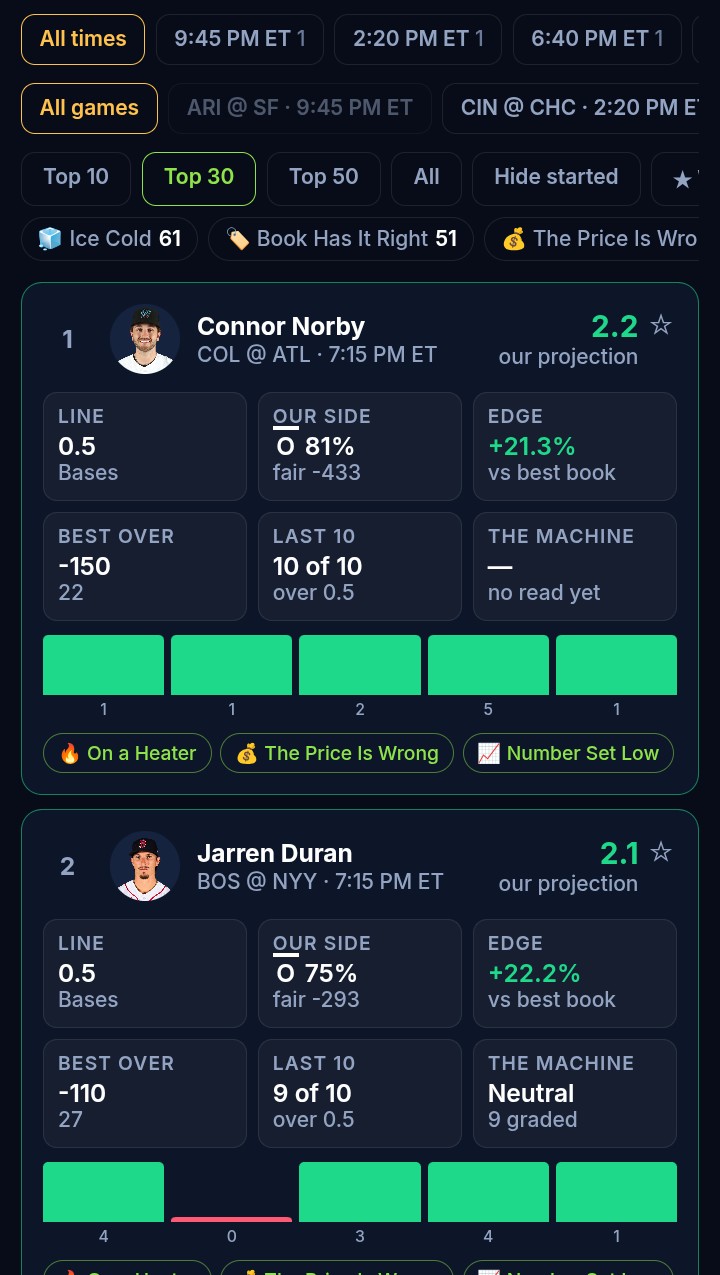
BetScore rates every prop 1 to 100 against the nine-book price, and the props boards carry every line in one place — MLB, NBA, NHL.
And the source numbers matter: props are only as good as the price they're taken from, so the heat maps put nine books side by side — NFL, MLB, NBA, NHL.
The Tournament Maths Nobody Discusses
Finding value is half of DFS. The other half is the arithmetic the sites never mention.
Rake — a 10% cut means you must beat the field by more than 10% just to break even. That single number is why two players of identical skill finish a season on opposite sides of zero.
Duplication — how many identical lineups are in that field. A lineup built entirely from popular plays isn't a lineup, it's a share of one.
Overlay — when a guarantee doesn't fill, the site covers the shortfall. That's free expected value, and it exists for about four minutes before lock.
Exposure — forty lineups feels diversified until your favourite play scratches and thirty-one are dead.
Correlation — and specifically the pairings the book has already priced as correlated, where the edge is gone before you build.
Swap EV — is that late swap positive EV, or just movement?
Building The Rest Of The Lineup
The DraftKings optimizer builds around the plays you've validated, and the DFS Edge boards put salary against real production: NFL · MLB.
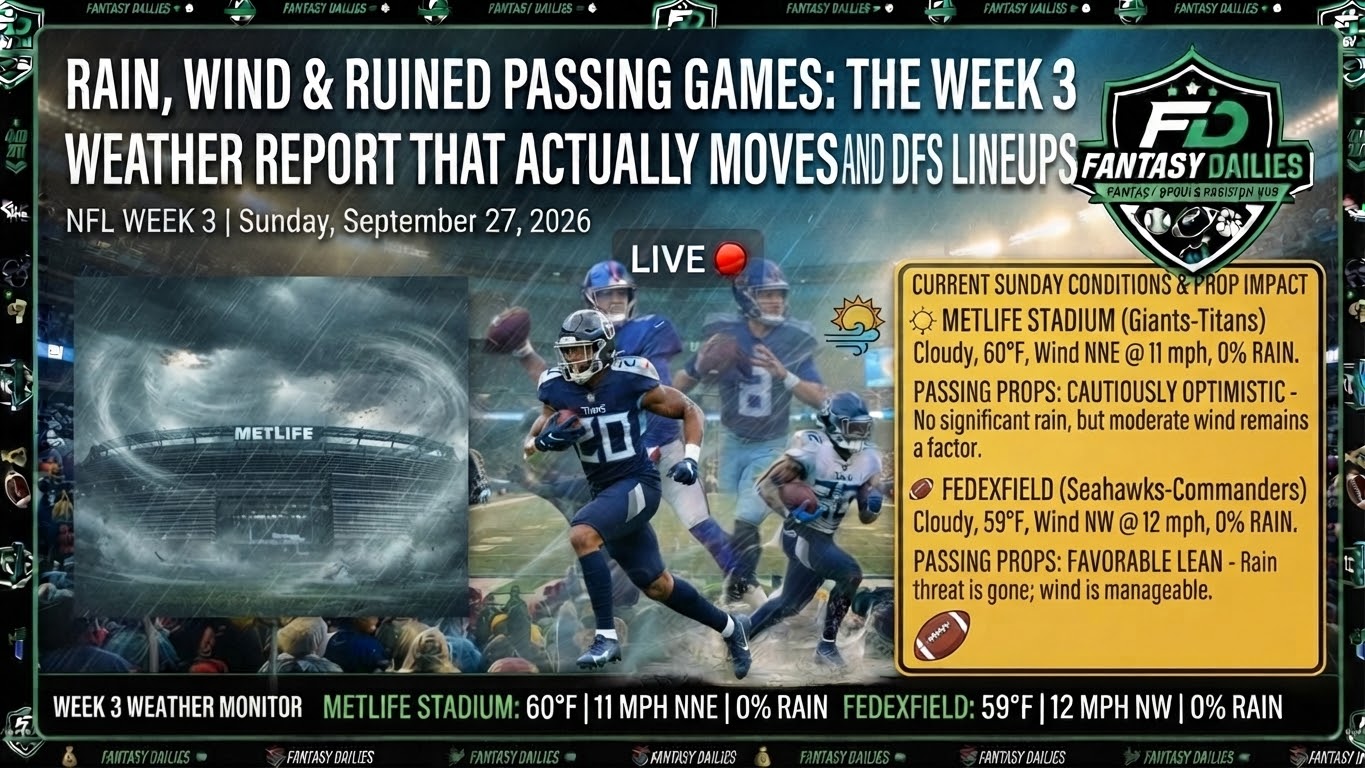
Then the inputs that decide who's even playable. Football: depth charts, injuries, the weather report. Baseball: MLB Tonight with lineups, ballpark weather and the bullpen report. Basketball: minutes, because every counting stat is downstream of them.
Everything else is in the Money Room, and every page on the site is indexed in the directory.
The Honest Part
A fair salary is an estimate built on other estimates. Prop lines carry the book's margin, so converting them to points inherits that — which is why the verdict is a comparison rather than a promise.
And a good price on a player who gets hurt in the first quarter is still a zero. Value tells you what to pay, not what will happen, and in a game decided by one enormous night from somebody, that distinction is the whole sport.
Run a value check → Pick a player, press Generate, get the verdict.
21+. Salaries and lines both move — confirm before you lock. 1-800-GAMBLER.