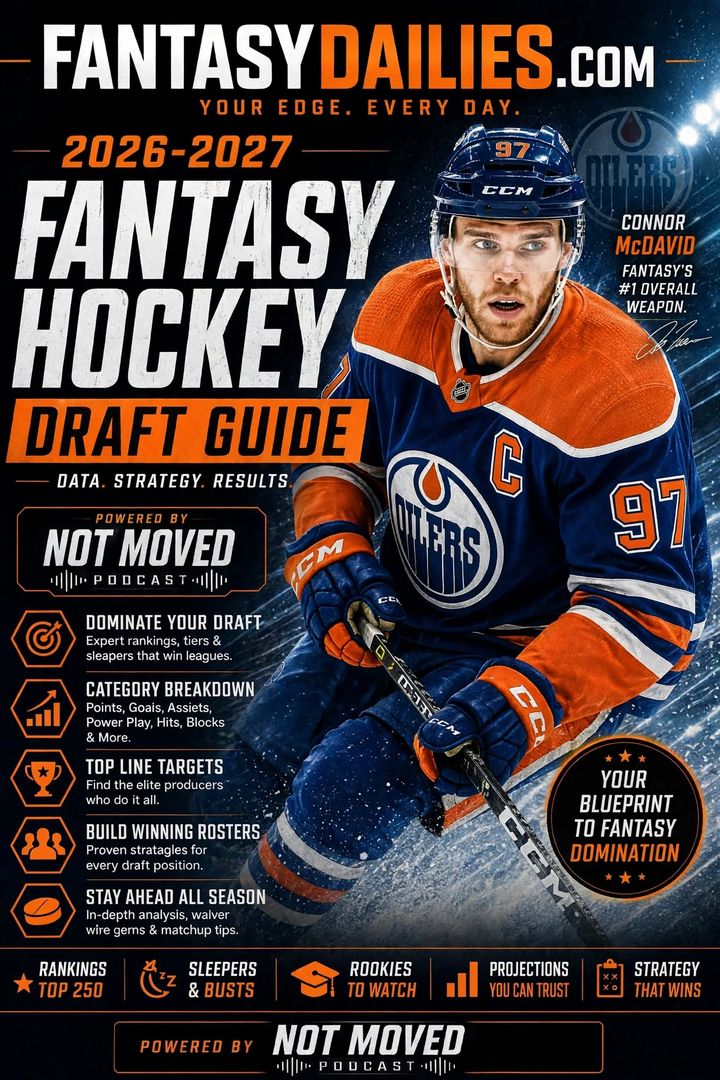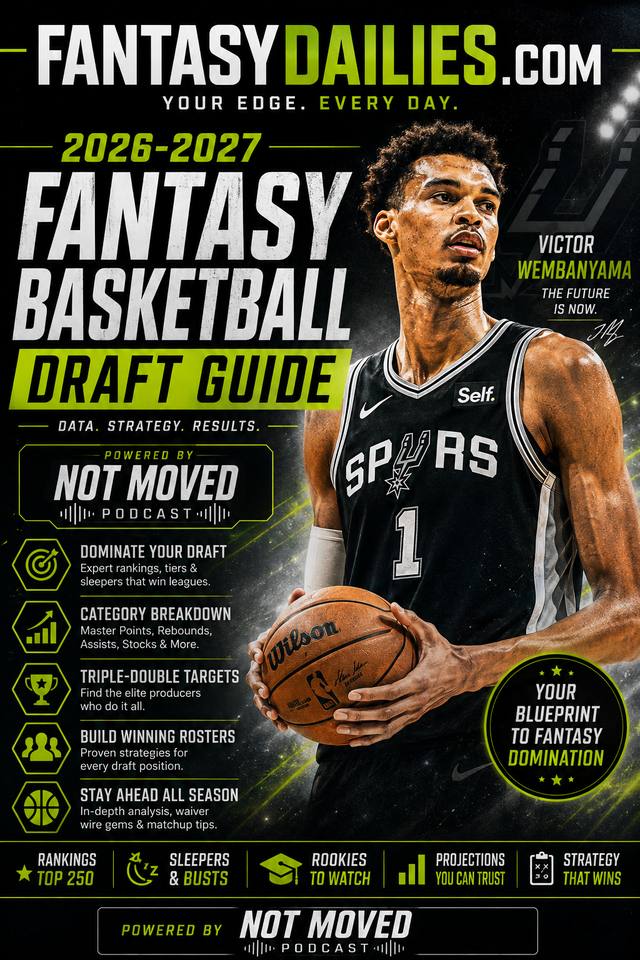
Most draft guides are a PDF you buy in August and lose in September.
All three of ours sit on one page — fantasy football, 2026-27 basketball and 2026-27 hockey — and every one of them is readable in full online, not just downloadable.
What "Our Own System" Actually Means
Every one of these is scored by the house system rather than assembled from a consensus. That phrase gets thrown around, so here's what it means concretely in each sport.
Football — priced off the betting market
The football guide runs 335 players deep, and every one is priced off what the betting market actually charges. Tiers are drawn where the money breaks, not at round numbers somebody picked because twelve is tidy.
That's why it diverges from the room in specific places — and why our 1.01 is a wide receiver.
Inside: all 335 write-ups, Hero-RB and Zero-RB and late-round QB translated into house math, and a round-by-round map from pick 1 to 15 with the dead zone marked.
Basketball — nine categories against the league
The basketball guide is a Top 250, every player scored on nine categories against the league rather than ranked by gut.
Which matters more in basketball than anywhere else, because a category league is nine separate contests wearing one trophy. A player who wins you three and loses you two is a different asset from one who is quietly useful in seven.
Plus the category breakdown, triple-double targets, sleepers, busts, rookies and the strategy for every draft slot.
Hockey — the hard problem nobody solves
The hockey guide does the thing most lists refuse to: it puts skaters and goalies on one scale.
Comparing a winger to a goaltender is genuinely difficult — two positions sharing almost no categories, scored on completely different terms. Most guides drop them in one column and hope. This one actually rates them against each other, which is the entire reason a hockey guide is worth having.
Plus top-line targets, because line deployment and power-play unit are coaching decisions and far more stable than the production that follows them.
Read It Online, Free With A Seat
The basketball guide runs to a full online edition — Top 200 by the house system, tiers, sleepers, rookies, team capsules and the ranking system explained, all readable in the browser.
That last item is the one I'd point at. A guide that shows you its ranking system is a guide you can argue with, and a guide you can argue with is worth more than one that hands down a list.
All three are included free with a Velvet seat at $9.99 a month — which also lifts the daily limits on every tool here and opens the call on every game.
The football guide is a published book already; basketball and hockey are heading to Amazon, Audible, Apple Books, Google Play, Walmart and Barnes & Noble.
The Tools That Come With Them
A guide is a list. These are what turn it into a draft.
Mock simulators — football, basketball, hockey. Unlimited reps against position-aware AI from your exact slot, because drafting from the 1 and from the 12 are different games.
Season simulators — basketball and hockey. Draft the roster, play the full season, then run it a hundred times. One season is a story; a hundred is a verdict.
Schedules — and in basketball and hockey this is not a footnote. The NBA fantasy-weeks grid counts games per club, because a four-game week is worth a third more than a three-game week from the same man. The NHL back-to-back board counts the nights that decide goalies — the Penguins play fifteen, the Flames eight.
December — football's version of the same idea. The December Board grades every player on Weeks 15, 16 and 17, scored against 2,172 real Decembers, because that's when your title is decided and virtually nobody in your room will check.
After The Draft
Import your team and the Roster Doctor grades every man you own. Then the boards that matter weekly: minutes in basketball, shots on goal in hockey, depth charts in football.
All three follow the same rule: opportunity beats talent, and opportunity moves first.
The Honest Part
Every ranking in every guide is an opinion with arithmetic behind it. Ours will be wrong about players, and some of those will be embarrassing by November.
What we can do is show the system, publish the reasoning, and grade every call we make in public — including the ones that go badly. That's a different promise from being right, and it's the only one worth making.