 Most NFL odds pages have the same problem. One enormous page, a week selector, and the moment you switch weeks the URL never changes — so you can't bookmark Week 12, can't send it to anyone, and can't get back to it without clicking through again.
So there are eighteen pages instead of one.
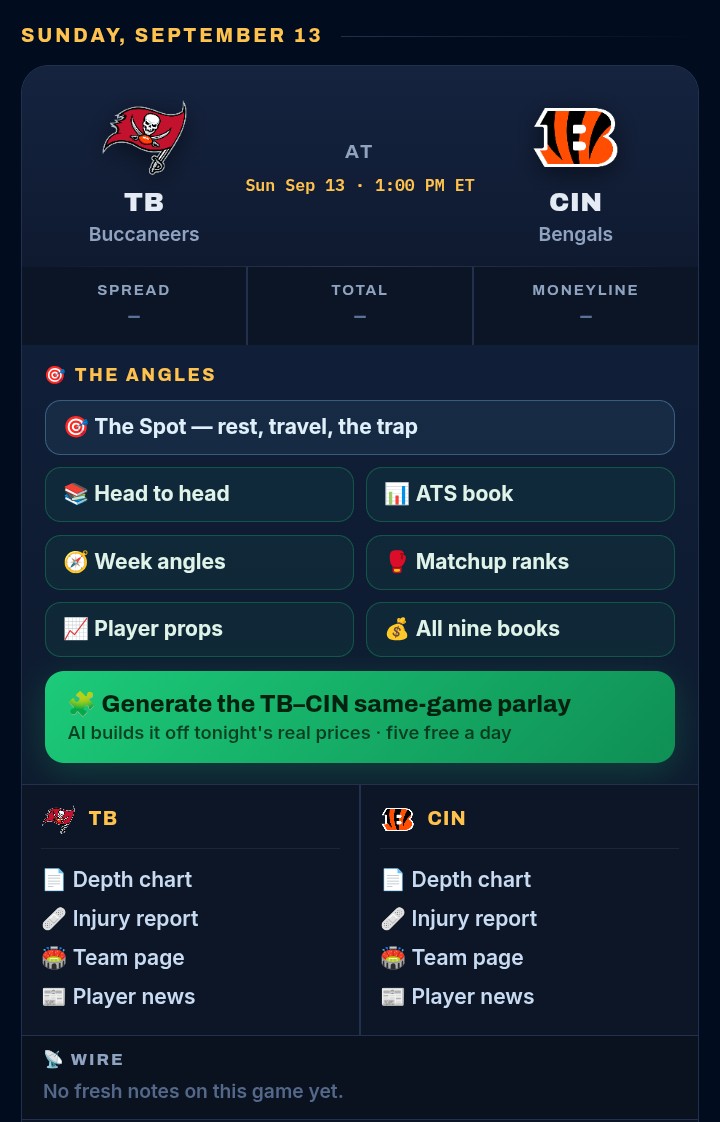
Every week of the season has its own board: all sixteen games with the spread, total and moneyline up top, the situational spot behind each matchup, and both teams' rooms underneath.
Week 1 · 2 · 3 · 4 · 5 · 6 · 7 · 8 · 9 · 10 · 11 · 12 · 13 · 14 · 15 · 16 · 17 · 18
What Sits Behind Each Game
The number is the start, not the answer. Every game on every board opens into the work:
The spot — its own page per game, carrying rest edges, short weeks, traps and letdowns judged against 25 years, plus the series record since 2002 and the average combined score to hold against tonight's total.
The ATS book — all 32 ranked against the spread with the rank right next to the team, filterable by home, road, favourite, dog, after a win and after a loss.
Matchup ranks — the Mismatch Machine crosses every game against 51 team stat ranks and floats the biggest gaps to the top.
Both rooms — depth charts, injury reports, team pages and player news for each side.
And a same-game parlay generator that builds off the real prices on that specific game.
The Stat That Decides Totals, And Almost Nobody Reads It Right
Here's one worth changing how you use, because the board is easy to misread in a way that flips its meaning.
Explosive plays allowed tracks the 20+ and 40+ yard passes and runs each defense surrenders, all 32 ranked fewest allowed first.
So a team sitting at zero allowed none all season. That is the best possible result, not the worst.
Why it matters more than yardage: two defenses can allow identical yards per game with completely opposite profiles. One bleeds six yards at a time across twelve-play drives. The other holds firm and then surrenders two fifty-yard bombs.
Only the second one wrecks an under — and the yardage column cannot tell them apart. If you bet totals and read one defensive board this season, read this one.
For fantasy, flip it entirely. A ceiling play needs a defense that breaks, so the units at the bottom of that board are the matchups your boom-or-bust guys want. Three seasons are on their own pages — 2024 and 2023 — because a defense shredded three years running has a structural problem, while one bad year is often two injuries and a bad month.
The Rest Of The Weekly Read
Team streaks shows live ATS, over and win runs — every number counted against a line we posted first, which is the difference between a fact and a claim.
The Weather Book holds 6,511 games joined to hourly stadium conditions, and wind moves a total further than cold ever does. Turnover stats flag the teams whose record is built on takeaway luck — the least stable thing in football and the best regression signal there is.
Full vault at the NFL hub, including the defence-vs-position sheets, because you never start a defence — you start a position.
Then Price It, Don't Just Like It
Devig the market to find the fair line with the margin stripped out. The +EV finder scans nine-plus books and flags anything paying past it. The Line Checker counts how many times a player has actually cleared any number you type. The hit-rate board shows the last 5, 10 and 20 in colour.
Shop it on the heat map, size it with Kelly, grade the slip with the Parlay Doctor, and log it in CLV — because beating the closing number is the only measure that separates skill from a hot month.
And We Grade Ourselves On The Same Board
Every game we call gets three verdicts — moneyline, spread and total. They stay live all week against the current number, lock twenty minutes before kickoff, and get settled the next morning against the number they were locked at.
Win, loss or push, on the public ledger, with nothing quietly removed after a bad week.
21+. If it stops being fun, 1-800-GAMBLER.