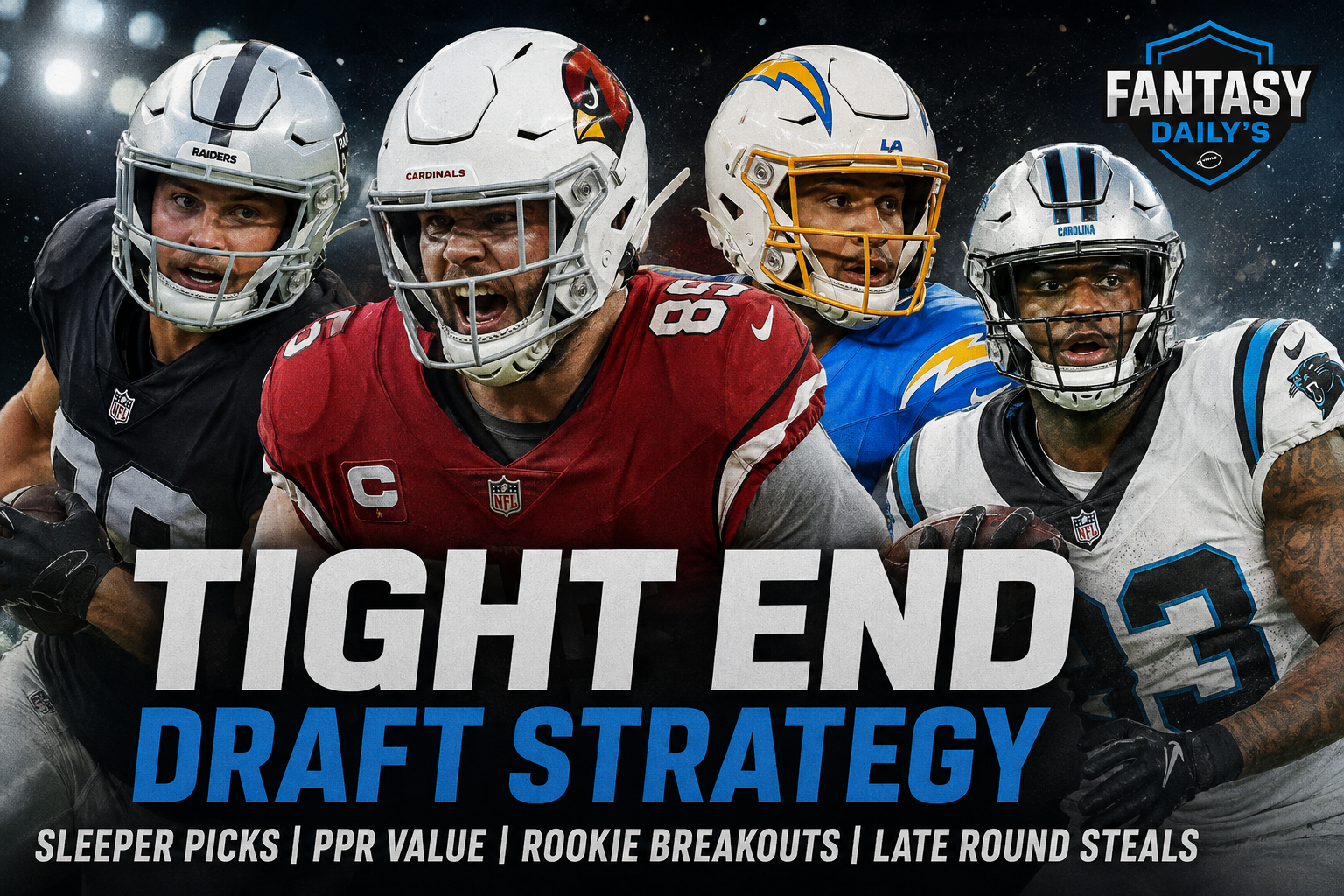
This is the weekend fantasy football managers circle on the calendar.
Draft rooms are packed. Friends who haven't opened a fantasy app since last September suddenly have "rankings." Somebody is going to take a kicker in the eighth round. Somebody else is going to draft three quarterbacks. And inevitably, someone will say, "I'm waiting on tight end."
That strategy used to make sense.
In 2026?
I'm not so sure.
The tight end position has changed dramatically, and the biggest mistake you can make this weekend is treating every tight end as if they're the same player with a different jersey.
They're not.
There are legitimate difference-makers at the position, there are incredibly safe PPR options, and there are several tight ends sitting in the middle and late rounds who could make your draft look much smarter six weeks from now.
And that's exactly where the value is.
THE FIVE-CATCH RULE
Here's the simplest way I can explain why tight ends deserve more attention in PPR leagues.
If your tight end averages just five receptions per game, that's 85 catches over a 17-game season.
In a full PPR league:
85 receptions = 85 fantasy points.
That's before you add a single receiving yard.
That's before a touchdown.
That's before a bonus.
That's before one 70-yard game or a red-zone touchdown.
Five catches a game doesn't sound spectacular.
But 85 catches from your tight end while everyone else is rotating through three-catch, four-catch and touchdown-dependent players suddenly looks pretty damn good.
Now add red-zone opportunity.
That's where the equation becomes extremely interesting.
A tight end who can consistently catch four or five balls per game AND gets legitimate red-zone targets doesn't need to catch 10 touchdowns to be valuable.
He's already giving you a weekly PPR floor.
The touchdowns become the ceiling.
THE 2025 RECEPTION LEADERS TELL THE STORY
If you're playing PPR, don't just look at touchdowns from last season. Look at volume.
Here were the top 10 tight ends in receptions during the 2025 regular season:
Rank
Tight End
2025 Team
Receptions
1
Trey McBride
Arizona Cardinals
126
2
Kyle Pitts
Atlanta Falcons
88
3
Dalton Schultz
Houston Texans
82
4
Jake Ferguson
Dallas Cowboys
82
5
Juwan Johnson
New Orleans Saints
77
6
Travis Kelce
Kansas City Chiefs
76
7
Tyler Warren
Indianapolis Colts
76
8
Harold Fannin Jr.
Cleveland Browns
72
9
Brock Bowers
Las Vegas Raiders
64
10
Dallas Goedert
Philadelphia Eagles
60
Look at that list.
Some of those guys are household names.
Others aren't.
And that's precisely the point.
PPR rewards boring.
You don't need your tight end to catch two touchdowns every Sunday.
Give me a guy who catches five passes, moves the chains, gets six or seven targets and occasionally falls into the end zone.
That player can quietly become one of the most valuable pieces on your roster.
THE OBVIOUS GUYS: BOWERS AND McBRIDE
If you're going to pay up, you want a tight end who can actually separate himself from the position.
Brock Bowers and Trey McBride are the obvious examples.
McBride was ridiculous in 2025:
126 receptions
1,239 yards
11 touchdowns
169 targets
He led all tight ends in targets, receptions and target share. His 27.4% target share was also No. 1 at the position.
That's not a tight end.
That's a wide receiver wearing a tight end designation.
And that's the value of drafting an elite tight end early.
You're not merely getting a tight end.
You're potentially getting WR1-level volume at a position where most of your opponents are hoping for 50 catches.
Bowers remains in that same conversation, although his 2025 season was shortened to 12 games. He still finished with 64 receptions, 680 yards and seven touchdowns.
If you're drafting one of those two early, you're buying positional separation.
That's a legitimate strategy.
BUT YOU DON'T HAVE TO SPEND AN EARLY PICK
This is where things get interesting.
The current fantasy market has several tight ends that I would happily wait for.
DALTON SCHULTZ — HOUSTON
This is one of my favorite boring picks.
And boring is exactly what I want.
Schultz caught 82 passes in 2025, tied for third among all tight ends.
He's currently being treated as a late-round value, with recent sleeper rankings putting his ADP around the mid-to-late TE2 range.
And there's an important development in Houston: the injury to Jayden Higgins could create additional opportunity in the passing game.
Schultz isn't sexy.
Good.
Fantasy football isn't a modeling contest.
If Schultz gives you five catches most weeks, you've already gotten exactly what you're looking for in PPR.
JUWAN JOHNSON — NEW ORLEANS
Johnson is another player I think fantasy managers continue to underestimate.
He caught 77 passes in 2025.
Seventy-seven.
That's basically 4.5 receptions per game.
And he's currently being drafted well outside the elite tight end tier. Recent consensus sleeper rankings have him around TE16-20 territory.
That's exactly the type of player I'm targeting when I'm waiting on the position.
He doesn't need to become Travis Kelce.
If he gives you 70-plus catches again, you're getting a dependable PPR starter without paying an early-round price.
CHIGOZIEM OKONKWO — THE CHANGE OF SCENERY I WANT TO WATCH
Here's one of my favorite late-round swings.
Chig Okonkwo is now in Washington.
That's important.
He spent his first four seasons in Tennessee, an offense that simply wasn't giving him the environment necessary to maximize his receiving ability.
Now he gets Jayden Daniels and a Washington offense that has already demonstrated that its quarterback will use his tight end.
Washington signed Okonkwo to a three-year, $27 million contract, and he's positioned to be the receiving leader in the tight end room.
He also had 56 receptions and 560 yards in 2025 despite playing in that Tennessee environment.
The touchdowns have been the problem.
He's never scored more than three in a season.
If that changes, you've got a potential fantasy breakout sitting in the middle-to-late rounds.
That's exactly the kind of bet I want to make.
A.J. BARNER — THE REALLY BORING ONE
Remember the five-catch theory?
Barner is interesting.
He caught 52 passes for Seattle in 2025, along with six touchdowns.
His snap share jumped from 45% as a rookie to 72% last season, and he's entering 2026 as Seattle's established TE1.
Seattle also didn't add a major pass-catching weapon during the offseason.
If Barner gets a larger piece of the passing game, he doesn't need to become George Kittle.
He simply needs to turn those 52 catches into something closer to 65-70.
And suddenly your late-round tight end is useful every week.
THE DAVID NJOKU SITUATION IS FASCINATING
And here's the one that made me scratch my head.
David Njoku left Cleveland and signed with the Los Angeles Chargers on a one-year deal worth up to $8 million.
Great player.
Great quarterback.
Great offense.
But...
What the hell is he doing in that tight end room?
The Chargers already have Oronde Gadsden II, who broke out as a rookie, and they also signed Charlie Kolar to a three-year, $24.3 million contract.
So now you've got:
Oronde Gadsden II
David Njoku
Charlie Kolar
all competing for targets.
The Chargers themselves have described the group as a deep tight end room.
From an NFL perspective, I understand it.
From a fantasy perspective?
I hate it.
Njoku could absolutely score touchdowns with Justin Herbert.
But I don't want to pay for the name without knowing how the targets are going to shake out.
And Gadsden is particularly interesting because he already showed he can produce in this offense.
Recent fantasy rankings have him around the TE20 range, which tells you exactly how uncertain the situation has become.
AND YES — DARREN WALLER IS BACK
If you missed this one, don't make the mistake of putting Waller in your free-agent pile.
He's a Carolina Panther.
Waller signed a one-year deal with Carolina on Aug. 17 after returning from retirement in 2025.
And his 2025 production was fascinating:
24 receptions
283 yards
6 touchdowns
9 games
Six touchdowns in nine games.
That's a touchdown every 1.5 games.
Carolina desperately needed a legitimate receiving threat at tight end, so Waller could have sneaky red-zone value with Bryce Young.
I'm not drafting him expecting 2020 Darren Waller to suddenly walk through the door.
But if you're looking for a late-round touchdown bet?
Now we're talking.
THE ROOKIE TIGHT ENDS
Here's where I would exercise some restraint.
The 2026 rookie tight end class has talent, but this isn't the year I'm going crazy drafting rookie tight ends in redraft leagues.
The name everybody knows is:
KENYON SADIQ — NEW YORK JETS
Sadiq was selected No. 16 overall by the Jets, making him the first tight end selected in the 2026 draft.
The athletic ability is ridiculous.
But here's the problem:
He's walking into an offense that already has Mason Taylor, plus Garrett Wilson and other established target competition.
Current fantasy analysis has Sadiq around the TE22 range, and that's about where I'd want him.
Don't draft the rookie because you love the prospect.
Draft him because the price makes sense.
MAX KLARE — LOS ANGELES RAMS
Klare went to the Rams at No. 29 overall.
NFL.com describes him as a highly athletic receiving tight end capable of earning volume and creating mismatches, particularly from the slot.
That's an interesting landing spot.
But again, rookie tight ends usually need time.
He's a better late-round stash than someone I'd count on as my weekly starter.
ELI STOWERS — PHILADELPHIA
Stowers went to Philadelphia in Round 2.
He's one of my favorite rookie names to monitor because of his athletic profile and receiving background.
But Philadelphia is not exactly a barren wasteland at the tight end position.
This is more dynasty-interesting than redraft-reliable.
THE SAM LaPORTA WARNING
One of the biggest names you need to pay attention to is Sam LaPorta.
He's dealing with a hip injury that has made his Week 1 status uncertain, although Dan Campbell has expressed optimism about his long-term health.
That doesn't automatically make him a player to avoid.
It does mean you need to pay attention to where his ADP goes this weekend.
If the injury causes people to panic and he falls?
That's when I'm interested.
If people ignore the injury and draft him at his full pre-injury price?
I'd rather take the discount elsewhere.
MY 2026 PPR TIGHT END DRAFT STRATEGY
Here's how I'd attack the position this weekend.
Rounds 2-4: PAY FOR DIFFERENCE
If Trey McBride or Brock Bowers falls into a reasonable range, I'm interested.
You're buying positional separation.
You're basically saying:
"I don't want to spend the rest of the season trying to figure out whether my tight end can catch four passes."
Fair enough.
Rounds 5-7: THIS IS MY FAVORITE RANGE
This is where I'm looking for players like:
Colston Loveland
Tyler Warren
Kyle Pitts
Tucker Kraft
Sam LaPorta
These players have legitimate top-five upside.
Loveland and Warren aren't theoretical anymore.
They already demonstrated that rookie tight ends can immediately become fantasy contributors.
Warren finished 2025 with 76 receptions, 817 yards and four touchdowns, while Loveland finished with 58 catches for 713 yards and six touchdowns.
Rounds 8-11: THE VALUE ZONE
This is where I start hunting.
Juwan Johnson
Chig Okonkwo
Dalton Schultz
Brenton Strange
Hunter Henry
Terrance Ferguson
A.J. Barner
Current sleeper rankings have several of those players sitting in this exact range.
This is where I want my tight end if I didn't pay up.
Rounds 12+: THROW DARTS
Now I'm looking at:
Darren Waller
Greg Dulcich
Gunnar Helm
Kenyon Sadiq
Mason Taylor
Dulcich is particularly interesting because his underlying efficiency numbers were strong when he was on the field last season, and Miami doesn't exactly have an overflowing cupboard of proven pass-catchers.
THE FORMULA I'M USING
Here's my tight end checklist for PPR.
Don't just ask:
"How many touchdowns did he score?"
Ask:
How many targets?
How many receptions?
What percentage of the team's targets does he command?
Is he actually running routes?
Does his quarterback trust him?
Does he get red-zone targets?
That's the combination I'm looking for.
Because the ultimate late-round tight end isn't necessarily the guy who catches 10 touchdowns.
It's the guy who catches five passes a week and gets five or six legitimate red-zone opportunities.
If he catches five passes per game, that's already 85 PPR points from receptions alone.
Give him another 600-700 receiving yards and you're sitting around another 60-70 points.
Now sprinkle in five or six touchdowns.
Suddenly your "boring" late-round tight end is sitting around 150+ fantasy points.
And you didn't spend a fourth-round pick to get him.
That's how you win the tight end position.
Not necessarily by finding the next Travis Kelce.
Sometimes you win by finding the guy nobody was paying attention to while everyone else was drafting quarterbacks in Round 6.
THE GUYS I'M CIRCLING THIS WEEKEND
EARLY: Trey McBride, Brock Bowers
MID-ROUND UPSIDE: Colston Loveland, Tyler Warren, Kyle Pitts, Tucker Kraft, Sam LaPorta
MY FAVORITE VALUE RANGE: Juwan Johnson, Chig Okonkwo, Dalton Schultz
DEEP VALUE: A.J. Barner, Terrance Ferguson, Hunter Henry
TOUCHDOWN DART: Darren Waller
ROOKIE DART: Kenyon Sadiq
POST-HYPE SLEEPER: Greg Dulcich
And here's the biggest takeaway:
Don't draft a tight end simply because he's a tight end. Draft the opportunity.
Five receptions a week is boring.
Five receptions a week plus 700 yards plus red-zone work?
That's not boring anymore.
That's your fantasy team's quiet little bastard winning you weeks while everybody else is waiting for their tight end to score a touchdown.
And on the biggest fantasy draft weekend of the year, that's exactly the kind of player I'm trying to find.