 Everybody has picks. That is not a product, it's a Tuesday.
What almost nobody has is a record — a public one, kept honestly, where the loser stays on the page next to the winner. And the reason is uncomfortable but simple: if you never write the pick down before the game, and never check it afterwards, you can be right every week forever.
So we built the machinery that makes that impossible to fake on our own site.
Every NFL game gets three calls — moneyline, spread and total — and each one moves through the same three states. No exceptions, no editing, no quiet deletions.
State One — LEANING
All week, the call is alive.
It's recomputed every five minutes against the current number, not the number from Tuesday. Because the honest position is that a prediction made against a −4.5 is a different prediction than the same one made against a −6, and pretending otherwise is how people fool themselves.
Every change gets appended to a drift trail, so the page can tell you the actual history: opened leaning KC −4.5, now leaning BUF at −6.
That trail is deliberately public. Watching a call move across a week tells you more than the call itself — a lean that's held firm through three days of line movement is a different animal than one that flipped when the number crossed a key number.
State Two — LOCKED
At kickoff minus twenty minutes, the call is written down and frozen. The pick and the exact number it was locked at, recorded once.
Two details matter here more than they sound.
It's locked by a scheduled job, not by a page view. So it happens whether or not a single person is on the site. Nobody has to visit for the record to be kept, which means the record can't be quietly skipped on a bad week.
And once a game is locked, nothing touches its call again. Not a line move. Not a rerun. Not a rebuild. That's the entire rule, and it's the only reason the record means anything:
If we could edit a call after the fact, the record would be a marketing document instead of a scoreboard.
State Three — GRADED
The next morning, every locked call is settled against the final — win, loss or push, against the number it was locked at.
That last clause is doing real work. Grading a pick against a number that moved is worse than not grading it at all. Say we leaned a team at −3 and the line closed at −6. If they win by 4 and we grade against the closing number, we look wrong. If we grade against −3, we look right. Only one of those is honest, and it's the one we locked.
Or put the other way round: a pick graded against a number that moved is a lie that flatters us.
Every graded call rolls into the public ledger — hits, misses, streaks, all of it, stamped the next morning with nothing quietly removed when it goes badly.
Where To Actually See It
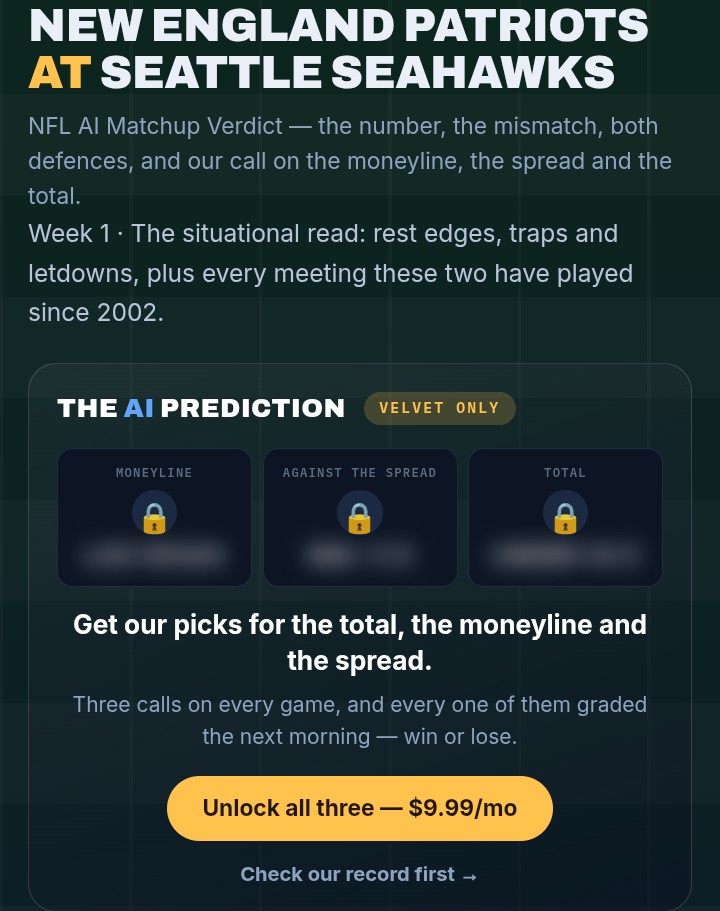
Every NFL game has its own page, and the call lives there alongside the homework: the game page carries the situational read, the series record since 2002, the average combined score and the board gap.
And you don't have to go looking. A link back to the relevant matchup rides on the other pages automatically — it reads whichever team a page is already showing, finds that club's next game in the schedule, and points you at it.
With one rule attached that I'd put on a wall: if it can't work out the right game, it renders nothing. A bar linking to the wrong matchup is worse than no bar.
The Week's Board
Every week now has a full odds and betting preview page — spread, total and moneyline on all sixteen games, with the spot behind each matchup and both teams' rooms underneath:
Week 1 · 2 · 3 · 4 · 5 · 6 · 7 · 8 · 9
Week 10 · 11 · 12 · 13 · 14 · 15 · 16 · 17 · 18
Check Our Work Against Yours
The point of a public record is that you can argue with it. The tools to do that are all free:
The Mismatch Machine crosses every game against 51 team stat ranks. The ATS board ranks all 32 against the spread with the rank right next to the team. Team streaks shows the live ATS, over and win runs. Schedule Spots reads rest edges and traps against 25 years, and head-to-head goes back to 2002.
Then price it yourself rather than taking our word for it: devig the market to find the fair line, the +EV finder flags any book paying past it, and the CLV tracker answers the only question that separates skill from luck — did you beat the closing number?
Conditions matter too: the Weather Book holds 6,511 games joined to hourly stadium weather, and the Surface Book splits every player by turf and grass.
The Honest Part
A locked, graded record is not a claim that we're right. It's a claim that you can find out. Those are very different things and only one of them is verifiable.
We will have losing weeks and they will sit on the page. That's the whole design — a scoreboard nobody can edit is only worth having if it's allowed to say something unflattering.
And none of this predicts a football game. It records a prediction, freezes it, and settles it in public. What you do with that record is entirely your business.
See the graded ledger → · This week's board →
21+. If it stops being fun, 1-800-GAMBLER.