 Let's start with the boldest call on our board, because it's no secret and there's no point being coy about it.
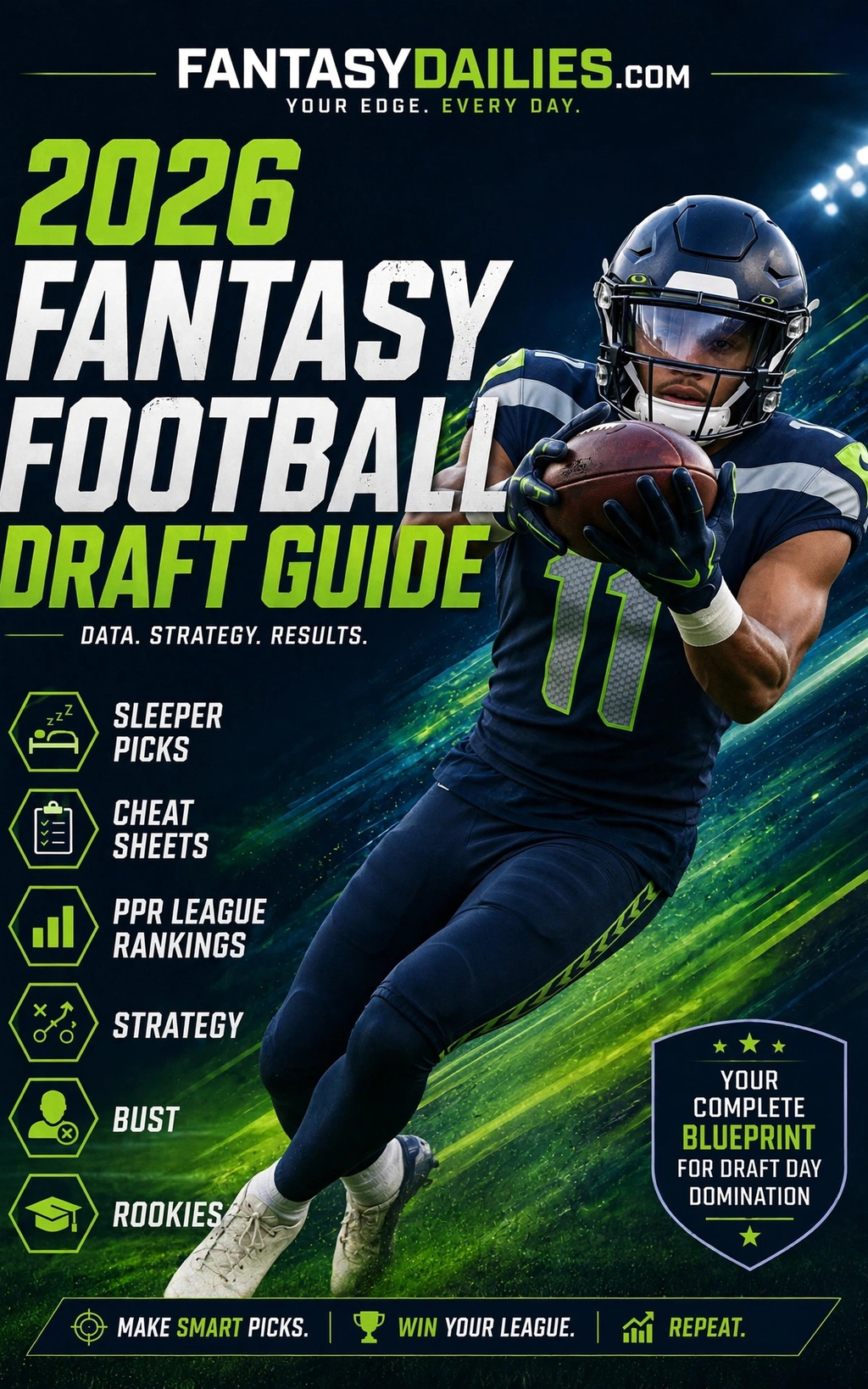
Our 1.01 is Jaxon Smith-Njigba.
Not a running back. A wide receiver — by the narrowest of margins over Bijan Robinson, and we know exactly how that reads in a room where the market is pushing backs up the board.
The case is short and it's not complicated. He is the reigning Offensive Player of the Year. He is a Super Bowl champion. He led the NFL in receiving. That's a player who did the hardest version of everything last season, and he is available at a price shaped by a market currently in love with running backs.
The full write-up is in the guide. What follows is the reasoning that surrounds it — because JSN at 1.01 isn't a one-player opinion, it's a symptom of the single biggest mispricing in drafts this month.
The Market Overcorrected, And Receivers Are The Discount
Running backs have climbed. Receivers have slipped. The room correction that started last year has overshot, and elite wideouts are now falling past where they belong.
Amon-Ra St. Brown, Justin Jefferson and CeeDee Lamb are sliding to late Round 1, sometimes Round 2. Drake London, Malik Nabers, A.J. Brown and Rashee Rice are settling near the 2/3 turn. Those are league-winning names arriving at prices that treat them as question marks.
Some of them genuinely are question marks. The job is separating the discounts from the traps.
How Our Board Is Actually Built
One thing worth explaining, because it's why our 1.01 differs from the consensus.
Our 335 players are priced off what the betting market actually charges — the idea being to draft the team the sportsbooks would draft. Every tier break is drawn where the money breaks, not at a round number somebody picked because twelve is a tidy figure.
That matters more than it sounds. A tier is only useful if it tells you where the genuine cliff is, and a cliff drawn by money is one you can trust. It's also why our board diverges from the room in a few specific places — Nico Collins at 8 being the clearest example, and one we're happy to defend: he posted WR8 numbers while stuck on an offense that couldn't run the ball or reach the red zone.
The Big Board is live and sortable. The reasoning behind each name is in the guide.
The Discounts Worth Taking
Justin Jefferson — the quarterback discount
The most instructive line on any 2026 board. Jefferson commanded a 28.5% target share last season — elite, top-of-the-league usage — and finished with 84 catches, 1,048 yards and two touchdowns.
Two.
That's not decline, that's a quarterback room collapsing underneath him. Target share is the input; touchdowns are the output, and the output was strangled by everything in front of him. With J.J. McCarthy under center there's a genuine rebound case, and you're buying a 28.5% target share at a discount created by circumstances that have already changed.
CeeDee Lamb — the injury discount
An early-season injury has caused managers to forget how dominant a healthy Lamb is. He's a perennial target monster in an offense that plays fast and throws constantly — the sort who can go 12 catches and 150 on any given Sunday.
The caution is real; he's missed games in consecutive seasons. But the price assumes injuries define him rather than interrupt him, and those are different bets.
Zay Flowers — the bargain nobody calls a bargain
Flowers finished seventh among all wide receivers in fantasy scoring last season and is being drafted like a WR13. The gap between production and perception is the definition of value.
A.J. Brown and DJ Moore — the relocation discounts
Brown lands in New England, his third franchise, and the market is treating relocation as decline. Same target-earning ability, cheaper price.
Moore is the one people are underrating. Buffalo sent a second-round pick to Chicago for him, and Bills head coach Joe Brady was Moore's offensive coordinator in Carolina during his best years — now attached to Josh Allen. A coordinator who already knows how to use you plus a top-three quarterback is a situation upgrade in two directions at once.
The Question Marks — Real, But Priced In
Malik Nabers (how healthy is he really?), Rashee Rice, Drake London (quarterback play again), Nico Collins (availability). Legitimate concerns, and precisely why all four are available later than their ceilings justify.
That's the trade: accept a real question in exchange for a real discount. The mistake is paying a premium and accepting the question.
Then Chris Olave, Garrett Wilson, George Pickens in Dallas, DeVonta Smith, Davante Adams with the Rams, Tetairoa McMillan, Tee Higgins.
The Three Veterans Everybody Is Asking About
This is where a lot of advice circulating right now is quietly out of date. All three situations have moved.
Keenan Allen — Colts, and not an early pick
Allen signed a one-year deal with Indianapolis, and the signing tells you as much as the player does: Alec Pierce is still on PUP after a March ankle procedure, nearly a month into camp.
The honest numbers at 34: 81 catches, 777 yards, 4 touchdowns on 122 targets — 10.8 PPR per game, the lowest of his career.
What's still genuinely good is target-earning. A team-leading 21.8% target share and 0.27 targets per route run, higher than both Ladd McConkey and Quentin Johnston. Quarterbacks still trust him.
But look at the room. Allen's average depth of target is 8.3 yards. Josh Downs runs at 7.5. Tyler Warren at 5.4. Three men fighting over the same patch of field, with Allen projected around 58% of pass plays as the WR3.
Where he belongs: a WR4/WR5 dart in PPR, later than most are taking him. Startable if Pierce misses real time. Not an early pick.
Deebo Samuel — back in San Francisco, late-round flier
Samuel returned to the 49ers on a one-year deal, and the door opened because that pass-catching group is a mess: George Kittle back from a January Achilles, Christian Kirk on a calf, Ricky Pearsall likely out the whole season with a mishandled PCL sprain, and a nearly-33 Mike Evans off declining metrics and hamstring trouble.
He's 30 and the last two years were rough — 10.2 PPR on 5.4 targets per game in 2024, both five-year lows, then 11.8 on 6.2 in Washington with a strong opening five games at 17.7.
His one remaining elite trait is worth naming precisely: 28.3% of his targets were screens, 27 caught for 270 yards at an 87.7 PFF grade — third among receivers with 15+ screen targets. A real specialised skill, entirely dependent on a coordinator choosing to use it.
The warning: he reportedly looked slow in preseason. A late bench flier in a familiar system, not a starter you plan around.
Tyreek Hill — he does not have a team
Plainly, because the gap between perception and reality is widest here. Hill is a free agent. Miami released him in February and he has not signed anywhere.
The injury was catastrophic: Week 4 last season he dislocated his knee and tore multiple ligaments including the ACL, two surgeries. In July, ten months on, he said in his own workout video he has "no power" in that left leg.
Agent Drew Rosenhaus has explicitly refused a timeline — "It's not when you come back, it's how you come back" — with midseason floated and Hill picking a contender rather than the first offer.
Not on your redraft board. A late-season waiver stash for someone with a spare IR slot, a dynasty hold if you own him. Watch the player wire and the transaction wire — the day he signs is the day the conversation restarts, and not before.
The Homework That Separates Receivers
Receiving leaders, with 2024 and 2023 on their own pages. Three seasons is how you tell a career year from a baseline — the most common way people overpay in August.
Red zone leaders — the closest thing fantasy has to a leading indicator. Touchdowns swing wildly; red-zone looks are a role. Jefferson's two-touchdown season beside a 28.5% target share is exactly this pattern, and exactly why he's a buy.
Defense vs WR — all 32 ranked on yards, receptions and touchdowns allowed to wideouts, three seasons deep. You never start a defense, you start a position.
Explosive plays allowed — read backwards for receivers. It ranks defenses fewest-allowed first, so a boom-or-bust wideout wants the units at the bottom of that board.
Depth charts and the injury report — Allen's situation exists because of Pierce's ankle; Deebo's exists because of Pearsall's PCL. Half of all busts were never getting the volume.
Player cards — snap share, target zones, and the air-yards-versus-YAC split that tells you who survives a quarterback change. That split is precisely what separates Deebo's screen-dependent profile from a downfield receiver's.
Plus turf and grass splits, the Weather Book — 6,511 games joined to hourly stadium conditions, and wind wrecks passing production harder than cold ever does — and the Mismatch Machine crossing every game against 51 stat ranks.
And The One That Actually Wins Leagues
The December Board grades every ranked player on Week 15, 16 and 17 — scored against 2,172 real Decembers.
Those schedules have been public since spring and virtually nobody in your draft room will look. Two receivers in the same tier, one spends the fantasy playoffs indoors and one goes to Buffalo in a wind advisory — take the first. It costs nothing, because you were flipping a coin anyway.
The Guide Itself
The top 12 preview is on the guide page — the opening lines of each write-up, word for word off the board, so you can judge the reasoning before committing to anything.
Inside the full guide: all 335 write-ups, every tier, and the parts that don't fit on a rankings list —
- Hero-RB, Zero-RB and late-round QB translated into house math, and which one the market says to run in 2026
- The round-by-round map — a 12-team PPR blueprint from pick 1 to pick 15, with the dead zone marked and the reaches flagged
- Tiers drawn by money, every break placed where sportsbook prices cliff
- Sleepers, busts, bye weeks and the printable cheat sheet
Two ways to get it. It's a published book — available in paperback, Kindle, audiobook and ebook from the usual vendors.
Or it's included free with a Velvet seat at $9.99 a month — which also lifts the daily limits on every tool on this site and opens the AI matchup verdict on every NFL game. Cancel any time.
Build The Board
Draft Central has the whole wing. The mock simulator runs a CPU room that reaches like humans do — and with receivers falling this year, knowing what actually reaches your pick is worth more than any ranking. The printable kit comes in 10, 12 and 14-team versions, and the sleepers board covers the late rounds where Deebo and Allen genuinely belong.
Then Use It All Season
Import your team and the Roster Doctor grades every man you own. Start or Sit settles the close calls, Boom or Bust shows the shape of a range, Consistency shows who clears his line weekly, and the Free Agent Wire flags the claims that win Octobers.
Betting receiving props instead? The Line Checker, the hit-rate board and the unders board.
The Honest Part
Everything here describes a market as it stands today. A camp body changes it, a Friday injury report changes it, and a veteran signing in October changes it completely.
Which is the real lesson of Hill, Allen and Deebo: the advice you read three weeks ago was written about situations that no longer exist. Allen had no team. Deebo had no team. Hill still doesn't.
Check the roster before you check the ranking. And if we're wrong about JSN at 1.01, it'll be sitting on the record where everyone can see it.