Pick any two teams and get their full history — every meeting back to 2002, the series record, who covered, how the total played out. That's the pitch, and it's a genuinely useful one before you bet or build around a rivalry game.
But the more interesting thing about the Head-to-Head board is what it deliberately leaves out.
Team Crests, Not Player Photos — And That's A Rule, Not An Oversight
Open the tool and every team gets its crest next to the comparison grid. What you won't find anywhere on the page is a quarterback headshot, a "starters to watch" box, or anything tying a specific player to either roster.
That's not a missing feature. It's a decision, and it's the correct one.
A team's logo is a fixed fact — it doesn't change week to week, so it's safe to print without checking anything. A player is not. Rosters turn over, starters get benched, a trade lands on a Tuesday and the depth chart is different by Thursday. Printing a player-team pairing without checking it against a live, current roster is exactly the kind of mistake that erodes trust fast — a page that confidently tells you the wrong quarterback is starting is worse than a page that says nothing at all.
So the board stays in its lane. Team history is safe to show. Player-specific claims need a live roster check first, and this page doesn't have one wired in — so it doesn't guess.
If you want the roster-verified version of that question, the depth chart and player cards are built for exactly that, checked against the current roster rather than assumed.
What's Actually On The Page
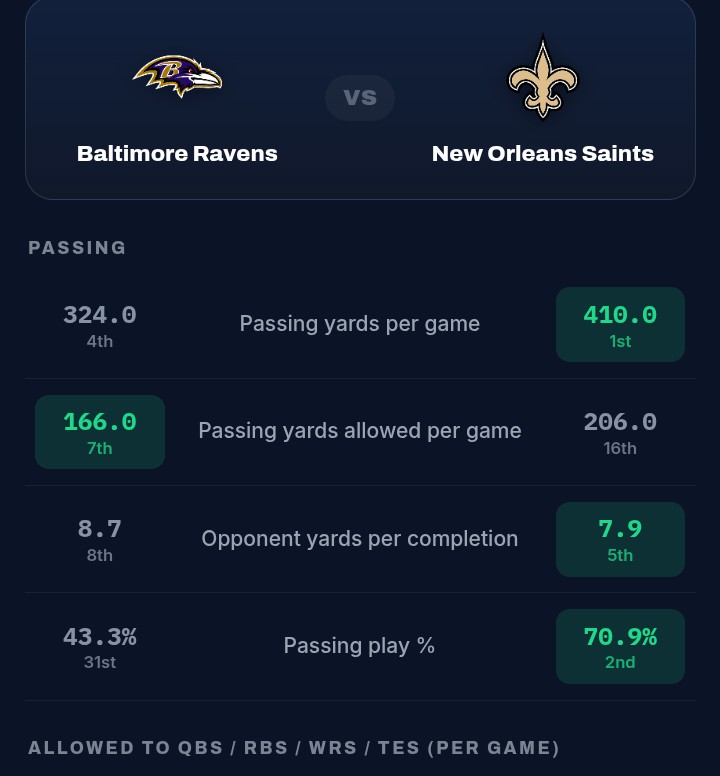
Pick two teams and you get a visual comparison grid — the better number in any given row highlighted, so you're not scanning a wall of digits to find the edge. The full series since 2002. And underneath it, a copy-to-clipboard sheet built for show prep, if you're prepping a broadcast or a stream rather than just checking a number yourself.
It's free, with no account and no daily limit — because it's a presentation of history rather than something computed fresh for you, it doesn't draw against the same allowance that gates the live tools.
How To Actually Use A Series History
The honest caveat first: a 15-3 all-time series record tells you almost nothing about Sunday. Rosters, coaches and schemes turn over completely inside fifteen years. Treating "Team A owns this series" as a betting angle on its own is exactly the kind of lazy trend that gets debunked the moment someone checks who was actually on the roster for those wins.
What it's genuinely good for: context before you build. Pull up the matchup, then layer the real, current-season tools on top. The Mismatch Machine crosses this week's version of the same two teams against 51 current stat ranks. Schedule Spots checks whether either side is walking into a rest edge or a trap, tested against 25 years, with the sample size printed on every split. The Weather Book has the conditions if the venue has a history worth knowing.
And for the game actually on the board this week, the Week 2 matchups page has the real spread, total and moneyline, with our call locked before kickoff and graded the morning after.
The Team Stat Boards Got The Same Verification Pass
Worth mentioning alongside this, because it's the same discipline applied somewhere else: offense and defense team stats are now checked field-by-field against the season's play-by-play file rather than assumed correct, with the season switcher built right into the page — 2026, 2025, 2024, 2023, all one tap apart.
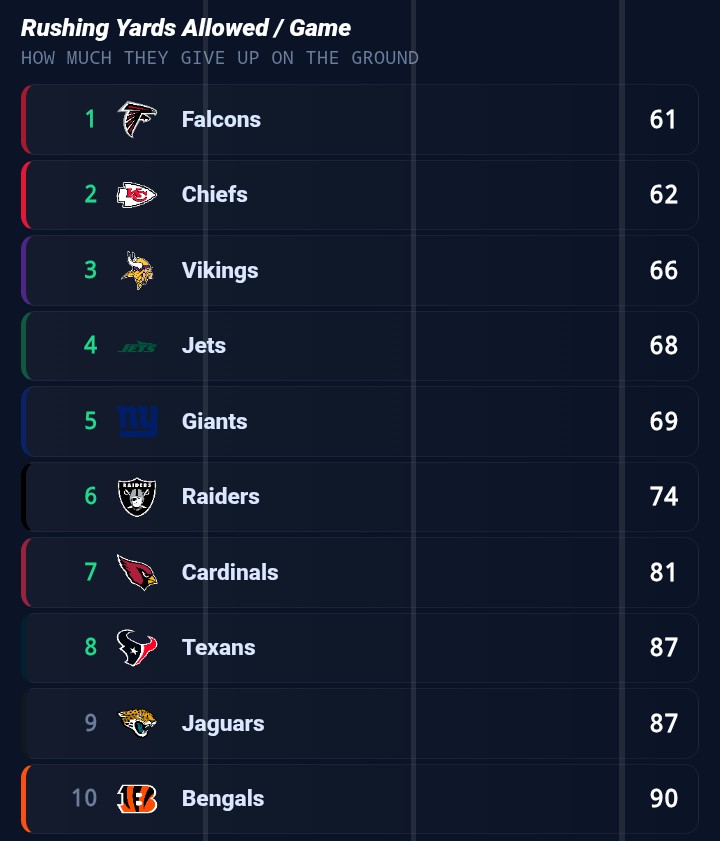
Offense: passing and rushing yards, pass rate, third-down and red-zone conversion, sacks allowed, turnover differential — every team ranked 1 to 32. Defense: passing and rushing yards allowed, sacks, and explosive plays allowed on 20-plus and 40-plus yard runs and passes — stingiest team at No. 1. Green for league-best, red for worst, so a full page reads in about ten seconds.
Three seasons of history sit right there for comparison, because one year tells you what happened and three tell you whether it's who a team actually is. The full NFL vault has everything else, and defense vs position breaks the same data down by what you actually start — a total-yardage rank hides four completely different jobs.
The Honest Part
A verified page isn't the same as a complete one. This tool tells you what happened, correctly, and stops exactly where a guess would start. That's a narrower promise than most stat sites make — and it's the one worth trusting, because the alternative is a page that fills the gap with something that reads confidently and turns out to be wrong.
21+. 1-800-GAMBLER.