 There is a version of sports betting that has nothing to do with picking winners, and almost nobody explains it in plain English because the people who understand it are charging $99 a month for the tool.
It works like this. Every game has a true price — the odds that genuinely reflect what's about to happen. Nobody knows it exactly. But nine sportsbooks, averaged together with the juice stripped out, get remarkably close.
Books set their lines independently. Sometimes one is slow, or short-staffed, or simply wrong. Its number drifts away from the true price and sits there for a while.
A positive EV bet is a book paying more than the true price. You're buying a dollar for ninety cents.
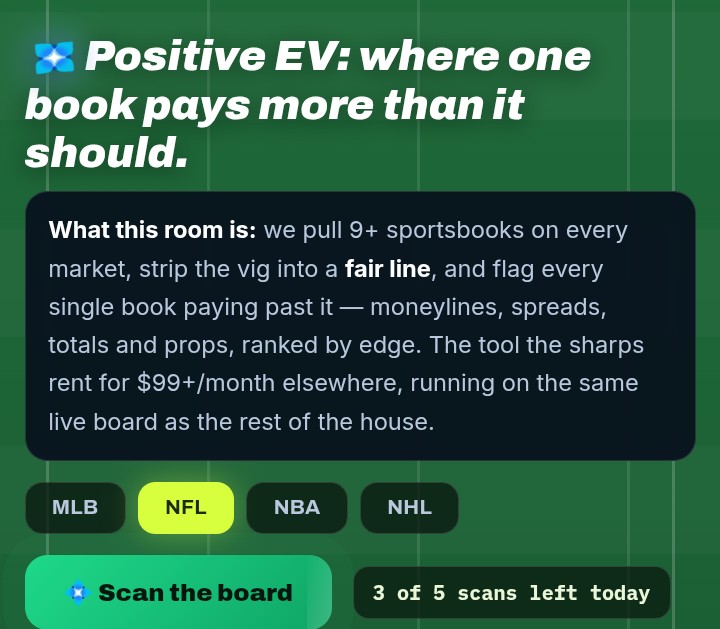
That's the whole idea. Our +EV finder does the comparison automatically, across every market, and it's free.
How The Scan Actually Works
Three steps, and none of them involve an opinion about who wins:
1. Pull every book. Nine-plus sportsbooks on every market — moneylines, spreads, totals and player props.
2. Strip the vig. Every posted price includes the house's cut. Devigging removes it and converts both sides into honest implied probabilities. The market median of those becomes the fair line.
3. Flag everything paying past it. Any book quoting better than fair gets surfaced, ranked by edge.
One detail that matters more than it sounds: lines our server marks incoherent never enter the math. A stale or broken quote can look like a massive edge when it's actually just wrong, and chasing those is how people think they've found free money and haven't.
Five free scans a day. Velvet goes unlimited.
Why This Is Different From Picking Winners
This is the part people struggle with, so it's worth being direct.
Individual +EV bets lose all the time. A bet that should win 55% of the time loses 45% of the time, and that will absolutely include the one you just placed. If you're looking for a tool that tells you tonight's winner, this isn't it and nothing is.
What +EV does is change which side of the counter the math sits on. Priced consistently better than fair across hundreds of bets, the edge accumulates the same way the house's edge accumulates against everyone else. You become the one with the small structural advantage.
That requires two things most bettors don't have: volume and discipline. A dozen bets tells you nothing. And a real edge staked badly still goes broke, which is exactly why the Kelly calculator exists — it turns your odds, your estimated win probability and your bankroll into the mathematically optimal stake, with half-Kelly and quarter-Kelly for the sane.
The Money Room: Do The Math Yourself
You shouldn't have to trust a scanner — including ours. Every calculation behind it is free and sitting in the Money Room, and the three below are the entire workflow in order.
1. Devig — find the fair line
The Devig Calculator is the sharp's first move, and the concept is simple once someone says it plainly:
Both sides of any market imply probabilities that add up to more than 100%. That overage is the vig. A standard -110 either way implies 52.4% and 52.4% — which totals 104.8%, and that extra 4.8% is the house's cut sitting in plain sight.
Scale both sides back down to 100% and you get the fair line: what the bet is genuinely worth with the margin removed. Enter both prices, get fair odds for each side, true probabilities, and the exact hold the book is charging.
That fair line is your yardstick. Any book paying better than it is a +EV bet — and comparing that automatically across nine books and every market is precisely what the scanner does all day.
2. Convert — know the break-even
The Odds Converter takes any format — American, decimal, fractional, implied probability — and updates the other three live. But the number worth memorizing is the one it puts underneath:
-110 demands a 52.4% win rate.
That's the break-even on the standard price. Win less often than that and the vig eats you no matter how sharp your reads feel. Every conversion on that page is the same truth wearing four different costumes, and if you internalize one number from this entire article, make it that one.
3. Kelly — size it properly
The Kelly Calculator answers the only sizing question that matters. The formula is f = (bp − q) / b, where b is your net decimal odds, p your win probability and q the chance you lose. It maximizes long-run bankroll growth.
The trap on either side: bet more than Kelly and variance eventually ruins you even with a genuine edge. Bet less and you leave growth on the table.
But almost nobody should bet full Kelly, and the reason is honest — your probability is an estimate, and full Kelly punishes optimism brutally. Half-Kelly keeps roughly 75% of the growth with half the swings, which is where professionals actually live. Quarter-Kelly is right there too.
And when the calculator reads NO BET, believe it. That answer has saved more bankrolls than any winning pick ever has.
The rest of the shelf: Parlay Truth shows what a parlay should pay versus what you're offered — the gap is the house cut in daylight. Plus implied probability, the parlay calculator, round robin (a robin isn't one bet, it's a stack of them, and the total outlay surprises people constantly) and the hedge calculator for when you're one leg from a real payout and need to know exactly what to lay.
The Rooms That Pair With It
The Hit-Rate Traffic Board answers a different question than the EV finder, and you want both. EV asks is the price wrong? Hit rates ask has this actually been cashing? — last 5, last 10, last 20 games in traffic-light color, graded off our own nightly ledger rather than a projection.
The middle finder — two books far enough apart that both bets can cash.
The book heat map — nine books side by side, so you never take a worse number by accident. Line shopping is free money and most people still don't do it.
Line movement and closing line value — CLV is the honest scoreboard for whether you're actually beating the market, independent of whether you won.
Then Do The Football Homework
A price being wrong and a bet being good aren't quite the same thing. The research is free:
The Line Checker counts how many times a player has cleared any number you type, with the game log underneath. The Mismatch Machine crosses every game against 51 team stat ranks. The ATS board ranks all 32 with the rank right next to the team. Schedule Spots reads rest edges and traps against 25 years, and every game has its own page with the series since 2002.
Plus the Weather Book, turf and grass splits, injuries and depth charts.
Grade It Before You Fire
The Parlay Doctor takes any slip and grades it A through F — the real break-even, the buried juice, the correlated legs, and which single leg is carrying the ticket. Nothing you paste is stored.
And the graded ledger stamps every call the next morning, win or lose, with nothing quietly deleted. Calibration goes further and asks the uncomfortable question most sites never ask about themselves: when we say 60%, does it hit 60% of the time?
The Honest Part
+EV is not a money printer and anyone presenting it as one is selling something. Edges are small, variance is enormous, and a genuine 3% edge can lose for weeks at a stretch without anything being wrong.
It also assumes the market median is close to true. Usually it is. On thin markets with few books posting, it's a rougher estimate — and thin markets are exactly where the biggest apparent edges show up. Treat a huge number with suspicion rather than excitement.
Scan the board → Five free scans a day, nine-plus books, ranked by edge.
21+. If it stops being fun, 1-800-GAMBLER.