Fantasy basketball punishes people who draft it like football.
In football every team plays once a week and the schedule is a tiebreaker. In head-to-head basketball a player is worth what his club plays that week — and that single fact decides more matchups than talent does.
The whole 2026-27 wing is live: the draft guide, a mock simulator, a season simulator and the complete schedule cut six ways.
The Grid That Wins Head-To-Head Leagues
Start here, because almost nobody in your draft room will.
A four-game week is a third more than a three-game week from the same man. A two-game week is a bench week no matter who he is.
That's not a small edge. It's the difference between a category win and a category loss, repeated eighteen times.
The fantasy weeks grid counts every club Monday-to-Sunday from October 19 — the way a fantasy week actually runs, not the way the league's calendar prints it. Two players in the same tier, one on a club with five four-game weeks and one with five two-game weeks, are not the same asset.
The Calendar Itself
The league released 1,200 of the 1,230 games on August 13.
It opens Tuesday, October 20 with three games — Boston at Detroit in the afternoon, Philadelphia at New York, Oklahoma City at San Antonio — and closes Sunday, April 11 with all fifteen games on one night.
Cut it the way you need it: by date · by team · key dates · national TV · Christmas, Cup and international games.
The Draft Guide
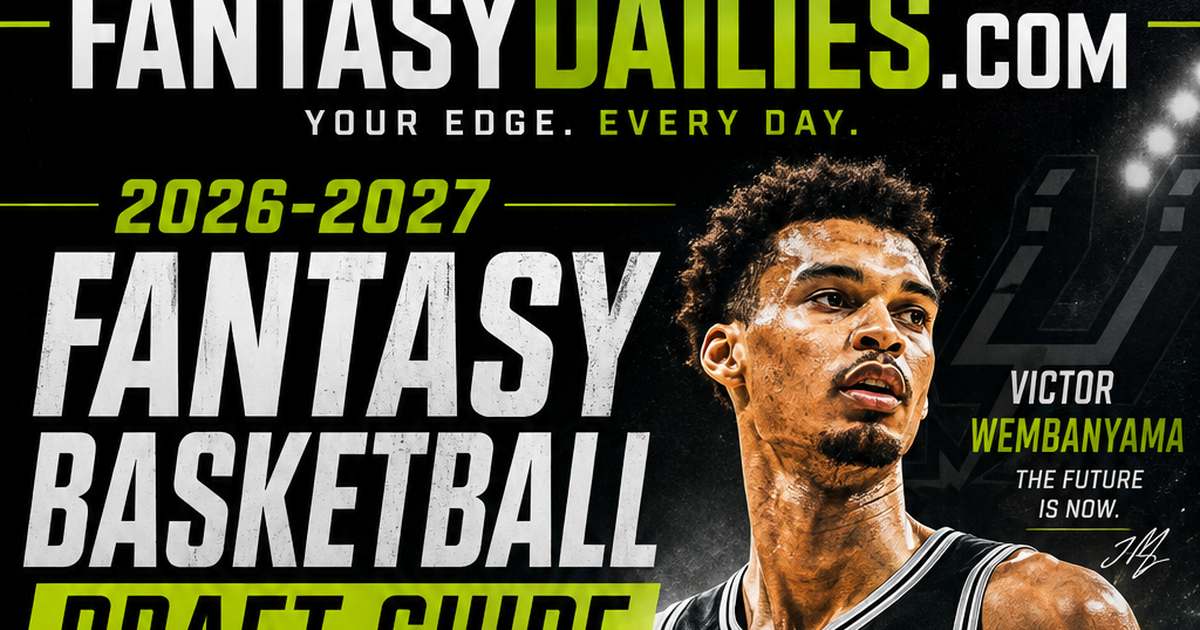
The 2026-27 guide is a Top 250 scored by our own system, not a consensus list — every player rated on nine categories against the league.
Inside: the category breakdown, triple-double targets, sleepers, busts, rookies to watch, and the strategy for every draft slot. Because drafting from the 1 and drafting from the 12 are different games, and the people who win from a rough slot planned for it.
It's free with a Velvet seat at $9.99, and the book is coming to Amazon, Audible, Apple Books, Google Play, Walmart and Barnes & Noble.
Two Simulators, Two Different Jobs
The mock draft simulator puts you against position-aware AI opponents drafting off the house rankings, with tiers, steals flagged, a report card and every team's roster visible. Unlimited reps from your exact slot — which is worth more than any ranking, because knowing what genuinely reaches pick 9 is the actual skill.
The season simulator does something different and better. Draft a full 13-man roster against the room, then play the whole season — eighteen weeks head to head, playoffs in weeks 19 and beyond, a champion at the end.
Then the part that matters: run it a hundred times.
One season is a story. A hundred is a verdict — the same roster, the same league, a hundred different years.
That's the honest way to evaluate a draft. Any roster can win one season. Finding out how often yours wins is a completely different question, and it's the one that tells you whether you actually drafted well or just got a good week in March.
Then The Season
Minutes is the board to live on. Every counting stat in basketball is downstream of how long the coach leaves a man out there, and NBA rotations move considerably faster than rankings do. It's the same principle as snap share in football: opportunity beats talent, every time.
The NBA hub has all nine boards — scoring, rebounding, assists, threes, steals, blocks, minutes, team offence and defence. The start/sit board grades every startable player, and the player wire carries player items only.
Betting it instead? The projection board puts our number against the best price at nine books, BetScore rates every prop 1 to 100, Splits shows how often he's actually cleared it, and the verdict slate carries our call on every game with the running record.
One honest note for basketball bettors: there are no key numbers in the NBA. Football margins pile up on 3 and 7 because of the field goal and the touchdown; basketball margins land almost evenly. Anybody selling you NBA key numbers is selling you nothing.
Also New
All three draft guides in one place — football, basketball and hockey.
And NBA trivia counts on the six-game network leaderboard, with a challenge link that hands your mate the exact fifteen questions you just played.
The Honest Part
A schedule grid is knowable in August and it doesn't change. That makes it the most reliable edge on this page — and the most ignored, because it isn't about players and it doesn't feel like analysis.
Everything else here is an estimate. Rotations shift, coaches get fired, a rookie earns twenty minutes in December. Which is why the guide is a starting point and the minutes board is the weekly check.