A plain-English guide to the NBA markets: what each one measures, how to read the price, and which FantasyDailies tools do the math.
The NBA season is almost here, and the betting side of it gets louder every October. Futures. Player specials. Same-game parlays that look like a bargain until the fourth quarter. Before you put a dollar on anything, it helps to know what each market is actually asking you to predict. That is what this guide is for.
One rule up front. We do not manufacture numbers to make an article look impressive. Season-long markets are posted before the season. Game-by-game lines and player props have to be checked against the actual matchup, the injury report and the latest posted price, so nothing on this page quotes a price. The tools below do the live work, and the NBA AI parlay builder is the place to start if you are building a ticket. For the full playbook, from straight bets to parlays to bankroll, read the FantasyDailies Sports Betting Strategy Book.
SEASON-LONG MARKETS: WHAT YOU ARE REALLY BETTING ON
Championship futures. A championship price reflects probability, public interest and the house margin, not a guarantee of who wins the title. Before you act, ask three questions: is the core healthy, does the depth hold up over a long season, and does the price offer value rather than simply paying you to back the most obvious name? Our team offense page and team defense page show how each team has been scoring and defending, and the NBA hub covers the rest.
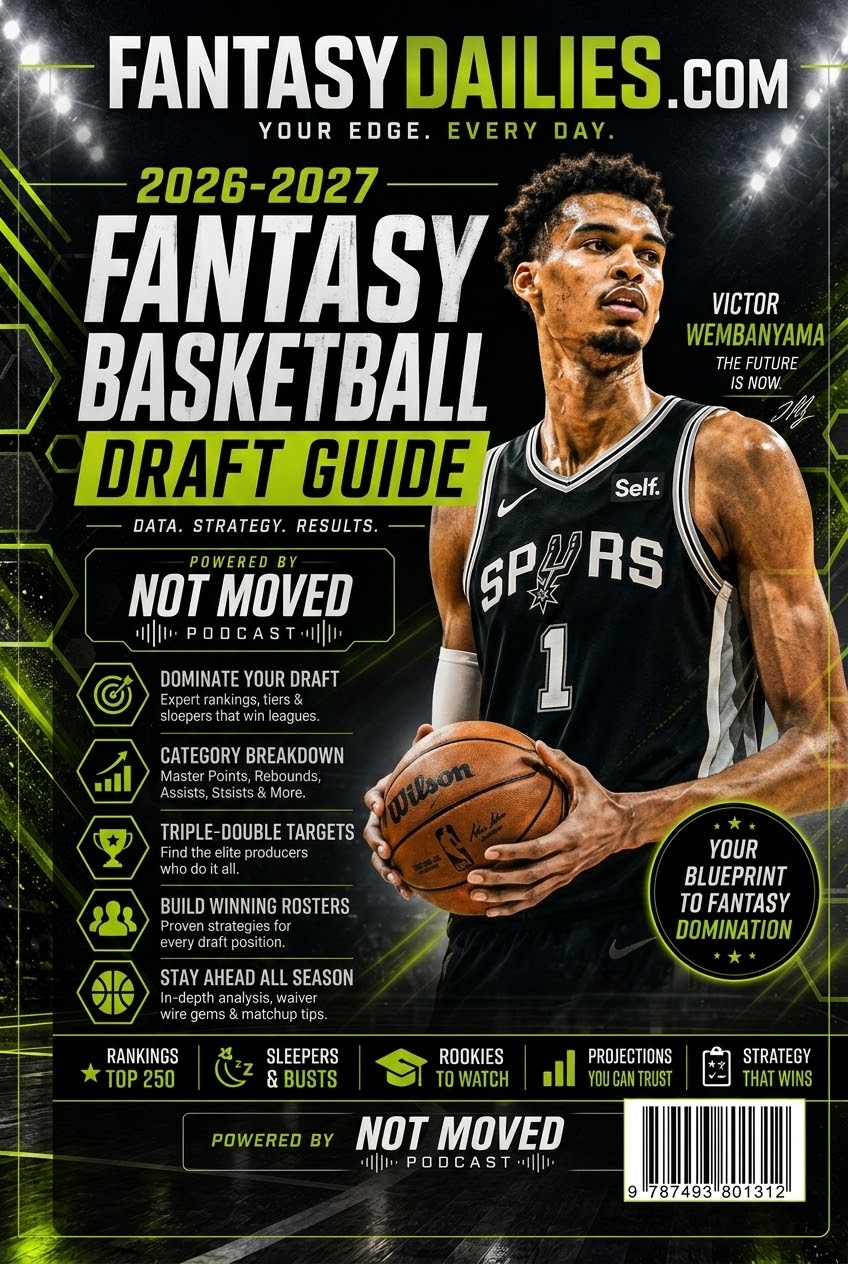
MVP. The MVP conversation is about narrative and production. The usual names sit at the top of our own NBA draft guide board: Nikola Jokic, Victor Wembanyama, Shai Gilgeous-Alexander and Luka Doncic are the first four. A good fantasy pick and a good MVP bet are different things. Games played, team record and a clean story all matter for one and not the other.
Statistical leaders. Scoring, rebounds, threes made and similar markets reward volume and availability as much as skill. The question is never just who is best at the stat. It is who combines a high rate with enough games to hold it for a full season.
- Scoring leader: look at projected minutes, usage rate, shot attempts, foul-line attempts and expected games played.
- Rebounds leader: do not automatically take the tallest player. Rebounds depend on defensive assignments, pace, missed shots, positioning and minutes.
- Threes made: this market rewards attempts as much as accuracy. A player who attempts eight a game can beat a better shooter who attempts four. Look for secure starting roles and steady minutes.
- Role-change specials: a new team, a new lineup or an injury elsewhere on the roster can open touches. It can also bring more competition for shots, so never assume a changed role means more production.
Every one of those inputs is on our NBA depth charts and injury report, and the roles that moved this summer are written up in the NBA draft guide.
IMPLIED PROBABILITY: THE ONE SKILL THAT PAYS FOR EVERYTHING ELSE
Every price is a probability in disguise. Convert the price into the chance it implies, then compare that number with your own honest estimate. If your estimate is higher than the market's, you may have found value. If it is lower, pass. That is the whole method, and it works on futures, props and parlays alike.
Use the odds converter to flip any price into its implied percentage, and the EV calculator and EV page to see what that edge is worth over many bets. The parlay truth page shows why stacking legs makes the combined price look larger while the real chance shrinks.
A few habits that keep you honest:
- Write down your own estimate before you look at the price.
- Remember the market includes a margin. The implied percentages on both sides add up to more than 100.
- Do not bet a team or a player simply because you like him.
- If the price does not offer value, pass. You do not need a bet on every game.
SPREADS, TOTALS AND PLAYER PROPS: HOW TO READ THEM
Before betting a single game, look at the whole matchup instead of isolating one statistic.
Point spreads. The spread is the margin by which a team is expected to win or lose. Compare it with your view of team strength, rest, injuries and likely rotations. A better team is not an automatic spread bet. A strong team can win the game without covering.
Game totals. The total is the combined score the market expects from both teams. Check pace, offensive efficiency, defensive matchups, injuries, rest and whether either team is likely to limit starters' minutes. The team offense page and team defense page are built for that comparison.
Points props. Compare the line with the player's projected scoring output, expected minutes, usage and matchup. A player averaging a certain number is not automatically an over when the line sits just above it, and an under can be a poor bet when his role is bigger than his season average suggests.
Rebounds and assists props. Rebounds depend on playing time, missed shots and positioning. Assists depend on ball-handling opportunities, teammates' shooting and offensive role. These props are useful alternatives to points markets, but they still need a matchup-specific projection, and the box scores are where you check how a player actually did.
PARLAYS AND SAME-GAME PARLAYS
Correlated outcomes make a same-game parlay appealing. A high-scoring game script can support a star's points and a teammate's assists in the same ticket. But correlation does not guarantee value. The price still has to justify the combined risk, and every extra leg makes the ticket harder to hit.
Build it with the NBA AI parlay builder or the parlay generator, run it through the parlay calculator, and read the parlay truth page before you finish. If the math does not hold up, the ticket does not go in.
Two more tools worth knowing about. The middle finder hunts for gaps where two sides of a market line up in your favor, and the hedge calculator tells you how to lock in a position when a leg comes in early. The NBA heatmap shows the markets side by side.
A SIMPLE CHECKLIST BEFORE YOU BET
- Check the injury report and the NBA player news for the latest status.
- Look at rest and schedule on the NBA schedule.
- Convert the price to an implied percentage with the odds converter.
- Compare it with your own estimate, and pass when there is no edge.
- Size the bet to a number you can afford to lose.
Want the whole system in one place? The Sports Betting Strategy Book walks through every bet type, every tool on the site and how to hedge, and it is built for exactly this stage of the season.
Playing fantasy too? The NBA draft guide is the other half of the NBA preseason homework, and our NBA DFS lineups covers the daily-lineup side.
FINAL WORD
The 2026-27 season offers plenty of opportunity for bettors and fantasy managers, and the edge comes from preparation rather than predictions made with false confidence. Start with the tools, compare the numbers, watch the rotations and injury news, and bet only when the price tells you to.
Keep the Sports Betting Strategy Book next to the tools while you work.
Odds, projections and rosters change. Verify current prices, official injury reports and league settings before acting. Betting involves risk: never wager more than you can afford to lose.
FantasyDailies: Your Edge Every Day.