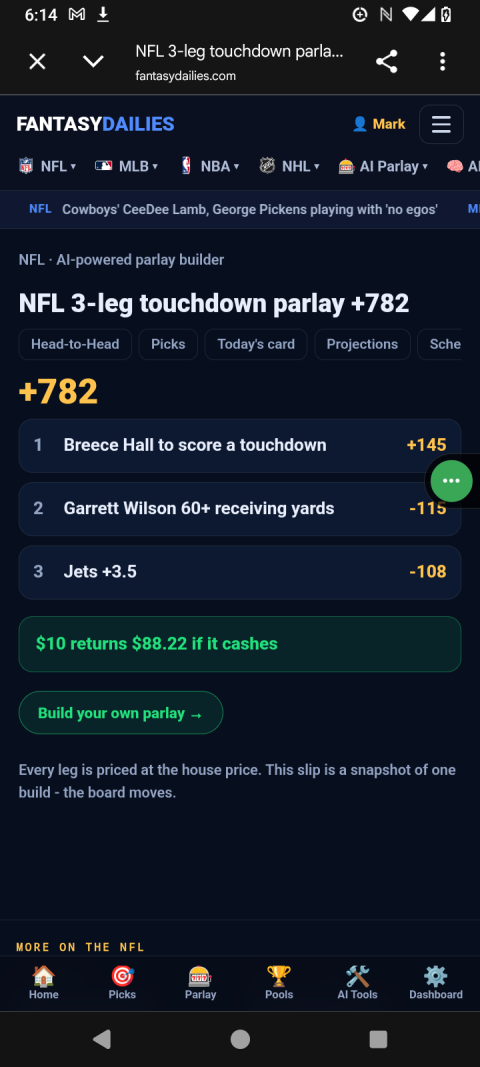
A parlay looks like one bet. It is several bets stapled together, and the house margin applies to every leg at once. The Parlay Truth Machine takes any slip you can type in and shows what it is really worth. The Odds Converter sits underneath it, translating every price into the one number that matters: the win rate it demands. Here is how both work.
The Number to Memorize
The standard two-way market demands a win rate of just over fifty-two percent to break even. Win less often than that and the margin eats you no matter how sharp the picks feel. The Odds Converter shows this for any price. Type into any box, whether American, decimal, fractional or implied probability, and the other three convert live, along with the break-even rate.
What Implied Probability Means
It is the win chance a price builds in, before you account for the margin inside it. A price that converts to a sixty percent implied chance is not saying the team wins sixty percent of the time. It is saying the market charges you as if it did, plus its cut. To find the true chance you have to remove the margin, which is what the devig calculator does.
How a Parlay Multiplies Against You
If every leg has a fifty-five percent chance of winning, the chance of the whole slip is those chances multiplied together. The drop is steep.
LegsChance every leg hits at fifty-five percent eachOne55 percentTwoAbout 30 percentThreeAbout 17 percentFourAbout 9 percentSixAbout 3 percent
Those are the odds before the margin. The slip pays as if each leg carried its own cut, so you pay that cut on every leg, stacked. That is the whole reason parlays lose more than singles over time.
What the Truth Machine Does
- Enter up to six legs, each with a price and an optional label, plus your stake.
- Set an assumed hold per leg. A standard two-way market holds roughly four and a half percent.
- The machine strips the margin from each leg to recover its true probability.
- It multiplies the legs to get the fair price for the ticket and the true chance of hitting.
- It shows the expected value of the ticket in dollars and the slice the house keeps, as a bar.
- It compares the same money placed as singles, so you can see the long-run difference.
The output is a verdict on the ticket, not on the games. It reads the math, not the matchups. Nothing here tells you which side to take.
Singles Versus the Slip
Splitting the same stake across the legs as singles removes the stacking. The Truth Machine puts both side by side so you can see the expected return of each. A parlay is a fine thing to enjoy for its payout. It is a poor thing to confuse with an edge. If you still want one, build it deliberately with the parlay calculator, check each leg's record on the hit-rate board, and let the Parlay Doctor look it over.
From Fair Price to Bet Size
- Find the fair probability with the devig calculator.
- Test whether the price pays more than fair with the EV calculator or the Positive EV finder.
- Size the stake with the Kelly calculator.
- If a ticket is already open and the last leg is pending, see the Hedge Calculator and read how it pairs with the Middle Finder.
Keep Your Own Books Honest
The math is only as good as the record you keep. Log your daily fantasy entries on the DFS profit tracker and see net, return and break-even. Pools have their own math, covered in the pool strategy guide and the survivor strategy guide.
The One Place the Site Takes a Side
The Truth Machine and the Odds Converter tell you what a price means. They do not pick games. For that, the NFL verdicts page is the only place FantasyDailies gives an opinion, and the full record of how those calls have done is public on the results page and the calibration page. The whole shelf of calculators is in the Money Room.
Runs are limited each day and unlimited with a Velvet seat.