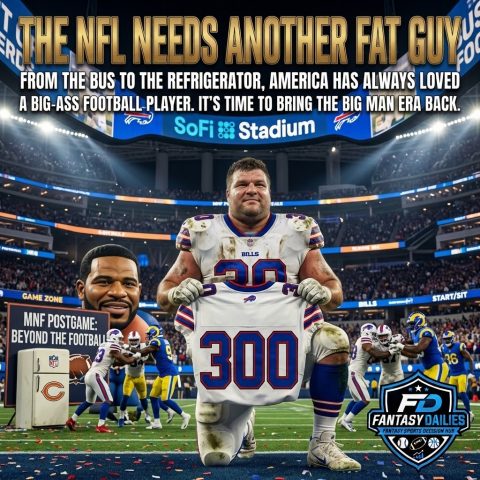
From The Bus to The Refrigerator, America Has Always Loved a Big-Ass Football Player. It's Time to Bring the Big Man Era Back.
There are two kinds of football fans in this world: people who appreciate a perfectly executed outside zone run, and people who want to watch a 280-pound man with a neck like a tree stump run directly through another human being and send him into the next zip code.
I know which group I'm in.
Give me the analytics. Give me the explosive plays. Give me your 40-yard dash times, your yards after contact, your Next Gen Stats, and your little charts explaining why a running back gained 4.7 yards when he could have gained 4.9 if he had followed the blocking scheme. We even have a few of those charts ourselves: the league leaders, the red zone page and the volume board. I put them on the site. I'm not a hypocrite. I'm a hypocrite with a point.
You know what else I'd like?
A fat running back. A REAL fat running back.
Not a guy who's listed at 225 pounds but looks like he could model underwear for Calvin Klein. Not a 215-pound speed demon who runs a 4.32 and spends his offseason taking pictures of his abs.
I'm talking about a guy who looks like he ate the offensive line during pregame warmups and is still looking around for dessert.
I'm talking about the kind of football player who makes you wonder whether the equipment manager accidentally ordered his uniform from the Big & Tall section at Costco.
And if you're old enough to remember the glory days of the NFL's lovable big men, you know exactly what I'm talking about.
We've been robbed. Check the depth charts if you don't believe me. Count the guys who look like they've met a vegetable. Then come back and apologize to me.
THE BUS: A NATIONAL TREASURE ON WHEELS
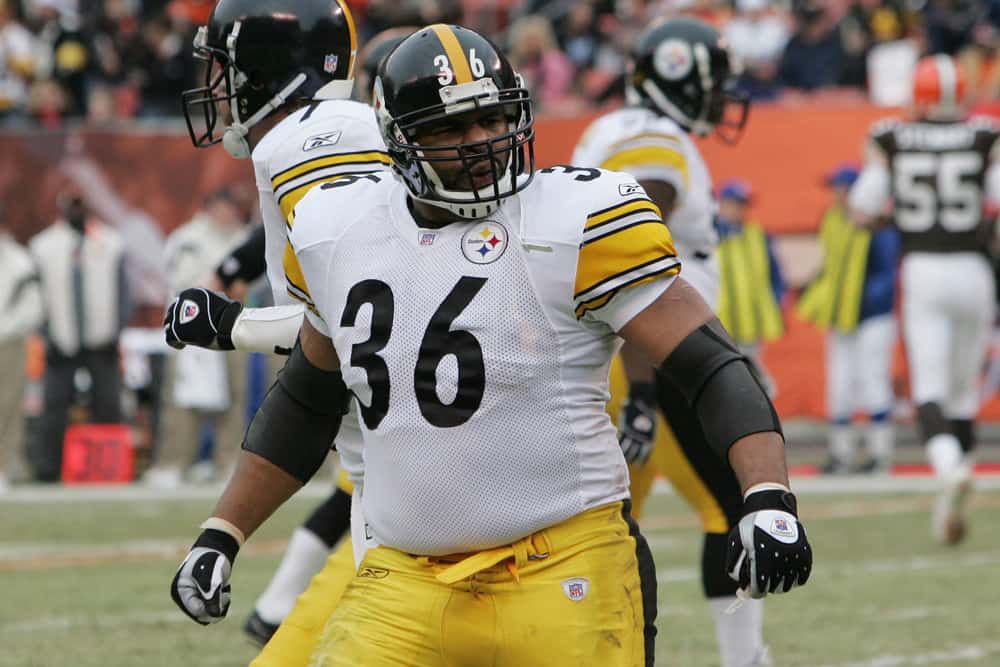
Let's start with Jerome "The Bus" Bettis.
Bettis didn't run like a typical NFL running back. He ran like somebody had just told him the buffet was closing in 30 seconds.
Bettis was a six-time Pro Bowler, a powerful runner, and a Super Bowl champion with the  Steelers, who beat the Seattle Seahawks in Super Bowl XL. Listed at 252 pounds, he wasn't exactly built like a guy who spent his mornings doing Pilates and drinking cucumber water. He started out with the
 Rams, then took the whole operation to Pittsburgh and made it a career. The Pro Football Hall of Fame put him in with the Class of 2015, which is a gold jacket for running through people on purpose and honestly the most reasonable thing the Hall has ever done.
He was a freight train with a face you could trust.
When The Bus got the ball, you didn't necessarily need a fancy blocking scheme. You needed somebody to call the highway department and make sure the road was cleared.
And here's the beautiful thing: nobody was asking The Bus to lose 20 pounds.
Nobody was telling him to work on his beach body. Nobody was asking whether his body-fat percentage was compatible with modern football.
We were asking one question: How many defensive backs are going to bounce off this man before somebody finally brings him down?
The answer was usually more than one.
Jerome Bettis made being a big running back cool. He made it marketable. He made it something kids wanted to imitate in the backyard, preferably while wearing shoulder pads three sizes too small.
You didn't need to be the fastest guy on the field. Sometimes, you just needed to be the guy the other team didn't want to tackle.
And that, my friends, is a beautiful thing.
IRONHEAD HEYWARD: THE MAN, THE MYTH, THE APPETITE
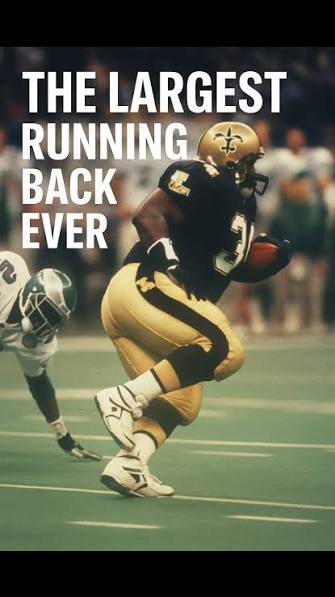
Then we had Craig "Ironhead" Heyward.
Now THERE was a football player who understood the assignment.
Ironhead played fullback, listed at 260 pounds and, depending on the year and who you ask, a lot more than that. He carried the ball for the Saints, the  Bears, the
 Falcons, the Rams and the
 Colts. In 1995 he ran for 1,083 yards for Atlanta and made the Pro Bowl, and nobody at fullback has hit 1,000 since. Read that sentence again. A fullback. A thousand yards. The position has been extinct longer than the fax machine.
That is the kind of guy who made defensive coordinators reconsider their career choices.
You could practically hear the conversation in the opposing locker room.
"Coach, who's got Ironhead?"
"That's your responsibility, son."
"Coach, I have a family."
Ironhead wasn't some novelty act who wandered onto the field because somebody lost a bet. He was a legitimate football player who could run, block, and punish defenders. He played in the NFL for a decade and change, and his physical style made him memorable.
The nickname alone deserves a place in the Hall of Fame.
IRONHEAD.
You don't give a guy that nickname because he runs a fast 40. You give him that nickname because when he lowers his head, the opposing linebacker starts updating his life insurance policy.
And that's what made these guys special. They weren't just big. They had personality. They had an identity. You remembered them.
Nobody was confusing Ironhead Heyward with some interchangeable running back wearing number 28 on a random Sunday afternoon.
You knew who he was.
And if you were the linebacker standing in his way, you probably knew who your chiropractor was going to be on Monday morning.
THE FRIDGE: CHICAGO'S ORIGINAL HUMAN REFRIGERATOR
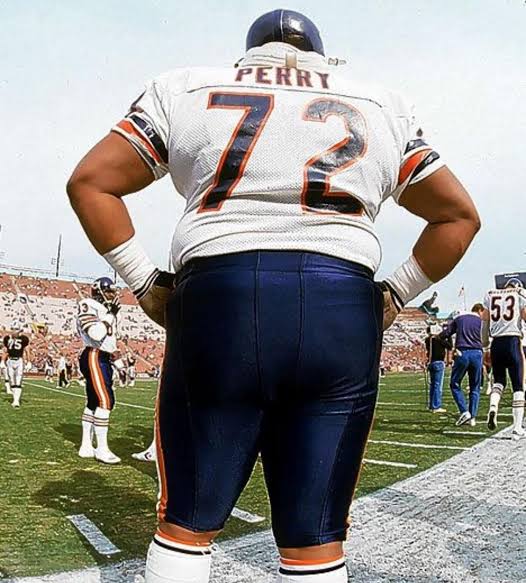
Then came William "The Refrigerator" Perry.
Oh, we need to talk about The Fridge.
The 1985 Bears didn't just have one of the most dominant defenses in NFL history. They had a defensive tackle who became a full-blown American celebrity.
Perry was enormous, powerful, entertaining, and impossible to ignore. Listed at 335 pounds, he looked like somebody had accidentally given a kitchen appliance a football contract.
And then Mike Ditka decided to hand him the football. Ditka lined him up at fullback near the goal line and in fourth-and-short, and the big man even lead-blocked for Walter Payton. As a rookie he ran for two touchdowns and caught another. Defensive tackle. Rookie. Three touchdowns. Meanwhile your fantasy running back can't find the end zone against a team that just lost its entire secondary.
You remember the Super Bowl Shuffle. The Fridge was in the video, and he somehow found time to make three rap records the same year. You remember the refrigerator jokes. You remember the spectacle of this giant man lumbering toward the end zone while grown professional athletes tried to stop him.
The Fridge scored a touchdown in Super Bowl XX.
A TOUCHDOWN.
He ran right over  Patriots linebacker Larry McGrew to get it. Imagine being a defender for the Patriots, preparing for the biggest game of your life, and finding out that the other team has decided to send its refrigerator through your front door.
What are you supposed to do with that?
The Bears could have handed the ball to Walter Payton. Instead, they gave America a moment it would never forget.
And that's the point.
Perry became a cultural phenomenon because football fans love a spectacle. We love watching extraordinary athletes do extraordinary things. And every once in a while, we love watching an extraordinarily large man do something that seems completely ridiculous until it works.
The man's Super Bowl ring was a size 25, the largest in the history of the game. Twenty-five. Somewhere there is a jeweler who still has nightmares and a very large insurance claim.
The Fridge wasn't just a football player. He was a marketing department's dream before every athlete had a social media manager, a podcast, and a personal brand consultant.
He was the brand.
You could sell cereal with that man on the box. You could put him in a commercial. You could make him the centerpiece of a Super Bowl promotion.
And the public would have eaten it up. Probably literally.
TONY SIRAGUSA: THE BIG MAN WITH THE BIG PERSONALITY
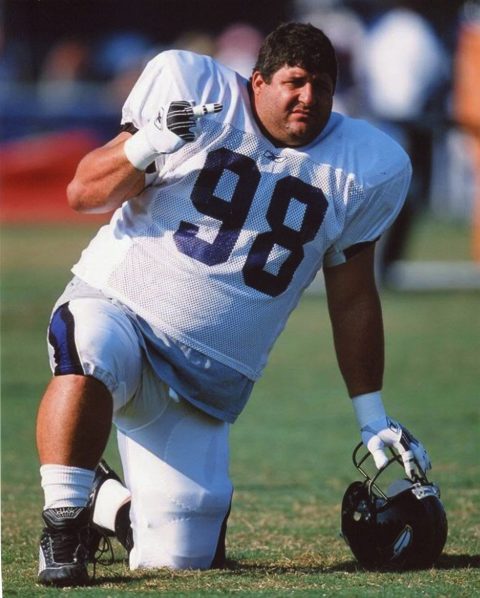
Then there was Tony Siragusa.
Goose.
If The Fridge was a human appliance, Siragusa was the guy who showed up at your barbecue, took over the entire patio furniture set, told the best stories, and somehow became the most popular person at the party.
Siragusa played defensive tackle for the Colts and the  Ravens, winning a Super Bowl with Baltimore after the 2000 season. He was a massive defensive lineman with a personality that could fill an entire stadium.
He wasn't trying to look like a fitness influencer. He was a football player who looked like he enjoyed being a football player.
And we loved him for it.
Goose had the jokes, the swagger, the facial expressions, and the personality that made television producers understand that putting a microphone in front of him was probably going to be more entertaining than whatever scripted segment they had planned. Which is exactly what they did. We have an entire podcast network full of people who talk for a living. Not one of them is as fun as Goose on a bad day.
He was proof that you don't have to look like a Greek statue to become a fan favorite.
Sometimes you just have to be a lovable giant who can play football, make people laugh, and look like he's about to order the entire menu.
And before anybody starts yelling at me about body composition and professional conditioning, relax. I'm not suggesting NFL players should stop training or that being heavier automatically makes somebody a better football player.
I'm suggesting that football is an entertainment business, and memorable characters are part of what makes it great.
We have room for the 175-pound receiver who runs like a Ferrari.
We have room for the 260-pound linebacker who looks like he was assembled out of spare truck parts.
And we should have room for another big personality who makes us laugh every time he walks into the frame.
WHY DO WE LOVE THESE GUYS SO MUCH?
There's actually a reason the big-man phenomenon keeps coming back.
First, there's the underdog appeal. The enormous guy isn't supposed to be the graceful one. He's not supposed to dance around defenders like a ballerina. When he suddenly moves faster than expected, breaks a tackle, or gets into the end zone, it's hilarious and impressive at the same time.
Second, there's the visual comedy.
Football is already a violent, chaotic sport. Add a 300-pound personality to the equation and you've got instant entertainment.
Third, there's the relatability factor.
Most of us aren't running 4.3-second 40-yard dashes. Most of us aren't jumping over linebackers. Most of us aren't spending six hours a day perfecting our route-running technique.
But plenty of us understand the joy of being a big guy who loves what he does, has a sense of humor, and doesn't need to pretend he's somebody else.
We don't need every athlete to look like he was carved out of marble.
Sometimes we want a guy who looks like he could eat a marble statue.
And finally, there's the fact that these players tend to have enormous personalities to match their enormous frames. The best ones know they're different, embrace it, and make the most of it.
That's what made Bettis, Heyward, Perry, and Siragusa memorable.
They weren't just big bodies. They were characters.
And in an era when every player has a carefully managed image, there's something refreshing about a football player who can walk into a room and make everybody laugh without consulting his publicist first.
THE NFL HAS A MARKETING OPPORTUNITY SITTING RIGHT IN FRONT OF ITS FACE
Here's where the NFL needs to get its act together.
The league is constantly searching for new ways to engage fans. New uniforms. New alternate helmets. New international games. New streaming deals. New ways to turn a three-hour football game into a six-hour experience with 47 different sponsored segments. Even we got in on it: our own Game Zone runs live games on the web, Roku and Fire TV, and I can promise you the sponsored segments are fewer than 47.
Meanwhile, somewhere out there is a 300-plus-pound football player with a great personality who could become a fan favorite overnight.
FIND HIM.
I don't care if he's a running back, a fullback, a defensive tackle, or a goal-line specialist whose entire job description is to get one yard while making the other team regret its career choices.
Find the guy who loves the cameras.
Find the guy who can deliver a one-liner in a postgame interview.
Find the guy who can carry the ball three times, score two touchdowns, and become a household name before the fourth quarter.
Find the guy who can sell a burger commercial without pretending he survives exclusively on grilled chicken, quinoa, and the tears of opposing linebackers.
And most importantly, find the guy who understands the assignment.
We don't need another manufactured personality.
We need a real one.
Give me a player who can laugh at himself, talk trash, deliver a great interview, and run through a goal-line defense like he's late for an all-you-can-eat buffet.
Give him a nickname that sticks.
Give him a weekly social media segment.
Give him a signature celebration.
Get him on a podcast. We have a few. Come on down to the Snake Sports, the Not Moved or the whole podcast lineup.
Put him in a commercial.
Let him become the unofficial ambassador of the NFL's big-man community.
I'm telling you, there is money sitting on the table here.
And if the NFL doesn't want it, somebody in marketing at a burger chain, pizza company, or mattress retailer is about to have the best idea of their career.
AND NOW, LADIES AND GENTLEMEN, I PRESENT: THE TRIPLE-DIGIT JERSEY
Now we get to my favorite part.
The NFL has loosened its jersey-number rules over the years, and the league approved the use of number zero beginning with the 2023 season. But the numbering system still runs from 0 to 99, double zero is still banned, and nobody is allowed a three-digit number. It gets better. Offensive linemen are boxed into 50 through 79. The league has a number for every big man already. It just never occurred to anyone that one of them might want something with a little more drama.
Which means it's time for a rule change.
I want a triple-digit jersey number.
Not for everybody. We're not turning the NFL into a phone book.
This privilege should be reserved for one player, one absolute unit, one walking monument to the glory of the big man.
Give me number 300.
THREE HUNDRED.
Imagine the introduction.
"At running back, number 300!"
The stadium announcer would need a moment to catch his breath.
Imagine the jersey hanging in a store. Imagine the kids wearing it to school. Imagine fantasy football managers drafting him as a flex play because he gets the goal-line carries. Our start/sit board and DFS edge page would have a field day, and the draft guide would need its own tab.
Imagine the opposing linebacker looking across the line and seeing a jersey that looks like somebody accidentally entered the player's weight instead of his number.
You could even give him number 350 if the league really wanted to make a statement.
And if we're going to get completely ridiculous, let's go with 999.
That's not a jersey number. That's a warning label.
Now, obviously, the league would have to approve a special exception or rewrite its numbering rules. I'm not suggesting that the equipment manager can just sew three digits onto a jersey and call the league office afterward.
But tell me you wouldn't watch the first NFL game featuring a running back wearing number 300.
Tell me that jersey wouldn't sell.
Tell me every fantasy football show in America wouldn't spend an entire week talking about the guy.
And tell me some defensive coordinator wouldn't lose sleep wondering whether his third-down package was ready for a man whose jersey looks like the scoreboard has malfunctioned.
This is the kind of nonsense America needs.
Not another debate about whether a quarterback's completion percentage drops by 2.4 points when the wind comes from the northwest. (We do track the wind, by the way. Our weather page has it for every stadium. I'm not proud.)
A BIG GUY.
A BIG NUMBER.
A BIG PERSONALITY.
THE SEARCH FOR THE NEXT GREAT AMERICAN BIG GUY
So here's my challenge to the NFL.
Somewhere in a college football program, there's a massive human being who can move, catch the football, lower his shoulder, and make people laugh.
Maybe he's a fullback nobody has paid attention to. Maybe he's a defensive lineman who played running back in high school. Maybe he's a short-yardage specialist who's been waiting his entire career for somebody to give him the ball inside the five-yard line.
Maybe he's sitting in the transfer portal right now wondering if anybody has noticed that he can carry three defenders into the end zone.
Let's find him.
Let's give him a chance.
Let's give him a nickname that the fans can rally around.
And let's give him a jersey number that requires an exception from the league office.
I want the next Bus.
I want the next Ironhead.
I want the next Fridge.
I want the next Goose.
I want a player who can make an entire stadium roar when he takes the field, not because he's the fastest guy alive, but because everybody knows something entertaining is about to happen.
And if he can run for a first down, score a touchdown, and deliver a hilarious interview afterward?
Even better.
Because football isn't just about numbers on a stat sheet. It's about memories. It's about personalities. It's about the characters who make us laugh, make us cheer, and make us remember exactly where we were when something ridiculous happened on a Sunday afternoon.
The NFL has spent decades finding ways to make football bigger.
I'm proposing something simpler.
Find us a BIG GUY.
Give him the ball.
Give him a microphone.
Give him a triple-digit jersey.
And let America fall in love with the big man all over again.
Because I'm tired of watching running backs who look like they were built in a laboratory.
I want a guy who looks like he was built in a pizza parlor.
And I want him wearing number 300.
Who's with me? Tell me in the FantasyDailies community. Argue with me there. Bring a snack.
Want the football without the fat jokes? The NFL hub, the power rankings, the news wire and the player news are right here, and the only place we take a side is the NFL verdicts.
FantasyDailies - Your Edge Every Day. And apparently, your edge could use another 100 pounds.