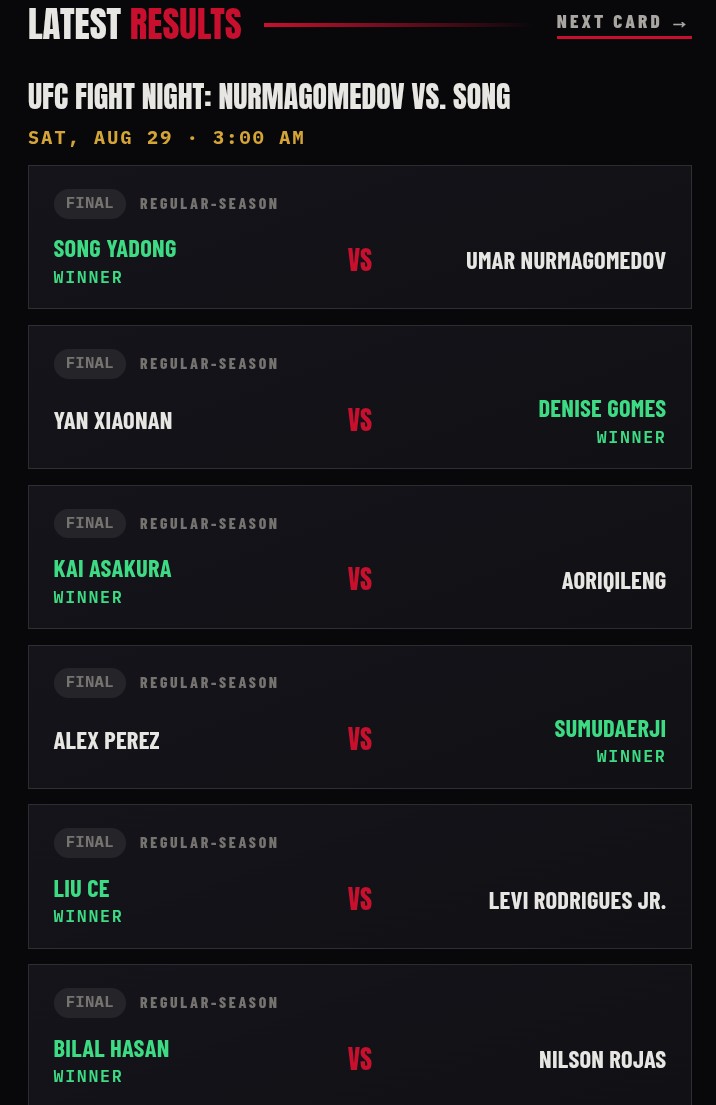
 Most fight result pages tell you who won. Name, checkmark, next.
Which is close to useless, because in this sport how a fight ended is the entire story. A five-round decision and a fourteen-second knockout look identical on a results page and mean completely different things about what happens next time.
The MMA Hub is built the other way: every card, every bout, every finish — with the method, the round and the exact time it ended. Submission, round one, 4:25. KO/TKO, round three, 0:15.
What's On The Page
The next event up top — full main card and prelims, every bout in order, weight class on each, title fights flagged in gold.
And bouts get pulled constantly in this sport — injuries, weight misses, visa problems. Scratched fights are marked rather than quietly disappearing, because a fight vanishing without explanation is how people end up betting a card that no longer exists.
Results below carry the finish detail, pulled off the live wire and refreshed through fight night.
Why MMA Is The Most Parlay-Abused Sport There Is
Read this part twice, because the format is practically engineered to separate people from money.
A UFC card has twelve fights. Scroll the odds and most favourites look enormous — −350, −450, −600. Stacking eight feels less like gambling and more like collecting.
It isn't, and two things work against you at once.
The juice compounds on every leg. Each pick hands the book another cut — by leg six you're paying a hold that would be embarrassing to state out loud. Parlay Truth names that gap in dollars.
And upsets in MMA are not rare events. They're a Tuesday. One left hand from a man losing every second of the fight ends it — no comeback drive, no bullpen, no timeout. Run a price through implied probability and it lands hard: a −450 favourite is a claim about roughly 82%. About one in five of those "locks" loses. Stack eight and you're asking for a sequence that mostly doesn't happen.
The Parlay Builder Built For This
The MMA parlay builder works two ways.
Build it yourself. Tap a fighter, or take the fight spread or round total. Every price is the best number on the wire across every book we hold — not one book's number.
Or have it built. Tell the generator how many legs, how much risk and a target payout, and it drafts from fighters actually priced on tonight's card.
The risk settings are honest about what they are. Balanced is two or three short favourites and one live dog — described as "the shape that survives a fight night," which is exactly right and emphatically not what most people build.
Then the part that separates it from any sportsbook app: the machine reads the ticket back to you before you place it — what it actually needs, where the weak leg is, and what you're being paid versus what the legs are worth.
The Parlay Doctor grades any slip A through F, including ones you built elsewhere — true break-even, buried juice, correlated legs, and which single leg is carrying the ticket. Nothing you paste is stored.
Fight Night Tools
The heat map — nine books side by side. Fight lines move hard around weigh-ins and they don't move at the same speed everywhere.
Line movement — where the money went. In MMA a Thursday afternoon move usually means somebody knows something about a weight cut.
The hedge calculator — one fight from a real payout, this computes the exact opposite-side stake that locks profit on every outcome. On a twelve-fight card that comes up more than you'd think.
Devig and Kelly — find the fair price with the margin stripped, then size it so a bad night doesn't become a bad month. The rest is in the Money Room.
And the graded ledger stamps every call the next morning, win or lose, with nothing quietly removed. The calibration page asks the harder question — when we say seventy percent, are we right seven times in ten?
210 Questions In A Cage That Rattles
UFC trivia — 210 questions from UFC 1 to tonight, played inside an octagon with six padded gold posts and a chain-link mesh.
Right answer and it pulses gold: "And still." Wrong and the cage rattles — "And new" — then names the answer.
Champions, finishes, submissions, records, PRIDE, Bellator, ONE, and the rules nobody actually knows: what a technical decision is, the 20% missed-weight forfeit, why 12-to-6 elbows are illegal and Jon Jones' only official loss came by disqualification because of them.
It's part of the Trivia Network — six games on one leaderboard, with a challenge link that hands your mate the exact round you just played.
The Scrap Sheet
Numbers don't watch tape. The Not Moved Podcast runs a fight preview show — The Scrap Sheet — bout by bout before every event: matchups, styles, who has the reach, who fades late, and where the line looks wrong.
They're live most nights on Twitch, Kick and YouTube, all embedded on their page, and they cover boxing too.
Talk About It
The community has a dedicated MMA tab now, alongside a Wrestling one. That's where the Saturday night arguments live — and where you can tell the crew they're wrong about the main event before it happens.
If your combat sports run past the cage, The Squared Circle has the full WWE and AEW calendar plus 243 wrestling trivia questions.
The Honest Part
MMA is the hardest mainstream sport to handicap and anyone claiming otherwise is selling something. Sample sizes are tiny — a fighter might have twelve professional bouts. Styles matter more than records. Weight cuts happen behind closed doors. And the sport's defining feature is that anybody can lose in four seconds.
What the hub does is make sure you're looking at the real card, the real finish data and the real price. The fight itself stays gloriously unpredictable, which is rather the point of watching.
Open the MMA Hub → · Build tonight's card →
21+. Prices move fast on fight night — always confirm at the book. 1-800-GAMBLER.