 Daily fantasy sites are very good at showing you one number: the top prize.
They are markedly less enthusiastic about the others. What the house keeps before a single point is scored. How many other people submitted the exact lineup you thought was yours. Whether the contest you just entered is one the site is quietly paying into rather than taking from.
None of these are opinions. They're arithmetic, they take about twenty seconds each, and almost nobody runs them — which is precisely why the industry looks the way it does.
We built the whole workshop. Here's what each number is, and the specific moment it changes what you do.
1. Rake: The Cut That Happens Before Kickoff
Start here, because everything else is downstream of it.
Every DFS contest pays out less than it takes in. The gap is the rake, and it is charged before a single point is scored.
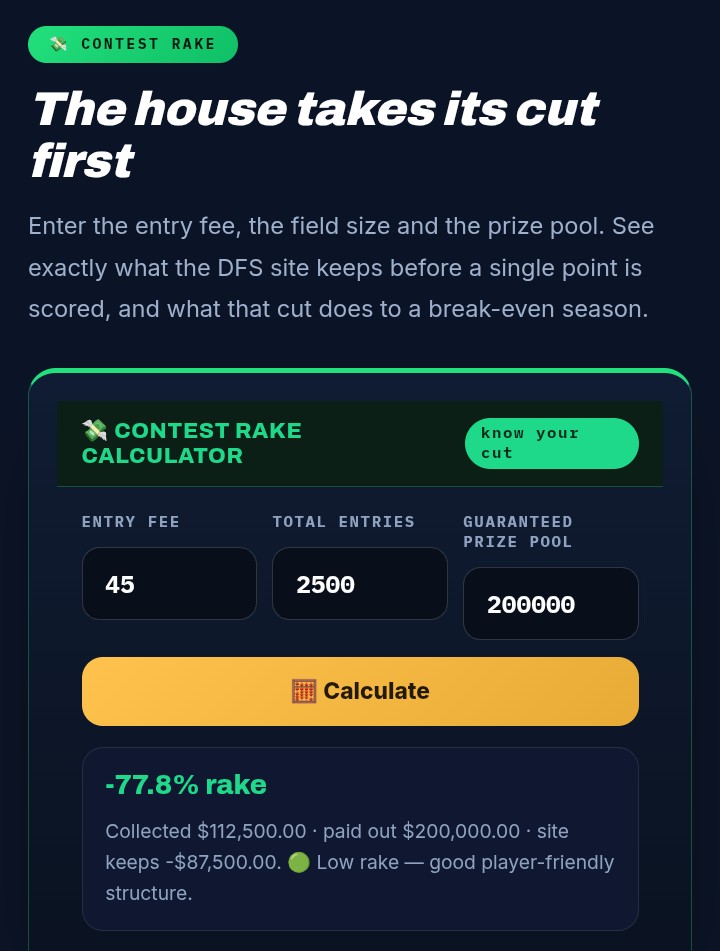
The Rake Calculator is three inputs — entry fee, total entries, guaranteed prize pool — and it tells you exactly what the site keeps.
Here's why that number decides seasons:
A 10% rake means you must beat the field by more than 10% just to break even. Not beat the field. Beat it by ten percent. That's the entire reason two players with identical skill and identical win rates can finish a season on opposite sides of zero — one played in contests taking 6%, the other in contests taking 15%.
Nobody talks about this because there's no way to talk about it that makes the product sound better. But if you only change one habit after reading this article, make it checking the rake before you enter.
2. Duplication: The Lineup You Think Is Yours
You build a lineup, you like it, you enter a 50,000-person tournament. Congratulations — so did four hundred other people, more or less exactly.
The Duplication Calculator takes your field size, how many chalk players you used, and their average ownership, and estimates how many twins of your lineup are sitting in that field.
The math is straightforward enough to state plainly: (ownership ÷ 100) ^ number of chalk players × field size.
The consequence is not straightforward at all. Winning a tournament outright and winning it split six ways are completely different outcomes — and which one you're playing for is decided before lock, by how many of your slots the rest of the field also filled.
A lineup built entirely from the popular plays isn't a lineup. It's a share of a lineup.
This is where DFS Edge earns its place — it grades DraftKings salary against actual production, snap share and target share, so you can find the plays that earn their price without being the play everybody else found.
3. Overlay: The One Time The House Pays You
This is the cleanest edge in daily fantasy and it exists for about four minutes at a time.
When a guaranteed prize pool doesn't fill, the site has to cover the shortfall out of its own pocket. That's overlay — a contest where the operator is contributing money rather than collecting it.
The Overlay Calculator takes the guaranteed pool, the entry fee and entries so far, and tells you how much of that shortfall is yours per entry.
Positive overlay means the site is paying out more than it collected. That is free expected value — genuinely, mathematically free — provided it holds at lock.
The catch is timing. Overlay only exists in the last few minutes before a contest closes, and it evaporates the moment enough people pile in. So it's a habit rather than a strategy: check the unfilled guarantees late, run the number, and enter if it's real.
4. Correlation: Do Your Stacks Actually Move Together?
Stacking is the most repeated advice in DFS and the least examined.
The Correlation Calculator sorts pairings into three buckets: the ones that genuinely rise and fall together, the ones that are independent no matter how good the story sounds, and — the important one — the ones the book has already priced as correlated, so the edge is gone before you build.
That third category is where most stacking advice quietly fails. If everyone knows a quarterback and his WR1 move together, that relationship is in the price. You're not exploiting a correlation; you're paying for one.
Same principle runs through the Parlay Doctor on the betting side — a quarterback over on passing yards plus his own receiver over on receptions is one event wearing two hats, and books price it as though it isn't.
5. Exposure: How Much Rides On One Man
You've built forty lineups. Feels diversified. Then the guy you liked in thirty-one of them is a late scratch.
The Exposure Calculator works out what share of your bankroll depends on a single player across a set of lineups — and, more usefully, the point where concentration stops being conviction and starts being a problem.
Conviction is fine. Forty lineups that are all the same bet wearing different hats is not diversification, it's one bet with extra entry fees.
6. Late Swap: Movement For Its Own Sake
Late swap feels like an edge because it feels like action. Frequently it's neither.
The Swap EV Calculator asks the only question that matters before you make the change: given what you give up and what you gain, is this genuinely positive expected value — or just movement?
Swapping out of a player because his game went badly for one quarter is the most common unforced error in the format.
7. The Profit Tracker: The Number That Ends Arguments
The DFS Profit Tracker logs entries, fees and cashes and returns the three things that actually describe your season: net profit, return on investment, and the win rate you need to stay level at the stakes you're playing.
That last one is the one people avoid. It's also the one that turns "I had a decent year" into a number you can check.
The Research That Feeds The Builds
Math prices a lineup. It doesn't find one.
DFS Edge grades salary against production for every league: NFL · NBA · NHL · MLB
Who's hot right now, off graded results rather than vibes: NFL · NBA · NHL · MLB
Start/sit boards graded on the work a player actually gets: NFL · NHL · MLB
Player news wires, because every projection is a lagging indicator of who's actually playing: NFL · NBA · NHL · MLB
And the stat vaults underneath: NFL, NBA and NHL, every leaderboard on its own page.
If You Bet As Well As Play
The same discipline transfers. The Money Room holds the betting side — devig to find the fair line, Kelly to size the bet, the +EV finder to catch books paying past fair, and the Hit-Rate Board for whether a prop has actually been cashing.
Building slips instead? NFL · NBA · NHL · MLB — real prices, with the true cost of every leg shown before you play it.
And the graded ledger stamps every call the next morning, win or lose, nothing quietly deleted.
The Honest Part
None of this makes you win. Rake, duplication and overlay are all structural — they describe the shape of the game you're playing, not who scores points on Sunday.
But structure is where most of the money leaks out, and it's the part you can control completely before a single ball is snapped. You cannot make a running back score. You can absolutely refuse to play a contest taking 15%.
Start with the rake → It's the number that decides whether the rest of it matters.
21+ where applicable. If it stops being fun, 1-800-GAMBLER.