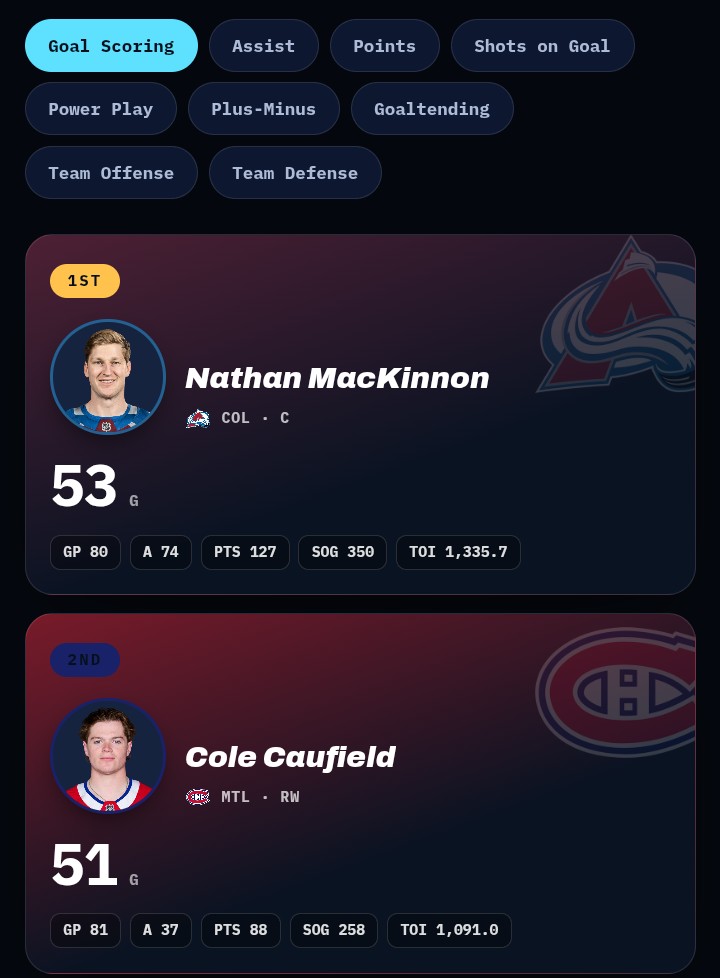
 Hockey punishes people who bet on goals.
Not because goal scorers aren't good — because goals are the noisiest event in mainstream sport. A great forward can go six games without one and then score three in a night, and neither streak means very much about the seventh game.
Which is why the most useful board in the NHL Stat Vault isn't the one people look at first.
Shots On Goal: Volume Survives A Cold Streak
Shots on goal is the most reliable prop in hockey, and the reason is simple: volume is a role, and finishing is a percentage.
A player who fires six pucks at the net a night keeps firing six pucks at the net whether they're going in or not. His ice time doesn't change because he's snakebitten. His linemates don't change. His job doesn't change.
Goals swing violently around that volume. Shots barely move.
So shots on goal does two jobs at once. It's the prop that actually holds up week to week — and it's the leading indicator that a scoring run is coming or ending. A player whose shot volume is climbing while his goals aren't is about to look like he got hot. He didn't get hot. The percentage caught up to the work he was already doing.
That's the same logic as red-zone targets in football: the opportunity is the signal, the score is the lagging result.
The Rest Of The Skater Boards
Goal scoring — and the hub says the important part out loud: read it beside the shots column or you're reading percentages. A goal leader with modest shot volume had a hot run. A goal leader with huge volume has a role. Only one of those repeats.
Assists — which separates who drives a power play from who finishes on it. Those are different jobs and they get priced as though they're the same one.
Points — the headline board, and the one everybody quotes.
Power play — the sneaky one. First-unit deployment drives the ceiling, and unlike even-strength production it's a coaching decision rather than a matchup outcome. Which makes it far more predictable. A guy who just got promoted to PP1 got a raise nobody has priced yet.
Plus-minus — the hub's own description is the correct one: context, never a verdict. It depends enormously on who you happen to be on the ice with, and treating it as a rating of the individual is how people talk themselves into bad conclusions.
Between The Pipes And Behind The Bench
Goaltending — the most important position in the sport and the hardest to project. Save percentage carries enormous variance, and a hot goalie can carry a mediocre team for a month before reality arrives.
Team offence and team defence, ranked per game — the matchup filter for every skater number above.
Every Board Is Its Own Page
Nine boards, nine URLs. Link one, send it, or drop it in the group chat mid-argument. A dropdown selection isn't a link and never will be, and "NHL shots leaders" is something people actually type into a search bar.
These are the completed 2025-26 regular season numbers, and the 2026-27 season drops the puck in early October — which makes this the book every opening-night line is built on.
From Board To Bet
Who's Hot Tonight for who's genuinely rolling, off graded results. The unders board for where a number sits too high — books shade toward the over because the public loves the over, and that shading is the under bettor's whole edge.
The start/sit board grades every skater on the work he actually gets and the defence across from him. NHL DFS Edge puts salary against production.
The slip builder stacks from tonight's real board with the true price on every leg. Then devig the market, check the count with the Line Checker, read the Hit-Rate Board, and grade the ticket with the Parlay Doctor.
One hockey-specific warning on parlays: two props from the same game are rarely independent. Stacking a shots over and a goals over on the same man is closer to one bet than two, and the Doctor flags exactly that.
Everything else is in the Money Room, and the player news wire catches the line changes and scratches that move all of it.
The Honest Part
Hockey is the hardest of the four to model and anyone claiming otherwise is selling something. Bounces decide games, goalies decide series, and a puck off a shin pad counts the same as a perfect wrist shot.
What the boards do is point you at the things that are stable — shot volume, power play deployment, ice time — and away from the things that aren't. That's a real edge and it's a modest one.
Open the NHL Stat Vault → Nine boards, no dropdowns, no account.
Also: the NBA vault and the NFL hub.