 Baseball is the best sport in the world for prop betting and the worst one to guess at.
It's the best because the slate is enormous — fifteen games a night, every night, for six months. It's the worst because the sample sizes underneath any given night are tiny and the variance is savage. A hitter is 0-for-4 and nothing is wrong. He's 4-for-4 and nothing is right.
That gap is exactly where a number helps and a hunch doesn't.
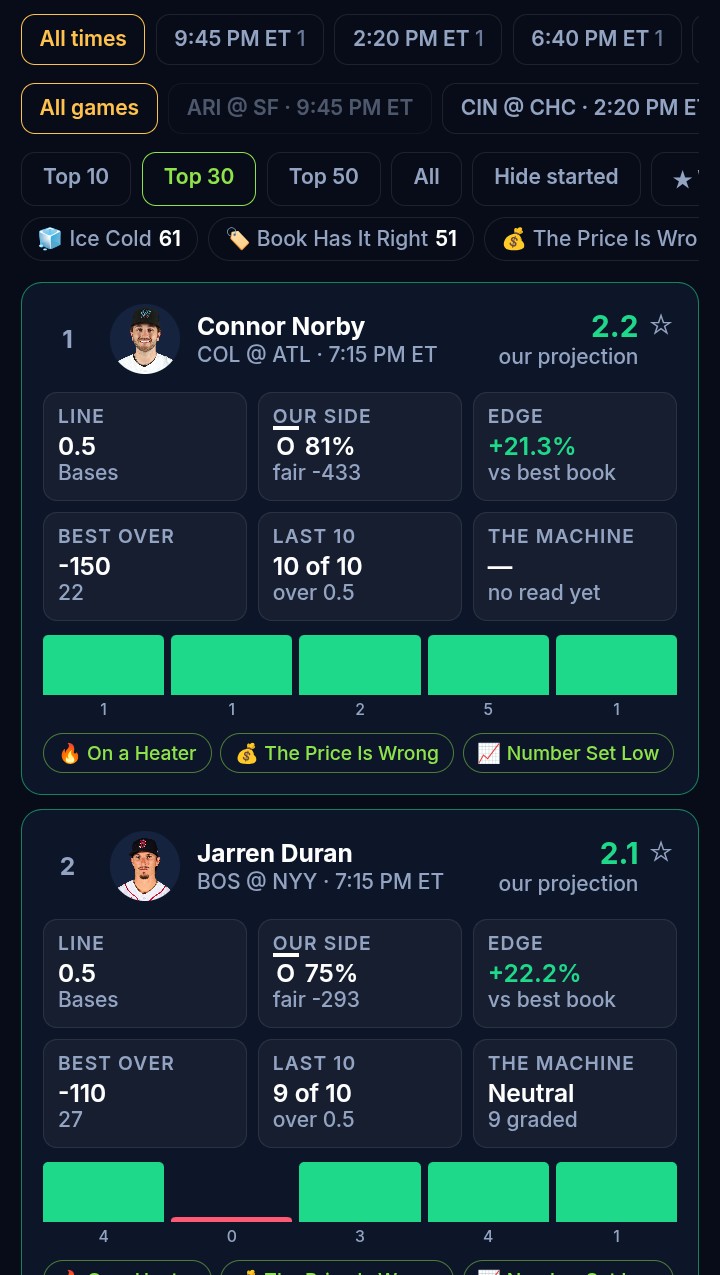
The MLB Projection Board puts every player on tonight's board — our projection, the best available price across nine-plus sportsbooks, and the edge between the two.
Fourteen Markets, Batters And Pitchers Split
Batters: hits, total bases, home runs, H+R+RBI, RBIs, runs, walks, strikeouts and stolen bases.
Pitchers: strikeouts, earned runs, hits allowed, walks allowed and outs recorded.
You can sort to the top 10, 30, 50 or the whole board, and hide games that have already started — which sounds minor until you've scrolled a fifteen-game slate at 8pm trying to work out which first pitches are still ahead of you.
Every player, incidentally, not a curated handful. A board that shows six picks a day has already made the interesting decision for you and made it invisibly. Seeing the whole slate means seeing the fades too, and the fades are where a lot of the value sits.
Why Baseball Rewards This More Than Any Other Sport
Two structural things make MLB props different.
The volume. Fifteen games a night times fourteen markets times two teams of hitters is thousands of individual prices, every single day. No trading desk prices all of that with equal care. Football has sixteen games a week and every one of them is scrutinised; baseball's Tuesday night board simply cannot be.
The independence. A strikeout prop on a pitcher in Cleveland has nothing to do with a total bases prop on a hitter in San Diego. In football, half a slate moves together on weather and game script. In baseball, the events are genuinely separate — which is the single most underrated advantage in the entire sport, because it means a bad beat in one game doesn't cascade.
That's also why correlation traps matter within a game and barely at all across them. Stacking a pitcher's strikeout over with the opposing team's total under is one bet wearing two hats — the Parlay Doctor flags exactly that.
We Keep The Receipt On Our Own Numbers
This is the part that separates a projection board from a projection feed.
Every projection gets logged before first pitch and graded afterwards. Player, market, line, our number, our probability, the best price — stamped with the day.
And written once, on first sighting. That rule does real work: a projection that moves all afternoon is not a projection. If you can quietly revise your number as lineups drop and then grade whichever version happened to be right, you aren't forecasting — you're keeping books in reverse.
Then the results are walked and each projection marked right or wrong. Not merely "did the over hit," but what did we claim the probability was, and was that honest? That's calibration, per market, and in baseball it's the only measure worth anything — because over a 162-game season a number that's 55% right when it says 55% beats a number that's spectacular for three weeks and can't tell you why.
Same discipline as the public ledger, where nothing gets quietly removed after a bad night.
The Board Is Only As Good As Its Inputs
Check ours against what actually happened:
The hit-rate board — every prop's real rate over the last 5, 10 and 20 games in traffic-light colour, graded off our own nightly ledger rather than a model. Baseball is where this earns its keep: when the 5-game window and the 20-game window disagree, something changed — a lineup slot, a platoon, an injury nobody announced — and it's worth finding out which.
The MLB unders board — lines hung above what a hitter has actually been producing. Books shade toward the over because the public loves the over, and nobody wants to root for a man to do nothing, which is precisely why those numbers stay soft.
Who's hot tonight — graded off real results, game by game, rather than whoever had a nice highlight.
Team streaks — win, over and cover runs, every one counted against a line we posted first. Which is the difference between a fact and a claim.
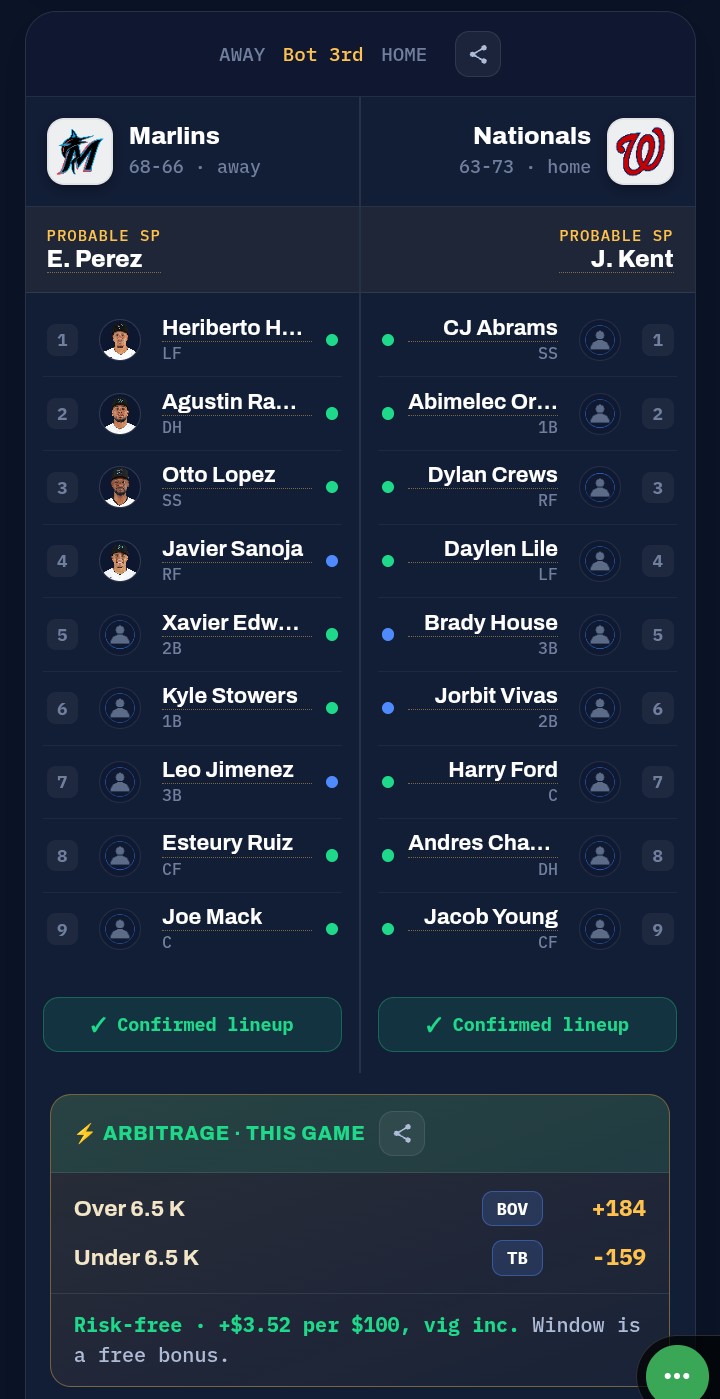
The MLB player wire — and in baseball this is close to decisive. A hitter's projection is downstream of his lineup slot, and lineup cards land a couple of hours before first pitch. A man batting second gets roughly one extra plate appearance a night than the same man batting seventh, which is the whole margin on a total-bases prop.
Price It, Don't Just Like It
Devig the market to find the fair line — a standard −110 market implies 104.8% total probability, and that 4.8% is the house's cut in plain sight. The odds converter tells you the break-even any price demands: −110 needs 52.38%.
The Poisson calculator deserves a specific mention for baseball. It's the right model for anything arriving as a count — strikeouts, hits, total bases, runs — and most people reach for a normal curve that genuinely doesn't fit the data. Enter an expected rate and a line, get the exact-count table and fair odds.
The +EV finder flags every book paying past fair. The heat map puts nine books side by side, and line movement shows where the money went — in baseball, a move an hour before first pitch usually means a lineup card. Kelly sizes it, because a real edge staked badly still goes broke.
Building a ticket? The MLB slip builder stacks from tonight's real board with the true price on every leg, Parlay Truth names the gap in dollars, and the Parlay Doctor grades any slip A through F. Everything else is in the Money Room.
Then log it in CLV. Over a baseball season you'll place hundreds of bets, and that volume is exactly what makes closing line value meaningful — a sample big enough to separate skill from a hot fortnight.
Playing DFS Instead
MLB DFS Edge puts salary against real production. Then the tournament math that decides seasons: rake — a 10% cut means beating the field by more than 10% just to break even — plus duplication, overlay and the profit tracker.
Setting lineups? The MLB start/sit board grades every startable bat on the work he gets and the arm across from him.
And We Call Every Game Too
The MLB verdict slate carries the house call on every game — moneyline, run line and total — with the running record attached. Finals show the call and the grade to everybody, so you can audit us without paying anything.
The Other Boards
NFL · NBA · NHL — all four run the same engine and the same grading. Everything that already happened lives in the stats hub.
The Honest Part
Baseball humbles projections faster than any other sport. A great model and a terrible night are entirely compatible, and anyone selling certainty over a fifteen-game slate is selling something.
What a graded board gives you is the ability to check whether a number has been any good over a season rather than over a weekend — which, in a sport with 2,430 games, is the only timeframe that means anything.
21+. Prices move and lineups drop late — always confirm at the book. 1-800-GAMBLER.