October 9, 2026
There are football coaches who win games. There are coaches who win championships. And then there are the rare few who become so much a part of a city, a team and a generation of fans that their names are woven into the fabric of the game itself.
Mike Ditka was one of those men.
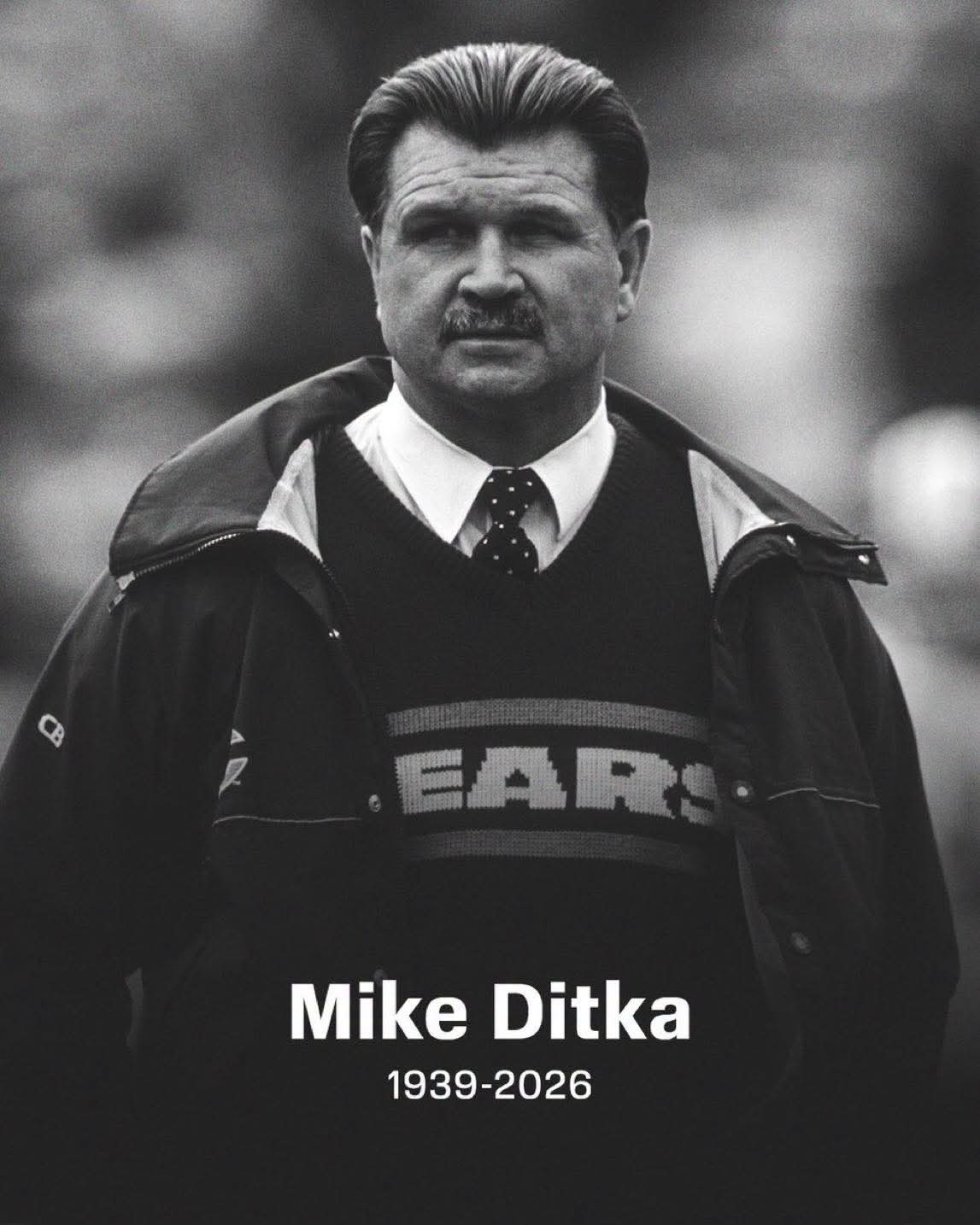
The legendary  Chicago Bears player and head coach died Friday at the age of 86, his family announced. To the football world, he was a Hall of Famer, a Super Bowl champion and one of the most recognizable personalities ever to stand on an NFL sideline. To Chicago, he was something more personal. He was “Da Coach.” He was Iron Mike. He was the unmistakable face of an era when the Bears didn't just play football. They made you believe that football could become an identity, a family tradition and a source of civic pride.
In a statement, his family called him their beloved husband, father, grandfather and friend, the heart of their family, and said, “Mike will be missed beyond measure and remembered forever.”
If you were fortunate enough to watch those Bears teams of the 1980s, you understand why his passing feels like the closing of another chapter in football history. Mike Ditka never did anything halfway.
Before He Was Da Coach, He Was Iron Mike
Long before the cameras, the championship parades and the sideline confrontations, Ditka was a tough kid from western Pennsylvania who made his way into professional football through talent, determination and a style of play that seemed to dare defenders to stop him.
He was born October 18, 1939, in Carnegie, Pennsylvania, and grew up in the working-class community of Aliquippa, where toughness wasn't something you advertised. It was something you demonstrated. He became a unanimous All-American at the University of Pittsburgh before the Bears selected him fifth overall in the 1961 NFL Draft.
He made an immediate impression. As a rookie, Ditka caught 56 passes for 1,076 yards and 12 touchdowns and was named Rookie of the Year. He was the first tight end to top 1,000 receiving yards, in an era when the position was still associated mostly with blocking.
Ditka helped redefine what the position could become. He was big enough to fight through contact, athletic enough to make plays downfield and aggressive enough to turn an ordinary reception into a collision defenders would remember. He wasn't simply a tight end who could catch a football. He was a new kind of weapon.
He played for the Bears, the Philadelphia Eagles, who acquired him in 1967, and the Dallas Cowboys from 1969 to 1972. He was a five-time Pro Bowler, won the 1963 NFL championship with Chicago and scored the final touchdown in Dallas's 24-3 win over Miami in Super Bowl VI. He later won another title with the Cowboys as an assistant coach under Tom Landry, and in 1988 he became the first tight end inducted into the Pro Football Hall of Fame.
That alone would have secured his place in football history. But Mike Ditka wasn't finished.
The Return to Chicago That Changed Everything
In 1982, George Halas brought Ditka back to Chicago as head coach. It was a reunion between a franchise legend and the city that had first embraced him as a player.
The Bears were building something special. Walter Payton was the heart of the offense. Jim McMahon brought swagger and unpredictability at quarterback. The defense was assembling a collection of ferocious talents who would soon become household names. Ditka was the man charged with bringing all those personalities together, and he did it his way.
He demanded effort. He demanded toughness. He demanded that his players believe they could beat anybody who lined up across from them. He could be confrontational, stubborn and explosive. He could also be fiercely loyal and deeply invested in the men wearing his team's uniform. Not everyone agreed with him, and not everyone liked him. But nobody could accuse Mike Ditka of being indifferent.
The Bears reached the NFC Championship Game in 1984. Then came 1985, a season that turned a football team into a legend. Chicago finished the regular season 15-1. The defense overwhelmed opponents. The offense had the power and personality to complement it. And their head coach stood at the center of it all, wearing his trademark intensity like a uniform of its own.
1985: The Year the Bears Became Immortal
Some championship teams are remembered for a great quarterback. Others are remembered for a dynasty, a dramatic comeback or a single unforgettable play. The 1985 Bears are remembered as an entire experience.
There was Walter Payton, one of the greatest running backs ever to play the game. There was McMahon, who seemed perfectly designed to irritate his coach while giving him every reason to keep putting him on the field. There was the monstrous defense, with Mike Singletary, Richard Dent, Dan Hampton and a cast of personalities who made opponents miserable. There was William “The Refrigerator” Perry, whose goal-line appearances became national events. And there was Ditka, presiding over the madness with a combination of authority, anger, humor and absolute conviction.
The team even recorded “The Super Bowl Shuffle,” a rap video that might have looked like the ultimate exercise in football arrogance had the Bears failed to deliver on the field. They delivered.
On January 26, 1986, Chicago beat the New England Patriots 46-10 in Super Bowl XX. The image of Ditka being carried off the field by his players remains one of the great photographs in NFL history. It captured a coach who had reached the summit with a team that reflected his personality: powerful, proud, unapologetic and impossible to ignore.
That championship remains the only Super Bowl title in Bears history. More than four decades later, it still looms over Chicago football. Generations of fans have grown up hearing about that team, watching the highlights and measuring every new Bears contender against the standard Ditka and his players set. The 1985 Bears didn't just win a Super Bowl. They gave Chicago a football memory that never grew old.
Ditka coached the Bears for 11 seasons, from 1982 through 1992, and went 106-62. Chicago made the playoffs seven times in those 11 years and reached the NFC Championship Game three times. He was named NFL Coach of the Year in 1985 and again in 1988.
A Coach Who Never Pretended to Be Somebody Else
Part of Ditka's appeal was that he was never a polished, carefully managed personality built for television. He was loud. He was emotional. He could be funny without trying to be funny and intimidating without raising his voice. When he was angry, you knew it. When he believed in something, he made sure everyone else knew it too.
He clashed with players. He clashed with fellow coaches. He sparred with reporters. His relationship with McMahon could be combustible, and his rivalry with defensive coordinator Buddy Ryan became one of the defining internal dramas of the championship-era Bears.
That was part of the story, too. Ditka was not a saint, and his legacy doesn't require us to pretend he was. His intensity sometimes became a liability. His three seasons coaching the New Orleans Saints, from 1997 to 1999, never came close to replicating the magic of his Bears years.
But the imperfections were part of what made him so recognizable. He didn't talk like a corporate executive. He didn't manage every sentence for public consumption. He brought the same demanding personality to the press conference that he brought to the practice field. Football was serious business to Mike Ditka, but he also understood the entertainment that surrounded it, and his personality made him a natural fit for television, commercials and comedy. He became a cultural figure beyond the boundaries of the NFL.
For years, the name Ditka meant more than a coach. It meant toughness. It meant Chicago. It meant the kind of football that seemed to leave a little grass stain, a little blood and a whole lot of pride behind. And in a sports world increasingly dominated by carefully constructed public images, there was something unmistakable about a man who remained so completely himself.
Da Coach
Mike Ditka leaves behind a Hall of Fame career as a player, a Super Bowl championship as a coach and a place in Chicago that no one else will ever occupy. The Chicago Bears play Sunday at Green Bay, and for a franchise that has built so much of its identity on his shoulders, it will be impossible to hear his name this weekend without remembering what he meant to the team and the city.
Rest in peace, Coach.