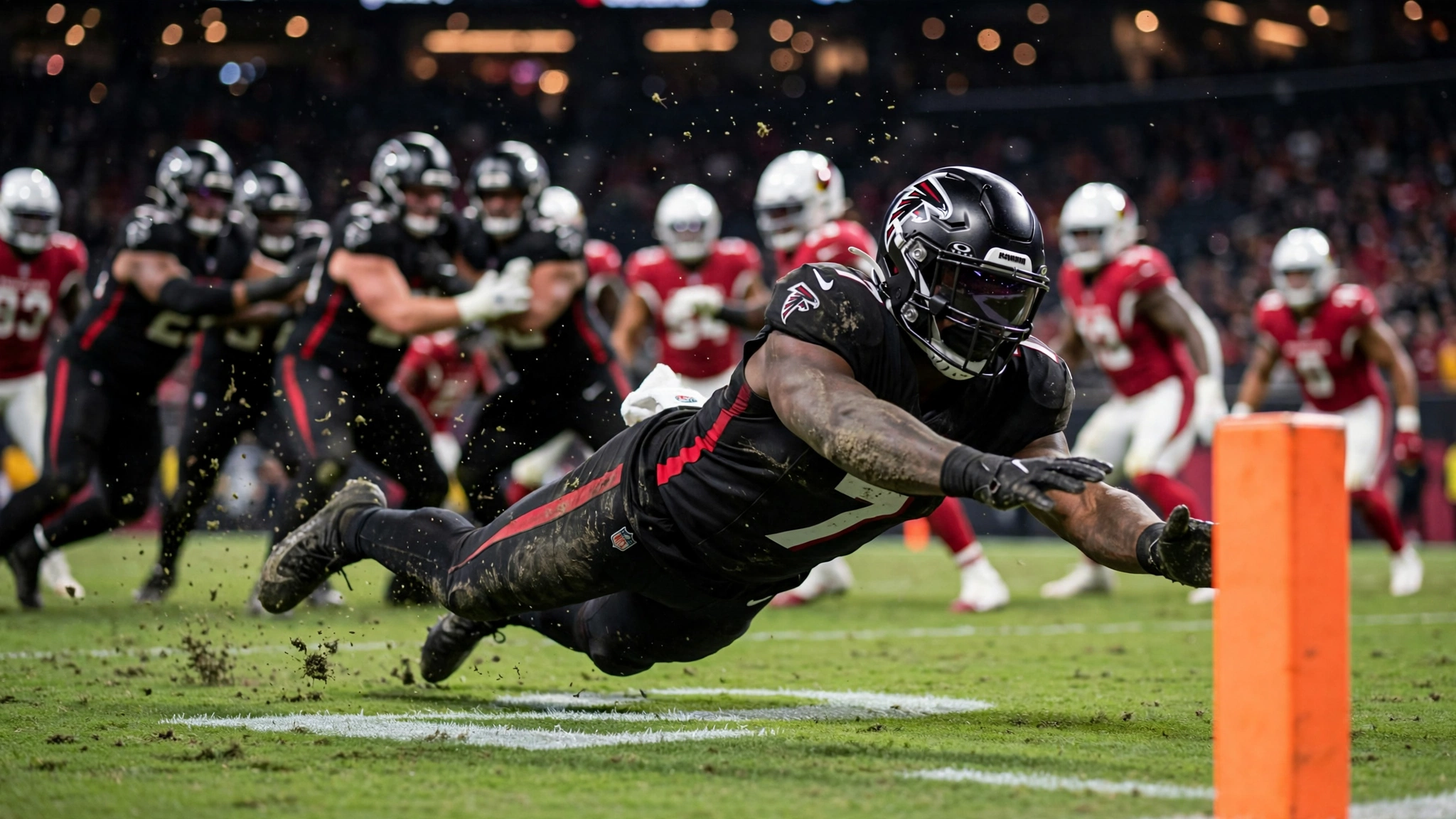
 Touchdowns don't follow talent. They follow a job assignment — and the job is "carry the ball from the two-yard line."
That's why goal-line usage is the most underrated number in fantasy football. A back can gain 1,100 yards and score four times while a teammate you didn't draft takes eleven scores from inside the five. Rushing yards are on every leaderboard on the internet. Goal-line carries are on almost none of them.
But here's the part that matters more than the data itself, and it's where most 2026 draft advice is quietly wrong: almost every back who owned a goal line in 2025 is somewhere else now.
Free agency didn't nudge these depth charts. It detonated them.
Who Owned The Goal Line In 2025
Carries inside the five, with the team each man played for that season:
- Derrick Henry (BAL) — 27
- Josh Jacobs (GB) — 22
- Christian McCaffrey (SF) — 21
- Zach Charbonnet (SEA) — 19
- James Cook (BUF) — 18
- D'Andre Swift (CHI) — 17
- Saquon Barkley (PHI) — 16
- David Montgomery (DET) — 16 — now in Houston
- Kareem Hunt (KC) — 15 — a free agent this offseason
Those bottom two names are a big part of the 2026 draft story, and neither man plays where that number says.
And the most valuable vulture of all doesn't even appear on that list, because his yardage was too poor to rank — which is precisely the point.
Jahmyr Gibbs Just Inherited An Entire Backfield
For three seasons Gibbs shared Detroit with David Montgomery. Sonic and Knuckles. It was the best running back tandem in football and it cost Gibbs touchdowns every single year — Montgomery took 16 carries inside the five in 2025, eighth-most in the NFL.
Montgomery was traded to Houston this offseason.
Detroit replaced him with Isiah Pacheco, and this is the part that matters: nobody expects Pacheco to be used the same way. Dan Campbell has explicitly called Gibbs the bellcow. Gibbs took 67% of the offensive snaps last season, up from 56% the year before, and that number is widely expected to push toward 75%.
Consider what Gibbs already did in a timeshare: 48 touchdowns in his first three seasons, an NFL record, plus back-to-back 1,200-yard rushing years. He posted those numbers while handing sixteen goal-line carries a year to somebody else.
Now he isn't. Gibbs is the clearest buy on the board, and the goal-line data is exactly why — his player card shows a back who was already elite between the twenties. The ceiling just moved.
Bijan Robinson Got The Same Gift
The exact same thing happened in Atlanta, and it's been talked about even less.
Tyler Allgeier signed with the Arizona Cardinals in March — two years, $12.25 million — after four seasons as Bijan Robinson's change-of-pace back.
Look at Allgeier's 2025 line, because it is the single cleanest illustration of what a touchdown vulture actually is:
143 carries. 514 yards. 3.6 yards per carry. And a career-high 8 rushing touchdowns.
That is not a good rushing season. It is barely a functional one on a per-carry basis. But eight touchdowns is a genuine fantasy asset, and every one of them came out of Bijan Robinson's pocket. Across four years in Atlanta, Allgeier scored 20 touchdowns in 67 games — almost all of it in the role Robinson was drafted fourth overall to own.
Now he's in Arizona. The 220-pound downhill runner who finished Atlanta's drives is gone, and there's no obvious replacement for that specific job.
Robinson has been an All-Pro talent handing away short-yardage work since 2023. Same profile as Gibbs, same correction, and in most drafts it isn't fully priced in yet.
One note if you're eyeing Allgeier himself: Arizona's backfield is crowded. James Conner is back on a restructured deal after a foot injury ended his 2025 in Week 3, Trey Benson is returning from a knee injury, and Bam Knight re-signed. The scheme fit is real — new coach Mike LaFleur runs outside zone and Allgeier has been top-ten in success rate on outside runs — but the touches are not guaranteed. Check the Arizona depth chart before you commit.
Kenneth Walker Walked Into Kareem Hunt's Job
Kansas City had a specific, unusual strength in 2025: they were poor running the ball on early downs — 25th in rush yards per game — and excellent in short yardage, because Hunt was nearly automatic at it. Fifteen carries inside the five, eight touchdowns.
Then the Chiefs signed Kenneth Walker III, the Super Bowl LX MVP, to a three-year, $43.05 million deal.
Walker arrives in an offense that has already shown it will feed a back at the goal line, attached to a quarterback — Patrick Mahomes, on course to return from his ACL tear for the Week 1 Monday nighter — who gets that offense inside the twenty as often as anyone.
One caution worth pricing: Walker has never been a true bell cow. He split with Charbonnet for three straight years in Seattle and his career high in carries came as a rookie. Kansas City paid for a workhorse; whether they deploy one is the open question.
The Charbonnet Trap
This is the one that will cost people money, because on paper it looks like the easiest call in the draft.
Zach Charbonnet had 19 carries and 9 touchdowns inside the five in 2025 — he became the first Seahawk since 2014 to post double-digit rushing touchdowns. Then Walker left for Kansas City. The path to a featured role looked wide open.
Two things closed it:
He tore his ACL in the divisional round and is expected to miss a significant chunk of the season.
Seattle drafted Jadarian Price in the first round, and with Charbonnet rehabbing, Price gets the runway.
So the back who looked like he'd inherit a Super Bowl-winning offense is hurt, in a contract year, with a first-round rookie taking his reps. That's not a value pick — that's a dart. Check the depth chart and the injury report before you spend anything real on him.
Montgomery Got What He Wanted
Montgomery was traded to Houston specifically because he wanted a bigger role, and the numbers say the Lions were already moving on — after Week 10 he played more than 40% of snaps in exactly one game.
Now he's the featured back somewhere that wants him featured, carrying a proven goal-line role with him. That's a genuinely interesting value in the middle rounds, and his goal-line history is the reason.
The Vulture Everyone Forgets Is The Quarterback
One more thing that quietly ruins running back seasons and almost nobody accounts for.
Jalen Hurts had 6 rushing touchdowns from inside the five and 8 from inside the ten. Trevor Lawrence had 8 from inside the ten.
Those are carries a running back never sees. On a team with a designed sneak package, a back can lead the league in carries between the twenties and finish with five scores, because the last two yards aren't his job.
So when you value Saquon Barkley's 16 inside-5 carries, hold it next to Hurts taking 6 touchdowns from the same patch of grass. Both are true.
How To Use This Before Your Draft
Discount big touchdowns on small goal-line usage. A back who scored twelve on limited inside-5 work got lucky, and you'll pay retail for that luck in August. Touchdowns regress; roles don't.
Upgrade the role without the scores yet. Usage is the leading indicator. The touchdowns follow it, not the other way round.
Name the vulture before you draft the starter. If you're taking a back, you should be able to say who's taking his goal-line carries without looking it up — and confirm that man is still on the roster.
Check the team, then the number. That's the whole lesson of this offseason. Every stat you read this month describes a situation that may no longer exist.
And look at yards per carry next to touchdowns. Allgeier at 3.6 a carry with eight scores is the signature of a pure goal-line specialist. When a back like that leaves, the starter ahead of him gets a raise nobody put in the rankings.
The rest of the kit: the 2026 Draft Guide runs 335 deep with tiers drawn where the market breaks, the Big Board prices off the live market, the mock simulator gives unlimited reps from your exact slot, and the printable board comes in 10, 12 and 14-team versions.
And the December Board grades every ranked player on Weeks 15 through 17 — the only weeks that decide a title. Those schedules have been public since spring: Week 15, Week 16 and Week 17 each have their own page, so you can see today exactly where your target spends the fantasy playoffs.
Worth combining with everything above: a goal-line back on a good offense with a soft December is about as clean a late-round target as exists, and almost nobody is doing both checks.
Then Use It All Season
Goal-line usage isn't only a draft tool. It's the best anytime-touchdown prop resource there is:
- Who owns the goal line — the board, with 2024 and 2023 to check whether it's a role or a season
- How often his offense gets there — the Red Zone Report, which splits trips per game from touchdowns per trip. A back on an offense that never reaches the 20 is a stat with nowhere to happen.
- How the opponent handles backs — defense vs RB, with receptions split out from rushing
- Has this actually been cashing? — the Hit-Rate Traffic Board shows his real hit rate over the last 5, 10 and 20 games in color, graded off the nightly ledger rather than a projection
- Is the number fair? — the Line Checker counts how often he's cleared any figure you type, and the +EV finder flags books paying past the market's fair price
- Size it — the Kelly calculator, because a real edge staked badly still goes broke
- Grade the ticket — the Parlay Doctor, A through F, with correlated legs flagged
Week to week, the Mismatch Machine crosses every game against 51 team stat ranks. Start or Sit settles the close calls, or import your team and let the Roster Doctor grade everyone you own.
The Honest Caveat
2025 usage is not 2026 usage — that's the entire point of this article. A back who owned short yardage last year can lose it in camp to a fifth-rounder nobody's heard of, or get traded in March.
Which is why the board runs three seasons back. A back who's owned short yardage for three years has a role. A back who owned it for one had a season. Then check the current depth charts and camp news before you act on any of it.
See the full goal line board → Free, no signup, built from official play-by-play.