Here is how nearly every survivor pool entry in America dies, and it almost never happens the way people think.
Week 1, you take the biggest favorite on the board. Obvious, right? Why would you take anything else. Week 2, you take the next biggest. Week 3, same thing. It feels responsible — you're taking the safest available pick every single week, which sounds like exactly what you should be doing.
Then Week 7 arrives. Every good team in football is already crossed off your list. The slate in front of you is a mess of coin flips and road dogs, your best remaining option is a 6-point favorite you don't believe in, and you go out on a Sunday you never saw coming.
You did not lose in Week 7. You lost in Week 1, by spending a resource you were always going to need in October.
That's the thing that makes survivor different from every other pool you play, and it's the thing that trips up smart people constantly: every team can only be used once. It is not a series of eighteen weekly questions. It is one allocation problem wearing eighteen weekly disguises.
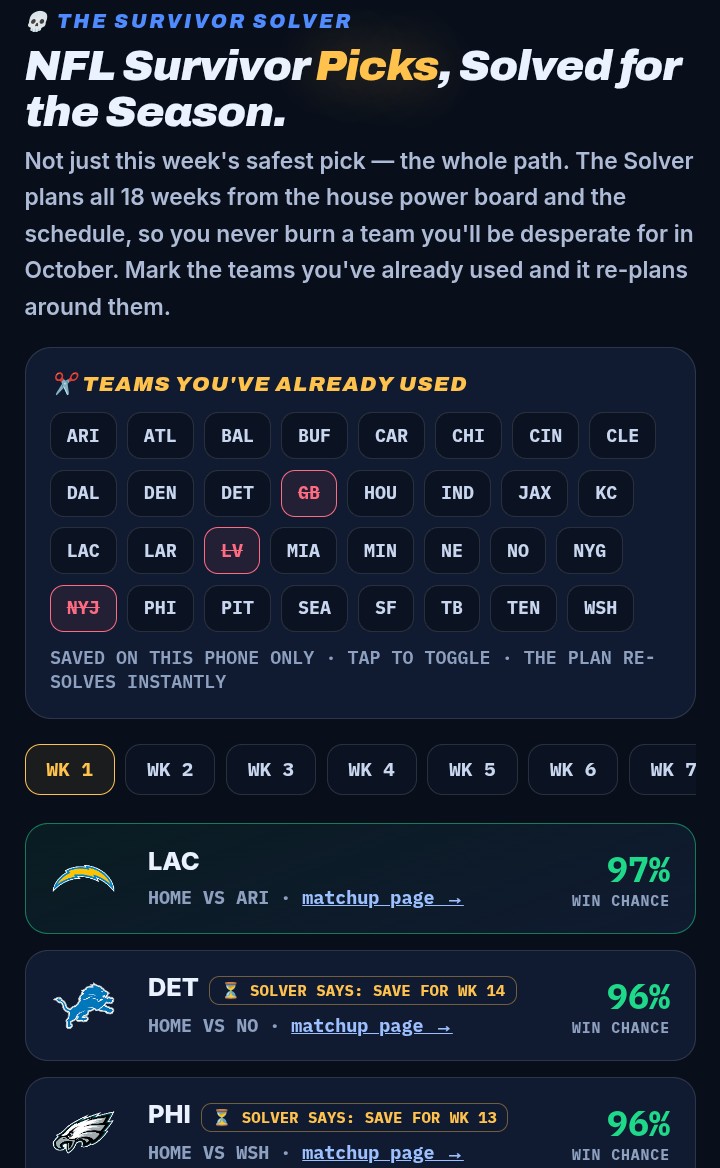
So we built the Survivor Solver, and it does something almost no survivor tool does — it does not just hand you the safest Week 1 pick. It plans the entire season.
How The Solver Actually Thinks
It reads the house power board and the complete 2026 schedule, estimates a win chance for every team in every week — power gap plus home field — and then assigns teams to weeks so that the season's total survival odds come out highest.
That last clause is the whole ballgame. It is not maximizing this Sunday. It is maximizing your probability of still being alive in December — and those two goals disagree far more often than people expect.
Which is why the Solver will regularly tell you to take a good-enough favorite now and save the juggernaut for the week it's your only strong option.
The math nobody does in their head
Say you have a 92% team available in Week 1 and an 88% team you could take instead. Everyone takes the 92%. It's four free percentage points, right there, no thought required.
But suppose that 92% team is your only decent option in Week 11, and the 88% team has three other good weeks scattered across the season. Taking the 88% now and holding the 92% for Week 11 is straightforwardly the better play, because the four points you give up today buy you a much bigger number later.
Human beings are terrible at this, and not because we're stupid. It's because the Week 11 cost is invisible and the Week 1 gain is sitting right in front of you. You can see the four points. You cannot see the disaster you've scheduled for yourself in ten weeks. The Solver can see both because it's looking at all eighteen at once.
What comes out is the full 18-week path: each team used exactly once, each week's pick chosen so the strong teams land where they're genuinely needed rather than where they happen to be convenient.
The Feature That Makes It Survive Contact With Reality
Most survivor advice is useless by the third week of the season, because it assumes you're starting from a clean slate and you never are.
This one lets you mark the teams you've already burned, and it re-solves the entire remaining season around them on the spot. Your used teams save on your phone — nothing stored on our end, no account, no signup, no email.
That means the plan stays honest to your actual entry rather than some theoretical one. And if you're in three different pools with three different Week 1 picks, you can track them separately and get three different paths.
One transparency note the page states plainly, and it matters right now: before Week 3 of 2026 the power ranks lean on final 2025 form, clearly stamped as such. After that they follow the live board.
We do not build anything off preseason. A starter playing twelve snaps against backups tells you nothing, and a survivor plan built on August football is a plan built on noise. Last season's completed, verified numbers are a far better estimate of who wins a Week 1 game.
Why Week 1 Is The Most Overrated Pick Of The Year
Everyone agonizes over the opener for two weeks and then plays the rest of the season on autopilot. That is precisely backwards.
Week 1 is the week with the most good options. Every team is healthy. Every team is available to you. The slate is stuffed with big favorites and nobody has a bye. It is the single easiest week of the year to survive.
The hard weeks are at the other end. By November, byes are done but injuries have stacked up, good teams start managing workloads, division games flatten everything out, and half your board is already spent. That's where entries die — and that's where you need the ammunition you cheerfully burned in September.
The scarcity is at the end, so the discipline has to start at the beginning.
If you want the underlying principles rather than the solved path, our survivor strategy guide covers them. But the Solver is where you see them applied to your specific board, with your specific used teams already crossed off.
The Homework Behind Any Given Leg
The Solver gives you the path. These tell you whether a given week's pick is as safe as the number claims:
Schedule Spots. Rest edges, short weeks, letdowns after an emotional win, lookahead traps before a marquee game. Every game judged against 25 years of history with the sample size printed on every split — and a plain "no edge here" when there genuinely isn't one, rather than a manufactured angle to keep you clicking. Survivor entries die on letdown spots far more often than they die on bad teams.
The Weather Book. 6,511 games joined to the hourly weather at the stadium they were played in. A road favorite in a wind advisory is exactly how a "safe" pick becomes a 16-13 coin flip. A split only publishes if it holds across ten-plus games and sits twenty points off that team's own win rate — which kills the most common fake weather stat, a bad team losing in the cold.
ATS trends. With the rank number sitting right next to the team, so you're not doing arithmetic across 32 tabs. Filter by favorite specifically: covering a big number is a completely different skill from winning a football game, and some teams are excellent underdogs and genuinely dreadful favorites. Survivor only cares about the win — but a team that consistently fails to cover as a big favorite is telling you something about how it plays with a lead.
The head-to-head book. Every regular-season meeting since 2002, series record, home and road splits. Divisional games are where favorites go to die, and rivalry history is the cheapest sanity check available. Every pair is its own link — Cowboys-Giants, Broncos-Chiefs, whoever you're weighing.
The injury report and depth charts. A quarterback ruled out on Friday afternoon turns a 90% pick into a 60% one, and your pool deadline does not care about your feelings.
Turnover stats. This is the sneaky one. Turnover differential is the most unstable "skill" in football — Chicago led 2025 at +22 with 33 takeaways, and that kind of number regresses hard. A team whose record is built on takeaway luck is a worse survivor pick than its win-loss suggests.
Power rankings — the board the Solver actually reads — and the Mismatch Machine for the collisions inside a game, crossed against 51 stat ranks.
Run The Pool Yourself
Playing in someone else's pool is fine. Running your own is better, and it costs nothing.
Survivor pools live here — commissioner tools, auto-graded picks, and buy-ins in sardines. The admin handles itself, which matters more than it sounds: the reason most office pools quietly collapse by Week 5 is that one person got tired of chasing everybody for picks and tallying results by hand.
And if your league has run survivor into the ground after three seasons of everyone dying in Week 4, there are other formats: the Gauntlet is the version with more teeth, weekly pick'em is the one everybody in the office can play without thinking, and squares is the best pool format ever invented and we are not taking questions on that. All of them sit in the pools hub.
The Honest Part
A solved path is a plan, not a prophecy. Win probabilities are estimates. Injuries wreck them. Games get flexed and the schedule itself moves underneath the model. The Solver re-plans as the season goes — that's the entire point of the re-solve — but nobody on earth can hand you eighteen weeks of certainty and anyone claiming otherwise is selling something.
What a solved path can do is stop you making the single most common, most expensive mistake in the format: spending your best asset on the week you needed it least, and finding out in October.
Open the Survivor Solver → Free, no signup, and your used teams stay on your phone.