



Every morning one player gets pulled out of the ledger. Usually the hottest bat, sometimes the coldest, occasionally the one who cost us a card the night before.
Nine prop lines on Juan Soto have been graded in our ledger across the last three days. All nine went over. That is not a prediction and it is not a recommendation — it is a receipt, and it is the reason the market has stopped giving him a friendly number.
No scouting report, no gut feel. If the streak board says a man is 0-for-3, a box score said so at two in the morning. Every line he was offered sits on the props board, and every outcome is in the graded ledger. Nothing gets quietly deleted the morning after it misses.
🔍 The Middle Finder
Two books. Two numbers. One of them is wrong.
How a middle works, and why we only find a few a month.
Need a play on a game that starts before our card drops? Our Live board carries real-time odds, props and line movement on every game, all day.
A middle is the least understood thing in this business. One sportsbook posts a pitcher at five and a half strikeouts. Another posts him at seven and a half. Both cannot be right, and some afternoons neither is.
Take the over at the low number and the under at the high one. If he lands in between, both tickets pay. You are not betting on the pitcher. You are betting that two sportsbooks disagreed by more than the game could resolve.
It isn't a hunch and it isn't a system. It's arithmetic that shows up for about fifty minutes and vanishes the moment the books see each other's numbers. Our middle finder scans nine books looking for exactly that shape.
When it finds one, we take it, we write it down before first pitch, and we print the result here the next morning. When it finds nothing, it says so — which is most days, and that's the part you should trust.
58 tools under one roof, covering baseball, football, basketball and hockey. No part of it is a highlight reel.
Build a parlay by hand, or let the randomizer build one and tell you what it's really worth. Shuffle a DraftKings lineup until the salary cap stops arguing with you. Find the two sportsbooks that disagree about the same pitcher and take both sides. Follow a hit streak, a home run streak, a cold streak four games deep. See which bullpen threw four innings last night and can't answer the phone tonight. See who's running hot inside tonight's games before you check the odds.
We even have a doctor on staff. Hand him your roster and he'll tell you what's wrong with it, who to bench, who to grab off the wire, and which of your sleepers is about to wake up.
And every single day, we use almost all of it ourselves. We make the calls in public, before first pitch. The next morning we come back and show you how they turned out — the ones we got right, and the ones we got badly wrong.
Every tool sits in the header and the burger menu, top right. Nothing is hidden behind a wall you can't see over. Nobody subscribes to a tool they were never allowed to touch.
👋 VisitorA daily allowance on every tool. No card, no email.
🎟️ Free SeatRegister free. A bigger allowance, every day.
⭐ Velvet · $9.99Unlimited. Every tool. Draft guide free.
Every morning we freeze four calls, one to a game, each sitting where the sportsbooks disagree with each other by the widest margin. Then we shut up until the games are over.
Needing four things to go right is a tax, and we pay it in public so you can watch what it costs. Most four-call cards lose. Anybody showing you only their winners is showing you a highlight reel.
The number underneath is the one that matters: whether we beat the closing line. If we take a man at −110 and he closes at −135, we were right about the price whether or not he got his hit. Over a season, being right about the price is the only thing that survives.
Hits, homers, RBI, steals, doubles, triples — every name graded against a final box score at two in the morning. Nobody's opinion touches it. Pittsburgh's six-game slide up top is the same story the bullpen tells two sections down.
Every morning our start/sit tool takes the two most expensive arms and the two most expensive bats on the DraftKings board and sets them against each other. It starts one of each and sits the other, in public, before a pitch is thrown.
It does not simply take the expensive guy. DraftKings' own projection gets nudged by recent form out of our ledger, so a cheaper arm on a good run will beat a pricier one who has been getting hit.
Pitchers grade on strikeouts. Batters grade on total bases. Both numbers already live in the ledger, so nobody decides anything the next morning — the box score decides it. The running record sits at the top of this page whether it flatters us or not.
✦
🏆 The Lineup · DraftKings
Fifty thousand dollars, and not a dollar left over.
A cheap lineup is not a good lineup. Finish the night with money unspent and you left points on the board, and points are the only currency the contest recognises.
So the shuffler does not hunt bargains. It maximises projected points subject to the cap, which is a different problem and a harder one. Sometimes that means paying twelve thousand seven hundred for an arm. Sometimes it means filling three outfield slots at two thousand apiece so the arm is affordable.
It refuses to print an illegal roster. Ten men, every position filled, fifty thousand dollars or less. If the slate cannot support a legal build it says so and prints nothing — which is more than most optimizers will do for you.
Red is gassed. Green is rested and dangerous. Full board →
The bullpen tool predicts nothing. It counts relief innings from last night and tells you which pen is empty. A gassed bullpen means the starter gets a longer leash, and a longer leash means strikeouts.
That read moves markets inside an hour. A strikeout line opens at 6.5 and closes thirty cents shorter across nine books, and the gap between those two facts is where every middle on this site lives.
💰 Price gaps
The same bat at −120 on one book and +134 on another is not an opinion, it is an error. The arbitrage finder hunts them.
📈 Steam
When a line moves thirty cents across nine books inside an hour, somebody knows something. The movement board times it.
🌡️ Temperature Board
Who's running hot inside tonight's games — the statistical leaders heating up across every matchup on the board.
Gold cells: books disagree by 12¢ or more. Full grid →
Nothing on today's card is a hunch. Each call sits where the books disagree with each other. A man at −120 on one book and −152 on another is a 32-cent spread, and that spread is the whole thesis.
One call per game, always. Two calls from the same ballpark aren't independent, and the payout math stops meaning anything the moment you pretend they are. Most parlay builders will happily let you do it and never mention this.
The card locks at nine in the morning. It cannot be edited, and tomorrow it gets graded in public.
A four-leg parlay needs four things to go right. Multiply four coin flips that each land 55% of the time and you are asking for something that happens about nine times in a hundred.
We take one anyway, every day, at a flat hundred sardines, because the point is not the payout. The point is that the ledger records it before the games and grades it after, and by October there is a number nobody can argue with.
Each leg sits where the sportsbooks disagree with each other by the widest margin. One leg per game — two legs from the same ballpark are not independent, and the payout math quietly lies to you the moment you pretend they are.
Sportsbooks do not move a number because they changed their minds. They move it because somebody they respect took a side, and the shop needs the other one.
That's steam. It's the closest thing in this business to reading somebody else's mail, and it's why we grade ourselves on whether we beat the closing line, not on whether the ball landed. If we take a man at −110 and he closes at −140, we were right about the price. The hit is a bonus.
The radar watches every market we cover and clocks the ones that ran. A number that walks is noise. A number that sprints, across nine books at once, inside forty minutes — that one is worth a look at the board.
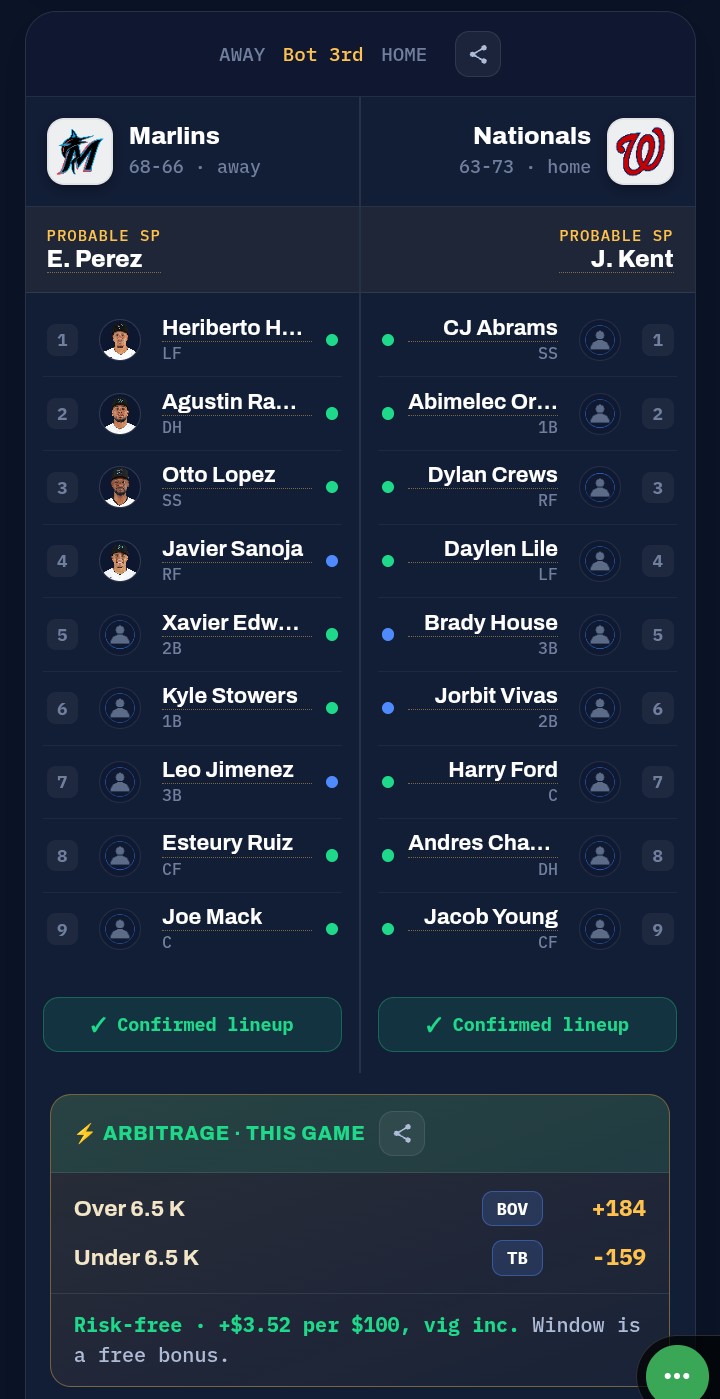
No arbitrage on the board right now — most hours there isn’t any, and a book that’s wrong rarely stays wrong for long. The board watches 9+ books and lights up the second one of them slips.
An arbitrage is not a good bet. It is not a bet at all. It is two sportsbooks quoting the same event at prices that cannot both be true, and a person standing between them taking both sides.
They exist because a shop mispriced a number, or because a lineup card dropped and one book was slow. They close in minutes. Ours are found by comparing every book against the median sane price and flagging what falls outside it.
We publish them because you can act on them, and because a site that only shows you winners never has to explain anything. Most days the box is empty. That is the honest state of the market, and we print it rather than manufacture something.
Some players score twelve every night. Some score two or thirty and nothing between. In a cash game the first man wins you money. In a tournament he loses it slowly.
🚑 Injury Wiretoday
LADMookie BettsDay-to-day
ATLRonald Acuña Jr.IL-10
NYMFrancisco LindorProbable
——status
——status
Scratches move lines faster than anything. The wire →
The split matters more than the average, and the average is the only number most sites show you. Boom or Bust measures the distance between a man's ceiling and his floor, then asks whether DraftKings is charging for the ceiling or the floor.