"He's got a good matchup this week" is the most repeated sentence in fantasy football, and nine times out of ten the person saying it glanced at total yards allowed.
Total yards allowed is nearly useless for setting a lineup. You never start a defense — you start a quarterback, a running back, a receiver or a tight end. Those are four completely different questions, and a defense can be elite at three of them and a disaster at the fourth.
So we cut the whole thing apart. Three full seasons — 2025, 2024 and 2023 — built straight from official play-by-play, every team ranked 1 through 32, per game, with the stingiest defense at the top.
This is the part nobody else formats cleanly: yards allowed to each individual position.
The Four Position Sheets
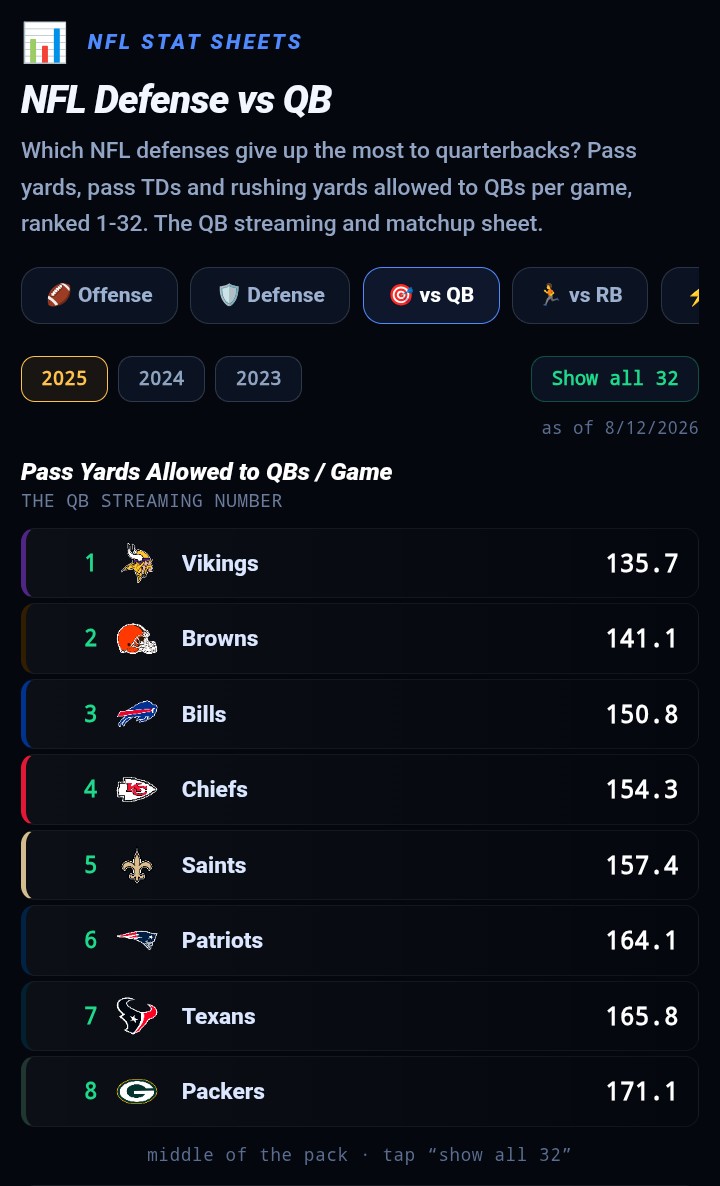
Defense vs QB — passing yards, passing touchdowns, and rushing yards allowed to quarterbacks. That last column is the one people miss. Mobile quarterbacks are a fantasy cheat code precisely because some defenses have no answer for the scramble, and it's a separate skill from stopping the pass.
Defense vs RB — split into rushing yards, receiving yards and receptions allowed to backs. This split is where lineups get won. Plenty of defenses stone the run and then hand out seven catches a game out of the backfield. In PPR that's the difference between a fade and a start, and total run defense tells you nothing about it.
Defense vs WR — receiving yards, receptions and touchdowns allowed to wideouts, plus rushing yards allowed to receivers for the jet-sweep offenses. The page that settles most flex calls and the first stop on any DFS slate.
Defense vs TE — yards, receptions and touchdowns allowed to tight ends. The most exploitable position in football, because a handful of defenses simply cannot cover the middle of the field and it shows up week after week after week.
The Team Sheets Underneath
The defense page carries passing and rushing yards allowed plus sacks — but also the numbers that quietly decide games: third-down conversion allowed, red-zone attempts and red-zone touchdowns allowed, and turnovers forced.
Red-zone defense is the underrated one. A unit can bend all day between the twenties and still be a nightmare for your tight end, because they stiffen inside the 20 and turn drives into field goals. Yards allowed hides that completely.
The offense page has yards, third down, red zone, sacks allowed, turnover differential — and pass rate, which might be the single most useful number on the site for fantasy.
Pass rate tells you whether an offense throws when it's ahead. It's the entire difference between a receiver who vanishes in a 24-point win and one who keeps eating regardless of score. Two receivers with identical talent on teams with opposite pass-rate profiles are simply not the same asset.
The combined sheet puts every team's offense and defense side by side, with green for league best and red for worst, so you can read a full matchup in about ten seconds.
And it goes back three years, which matters more than it sounds — it lets you tell a real defensive identity from one weird season.
The Player Leaderboards
The leaders page is players only, and deliberately not built around the counting stats you can get anywhere.
Red-zone targets. The closest thing to a leading indicator that exists in fantasy football. A receiver quietly piling up red-zone looks is a touchdown regression candidate before the touchdowns arrive in his box score. That's the buy-low window.
Red-zone touchdown leaders and red-zone rushing touchdowns — separated, because the goal-line back and the red-zone receiver are two different assets and lumping them together hides both.
Explosive plays — chunk catches and chunk runs. Consistency wins you weeks; explosive plays win you playoff matchups. A player who produces chunk gains has a ceiling, and ceilings are what you need in a single-elimination fantasy semifinal.
WR yards per catch and RB yards per rush, with a minimum-volume filter so a guy with six carries doesn't top the list. That filter is the whole reason the page is trustworthy — efficiency leaderboards without one are just noise dressed up as insight.
The full return game — kick and punt return yards per attempt, return touchdowns, and the longest returns. Forgotten by almost everyone, and worth real points in return-scoring leagues.
The Sunday Sequence
- Who's actually playing. Injury report and depth charts first. A perfect matchup for an inactive is worth nothing.
- Pull the position sheet for the exact call you're making. Flex? Go to the WR page.
- Check the range. Boom or Bust for ceiling and floor, Consistency for who you can trust.
- Layer the conditions. Turf or grass, the Weather Book, and Schedule Spots for rest edges and traps.
- Settle it. Start or Sit, or import your team and let the Roster Doctor grade every man you own.
The Honest Part
Matchup data describes what a defense has done. Corners come back from injury, coordinators change, personnel turns over. Three years of history helps you separate identity from noise — but early in a season the current sample is tiny, and a two-game ranking is two games no matter how convincing it looks on screen.
It's a tiebreaker and a fade signal. It is not a reason to bench a genuine stud because a number says 8th.
Pick the position that's giving you trouble: QB · RB · WR · TE · Player leaders · Full team sheets
All free, no signup, and it all sits in the NFL Fantasy & DFS Hub.