That's not a take. It's a record.
Green Bay is a cold-weather team. Everyone knows this. It's most of their brand — the frozen tundra, the shirtless guys in the stands, the whole mythology. And at Lambeau it holds up fine.
On the road, at night, under forty degrees, they have not won in ten tries.
That's the kind of thing that should be common knowledge and somehow isn't, and it's the reason we built the Weather Book.
What We Actually Did
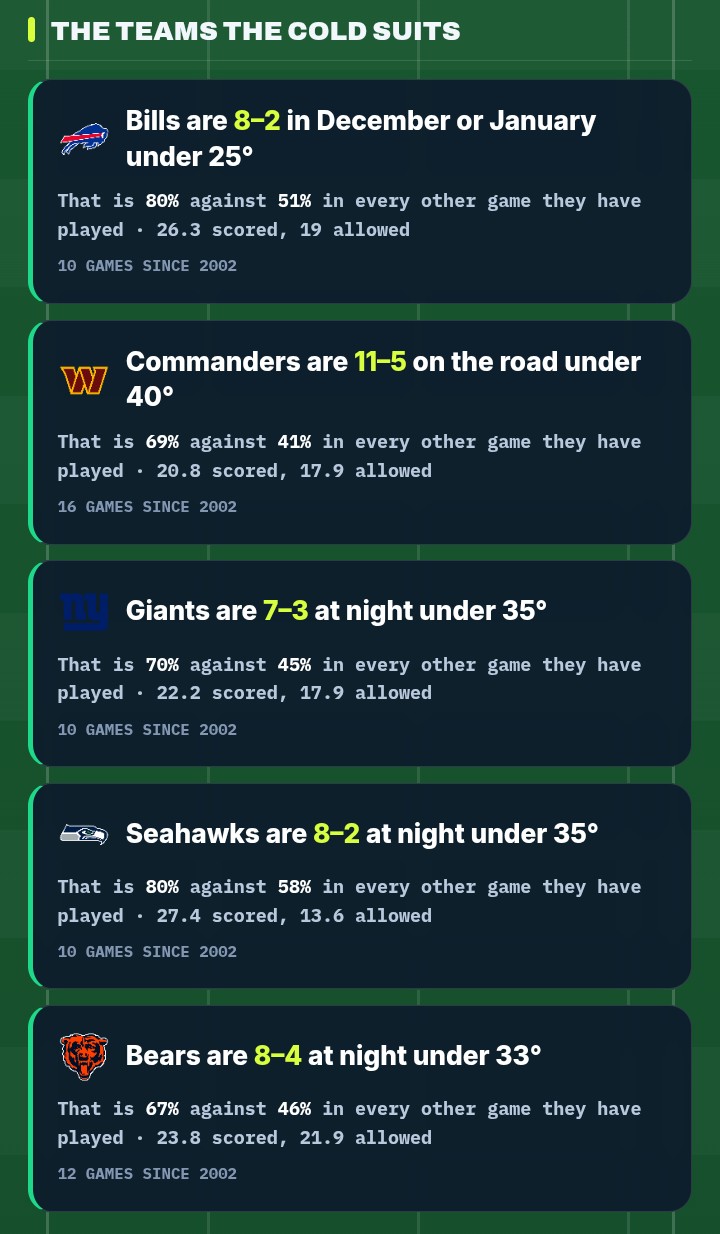
We took every NFL result since 2002 — 6,511 games — and joined each one to the hourly weather at the stadium it was played in, matched to the actual kickoff time. Not the daily average. Not the forecast. What the conditions actually were when the ball was in the air.
Then we asked the book a few thousand questions. How does this team do below freezing? In wind? At altitude? At night? In December specifically? On the road versus at home?
Most of the answers came back boring, which is exactly what you'd expect and exactly why the interesting ones matter.
The Rule That Makes It Trustworthy
This is the part worth understanding, because it's what separates a real finding from the noise most weather content is made of.
A split only appears in the book if it clears two bars. It has to hold across at least ten games, and it has to sit twenty points or more away from that team's own overall win rate.
That second condition is the important one. Measuring a team against its own baseline kills the most common form of fake weather analysis: a bad team losing in the cold. If a team wins thirty percent of the time in every condition, then losing in the cold isn't a weather finding — it's just a bad team. It only becomes a finding when the cold makes them meaningfully worse than they already are.
And the sample size is printed on every single line. Ten games is ten games. It's a signal, not a certainty, and we'd rather show you the number than hide behind it. Most sites bury the sample size precisely because most of their trends fall apart the moment you can see it.
What Actually Moves A Game
Wind is the one people underrate. Cold gets the attention because it's the thing you feel through the TV, but wind is what breaks a game plan. A twenty mile-per-hour crosswind takes the deep ball out of the offense, turns field goals into adventures, and pushes a total down further than a cold snap ever will. If you only check one weather number, check that one.
Cold is real but uneven. Some offenses barely notice twenty-five degrees. Others fall apart. The difference usually comes down to how much of the offense lives downfield versus in the run game — and that's a team-by-team question, not a league-wide rule. The book has it team by team.
Heat is the forgotten one. Everyone plans for December and nobody plans for a one o'clock kickoff in September in Florida against a team that flew in from Minnesota. That's a real edge and it's sitting in the early-season slate every year.
Night games are their own animal. Which is exactly why the Packers stat above is specifically road, night and cold — stack the conditions and the splits get sharper.
Who This Is For
If you bet totals, this is the most direct application. Wind and cold both suppress scoring, and the market doesn't always price a specific building's history the way it prices a forecast. Take it into the NFL betting room, where lines and props are priced across nine books, and grade whatever you build with the Parlay Doctor before you fire. If you'd rather have it built for you, the AI parlay generator runs a live odds engine across all four leagues.
If you play fantasy, it's a start-sit input in December and a draft input in August — which is exactly what the December Board is built on. Every ranked player gets graded on the buildings he actually visits in Weeks 15 through 17, using this same weather history. Pair that with the 2026 Draft Guide, the Big Board, and Draft Central for the rest of the kit — and Start or Sit once the weather is actually falling on a Sunday.
If you run a pool, weather is one of the cleanest ways to fade a favorite everyone else is taking — a road favorite in a wind advisory is exactly how survivor entries die. Run or join a survivor pool, a weekly pick'em, a gauntlet, or a squares grid.
And if you want the player-level version of all this, every NFL card now carries a zone breakdown showing where a guy actually produces — Josh Allen is a good one to start with, since his deep-ball numbers are exactly the kind of thing wind punishes. Same for Ja'Marr Chase and Jahmyr Gibbs.
The Sources, Since You Should Ask
Weather comes from the Open-Meteo historical archive, matched to stadium coordinates and kickoff time. Results come from our own vault of 6,511 regular season and playoff games, 2002 to today.
We publish the sources because a weather claim with no sample size and no origin is just a guy on the internet saying something confidently. There's plenty of that already.
Open the Weather Book here — every team, every condition, and the sample size next to all of it.
Where To Go Next
- Schedule Spots — rest edges, short weeks, traps and letdowns from the same 25 years
- The December Board — weather and scoring history applied to the fantasy playoff weeks
- Power Rankings — where teams actually stand right now
- The injury report — because health beats weather every time
- Live scores — track it all while it happens
- The graded ledger — every call we make, stamped the next morning, win or lose
The whole football arsenal sits in the NFL fantasy and DFS hub, and the betting side lives in NFL Betting Tools. Two rooms, so you always know which door you want.