 The 2026 season does not begin on a Thursday.
It begins Wednesday, September 9, with the Patriots at the Seahawks at Lumen Field — a Super Bowl LX rematch, seven months after Seattle beat New England for the franchise's second Lombardi. It's the first Wednesday opener the league has run since 2012.
And here's the part that should make the hair stand up: the last Wednesday kickoff, September 5, 2012, was Cowboys at Giants — Dallas 24, New York 17, Tony Romo throwing three touchdowns, two of them to Kevin Ogletree of all people, in front of the largest crowd MetLife had ever held for a Giants game. It was the first time in nine tries that a defending champion lost the midweek kickoff.
Fourteen years later, Cowboys at Giants is the Sunday night game of Week 1. Dak Prescott against Jaxson Dart. The schedule has a sense of humor.
Before that 2012 game, the NFL hadn't played on a Wednesday since September 22, 1948, when the Rams beat the Lions 44-7. That's the entire modern history of Wednesday football: 1948, 2012, and now.
The Whole Opening Week Is Strange
Wednesday is Seattle. Then Thursday is 49ers vs Rams in Melbourne, Australia, on Netflix. Sunday afternoon runs normally, Sunday night is Cowboys-Giants, and Monday night is Broncos at Chiefs with the possible return of Patrick Mahomes.
Four different broadcast realities, two continents, and a midweek start. That's how Week 1 lineups get wrecked — everybody sets them on August information, then the calendar does something August never accounted for.
Here's what's actually knowable before any of it kicks off.
Start With The Series, Not The Storyline
Every talking head this week will tell you what these matchups "mean." Almost none of them will tell you what's actually happened when these teams play.
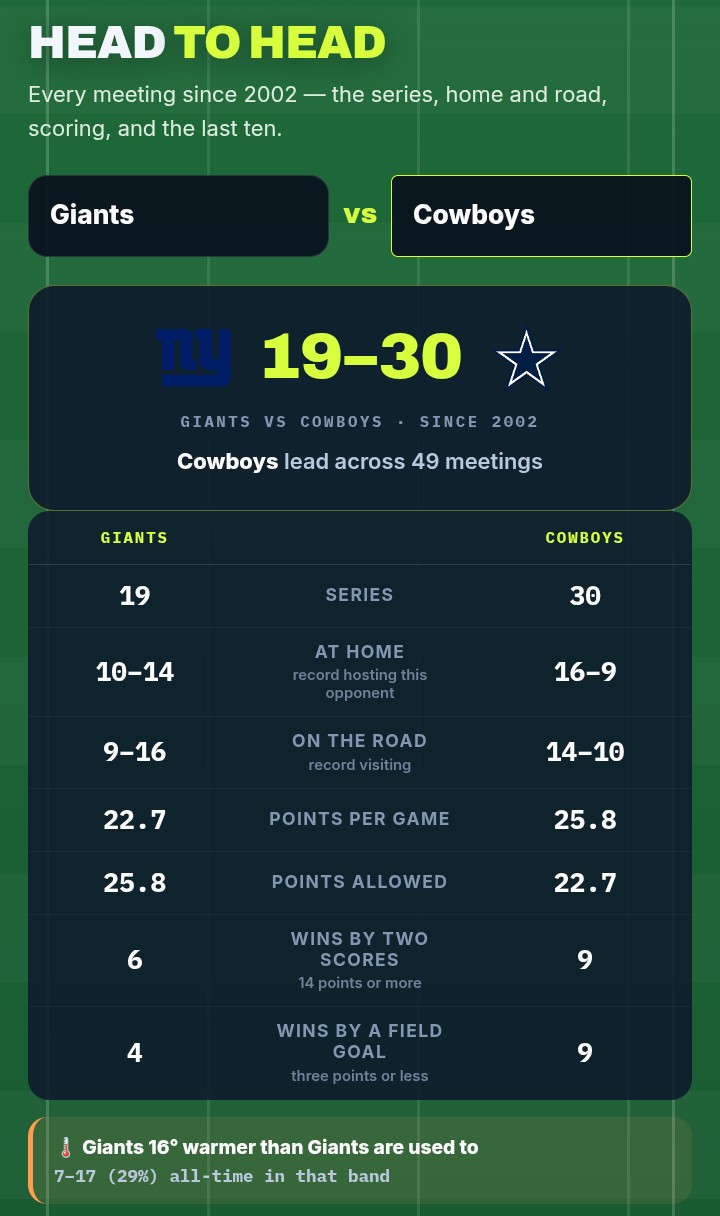
We keep every regular-season meeting since 2002 — series record, home and road splits, scoring, and the last ten games. Pull the Week 1 pairs before you listen to a single preview:
- Cowboys vs Giants — the Sunday nighter, and the ghost of the last Wednesday opener
- Patriots vs Seahawks — the Super Bowl rematch that starts everything
- 49ers vs Rams — a division game played 8,000 miles from either home stadium
- Broncos vs Chiefs — Monday night, and one of the most lopsided series in football
- Bears vs Panthers — the quiet 1:00 game with real fantasy implications
Twenty-four years of head-to-head beats a hot take every time, and it takes about ten seconds to check.
The Melbourne Game Is The Most Mispriced Situation On The Slate
The 49ers and Rams are playing a division game in Australia. That's a body-clock problem, a travel problem and a surface question stacked into one afternoon, and it's the least-analyzed game of the week because it doesn't fit anyone's normal routine.
Situational history is exactly what Schedule Spots exists for. Every game judged against 25 years of results, with the sample size printed next to every split — and when there's genuinely no edge, the page says so instead of inventing one to keep you clicking.
Then check the ground under them. Every stadium's surface is public, and the Surface Book splits every player's carries and catches by turf versus grass, straight from play-by-play. Some guys are demonstrably a different player depending on what's under their feet — and a neutral-site game in another hemisphere is the one week nobody bothers to look it up.
The Wednesday Start Bends The Whole Month
The knock-on nobody mentions: Seattle and New England open on a Wednesday, which changes their rest math for the rest of September. Everyone else in the league is running a normal calendar; those two are not.
Rest edges are among the oldest and most durable situational angles in football — extra days, short weeks, letdowns after a war, lookahead traps before a marquee game. All of it sits on the Spots page, and all of it has been knowable since the schedule dropped in May.
Snap Share Is The Only Real Predictor In September
You don't know who's good yet. Nobody does. You do know who's going to be on the field.
Opportunity beats talent every single time and it isn't close. A player on the field for 90 percent of snaps has a floor. A player at 40 percent is a coin flip no matter how gifted he is, because the touches have to find him. Half of all fantasy busts are guys who were never getting the volume — and that's diagnosable right now, not in October.
Snap share is on every player card, alongside the zone charts, and the depth charts give you the pecking order for all 32 teams before a single snap.
Three Years Of Defense Beats Two Weeks Of Noise
By Week 3, everyone's quoting defensive rankings built on two games. Two games is two games.
What actually helps in September is the longer view, which is why our team stat sheets run 2025, 2024 and 2023 — enough to separate a real defensive identity from one strange year. A unit that's been shredded by tight ends three seasons running did not fix that over the summer.
And it's cut by position, because you never start a defense, you start a position:
- vs QB — including rushing yards allowed to quarterbacks, the column that separates mobile-QB matchups from the rest
- vs RB — receiving yards and receptions split out from rushing. Plenty of defenses stone the run and then hand out seven catches a game out of the backfield. In PPR that's a start-or-sit swing, and total run defense hides it completely.
- vs WR — the page that settles most flex calls
- vs TE — the most exploitable position in football, because a few defenses simply cannot cover the middle of the field
Full team context on the defense sheet — third down allowed, red-zone attempts and touchdowns allowed, sacks, turnovers forced.
Pass Rate Tells You Who Survives A Blowout
One number on the offense sheet does more fantasy work than most ranking lists: pass rate.
It tells you whether an offense throws when it's ahead. That's the entire difference between a receiver who vanishes in a 24-point win and one who keeps eating regardless of script. Two equally talented receivers on teams with opposite pass-rate profiles are simply not the same asset — and Week 1 produces more blowouts than any other week, because nobody is calibrated yet.
Red-Zone Targets Are The Leading Indicator
Touchdowns are wildly volatile week to week. Red-zone looks are a role.
A receiver quietly collecting red-zone targets is a touchdown regression candidate before the touchdowns show up in his box score — that's the buy-low window, and it slams shut the moment the scores arrive. The leaders page ranks red-zone targets, red-zone touchdowns and red-zone rushing scores separately, because the goal-line back and the red-zone receiver are different assets.
Same page carries explosive plays — chunk catches and chunk runs — because consistency wins you weeks but ceilings win playoff matchups. The efficiency boards run a minimum-volume filter, so a guy with six carries can't top the yards-per-rush list and fool you in September.
The Cardinal Sin: Cutting A Good Player After One Game
Everyone does it, and it's the most expensive mistake on the calendar.
Before you drop anybody, run one test: did the usage change, or just the production? If his snap share held and the points didn't show, that's variance, and variance corrects. If the snap share dropped, that's information, and you should move immediately.
Consistency tells you who actually clears his line, Boom or Bust tells you whether one quiet game was always inside his range, and Hot and Cold tracks the direction.
Championships Get Built In Weeks 2 Through 5
The biggest edge available all season is being the person who notices a role change first, while everyone else is still complaining about their draft.
A backup who just played 60 percent of snaps is worth more than anything on your bench, and he's usually free for about four days. The Free Agent Wire flags the claims worth making, Sleepers tracks whose opportunity is growing, and the wire catches the roster moves that start it.
What Actually Changed For 2026
New quarterbacks in Atlanta and Minnesota. A receiver room rebuilt from scratch in Miami. Backfields where the camp pecking order shifted and the market hasn't caught up. Mahomes potentially back under center Monday night in Kansas City.
Every one of those is a volume story before it's a talent story — which is why the depth charts tell it before the box scores do, and why the injury report through inactives is the last thing you check before lock.
Sunday Morning, In Order
- Injury report — a perfect matchup for an inactive is worth nothing
- The position sheet for the exact call you're making
- The head-to-head book for what these two actually do to each other
- Surface, weather and situation — all knowable months ahead, checked by almost nobody
- Start or Sit to settle it — or import your team and let the Roster Doctor grade every man you own and set the lineup
Still drafting? Draft Central, the 2026 Guide, the Big Board, and the December Board for the weeks that actually decide your league.
Track it all live on the scoreboard, and everything else lives in the NFL Fantasy & DFS Hub. Free, no signup.
Wednesday, September 9. Set an alarm.