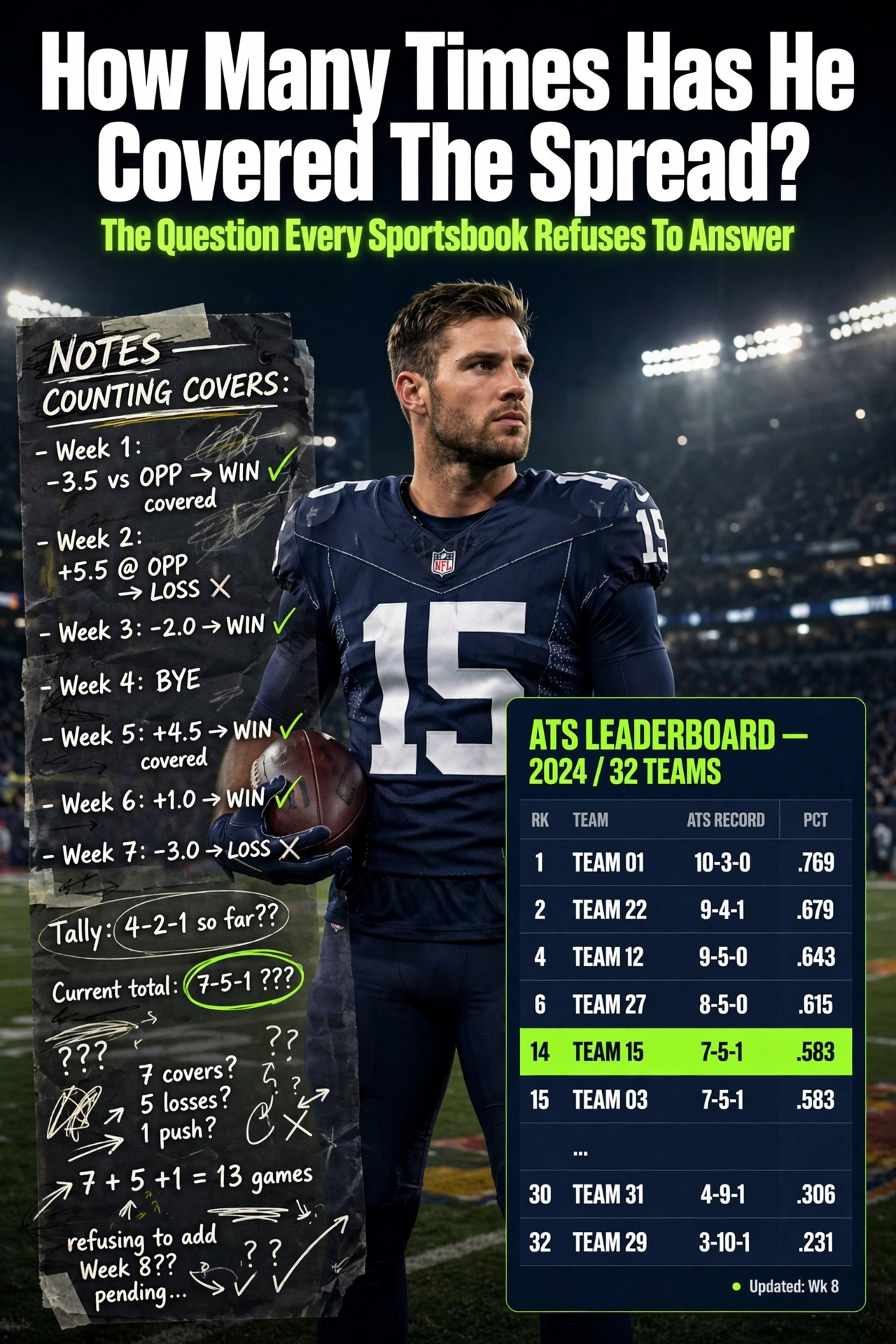
Watch what a prop bettor actually does before placing a bet.
The book posts Mahomes over 299.5 passing yards. You want to know how often he's really done that, so you open the app, find his game log, and start scrolling. 312 — yes. 287 — no. 340 — yes. 264 — no. You lose your place around game nine, start over, arrive at a number you're only half confident in, and fire anyway because the game starts in four minutes.
Every sportsbook on earth shows you the line. Almost none of them show you the count.
That is not an oversight. The count is the single most decision-relevant number in prop betting, and it is the one number the people taking your action have no incentive to put on the screen.
So we built it: the NFL Over/Under Line Checker. Pick a player, pick a stat, type any number, and see exactly how many games he's gone over it — with the full game log printed underneath as the receipts.
Three Steps, Ten Seconds
1. Find the player. Search by name, or filter down by team when you're working a single game.
2. Pick the stat. Passing yards, rushing yards, receiving yards, or receptions — the four markets carrying the overwhelming majority of prop volume.
3. Type the line. Not a preset. Not a rounded number. The exact figure your book has posted for his next game. 64.5, 71.5, 299.5 — whatever it says, type it.
Out comes the count and the game-by-game log behind it, so you can see which games cleared and which didn't. That context is the difference between a real read and a fake one: eight overs is a completely different bet if six of them came before a coordinator change.
Why The Average Is Lying To You
This is the core of it, and it's why projections keep failing people on props.
A prop is not an average — it's a threshold. Those are entirely different questions, and averaging turns the second into the first while destroying the information you needed.
Take a receiver averaging 68 yards a game against a 64.5 line. Sounds like a clear over. Now look at the actual games:
110 · 22 · 95 · 18 · 140 · 20
Average: 67.5. Times he cleared 64.5: three out of six.
That's a coin flip being sold to you as an edge, and the average hid it completely. The count didn't hide anything, because the count is just the honest version of the question: how many times has this actually happened?
Boom-or-bust players wreck averages. Consistent players are underrated by them. Boom or Bust shows you the shape of a player's range rather than its midpoint, and Consistency tracks how often each player clears his line across markets — the two tools that pair most directly with the Checker.
Six Things To Check Before You Fire
The count tells you what has happened. These tell you whether it happens again.
Shop the number first. The props board prices every player prop across nine books. Taking a worse line is the most expensive habit in betting and it costs nothing to fix — a half point on receptions is a genuinely different bet.
Check who he's facing. Opponent decides more than season average ever will, and you never bet against a defense — you bet against how that defense handles his position: vs QB (including rushing yards allowed to quarterbacks), vs RB (receptions split out from rushing, which is the PPR and reception-prop swing), vs WR, vs TE. All ranked 1–32, three seasons deep.
Confirm the workload. A gorgeous count on a player who just entered a committee is a trap. Depth charts for all 32 teams, and the injury report through inactives.
Check the sky. Wind destroys passing props harder than anything else on the board — harder than cold, harder than rain. The Weather Book holds 6,511 games joined to hourly stadium weather, and a split only publishes if it survives ten-plus games and sits twenty points off that team's own win rate.
Check the ground. The Surface Book splits every player's production by turf versus grass, straight from play-by-play, with the sample size printed next to each split.
Check the situation. Schedule Spots reads rest edges, short weeks, traps and letdowns against 25 years of games. And every matchup now has its own page with the series record since 2002 and the average combined score.
Where Props Come From: Volume, Then Efficiency
A prop is a volume bet wearing an efficiency costume. Yards follow targets and carries, and targets and carries follow role.
That's why the leaderboards matter for props, not just fantasy — 2025 receiving leaders, rushing leaders, and red-zone leaders, with 2024 and 2023 on their own pages so you can tell a career year from a baseline.
Touchdown props especially: the Red Zone Report ranks every team by touchdowns per red-zone trip and trips per game. A team that racks up trips and settles for field goals is where anytime-scorer props go to die.
Then Grade The Ticket Before You Fire It
The Parlay Doctor takes any slip — ours, your book's, a screenshot from the group chat — and grades it A through F: the true break-even, how much juice is buried in it, which legs are correlated, and which single leg is carrying the whole thing.
Correlation is the one that quietly kills prop parlays. A quarterback over on passing yards plus his own receiver over on receptions is not two independent events — it's one event wearing two hats, and books happily price it as though it isn't.
Nothing you paste is stored or sent anywhere; the whole diagnosis runs inside your browser.
Want the ticket built instead? The AI parlay generator works off a live odds engine across all four leagues, and Parlay Central holds all fourteen tools. Whatever we call gets stamped the next morning in the graded ledger, win or lose, nothing quietly deleted.
The Honest Part
A count is history, not a forecast. Six overs in eight games is real information and it is not a promise. Roles change, opponents change, and a player who cleared a number all September against soft coverage can stop clearing it the moment a defense decides to take him away.
Small samples are the trap. Four games is four games, no matter how convincing three-of-four looks. That's exactly why the game log is printed underneath the count instead of hidden behind it — you should always be able to see the games the number came from.
We'd rather hand you a real number with its caveats attached than a confident story with nothing behind it.
Open the Line Checker → Free, no signup, no account.
Everything else: the NFL stats hub for the boards, ATS trends for the sides, the fantasy hub if you're setting a lineup instead.
21+. If it stops being fun, 1-800-GAMBLER.