Here's a thing almost nobody does on draft day, and it costs people championships every single year.
You spend all August studying rankings. Those rankings are built to answer one question: how good will this player be across a full season? It's a reasonable question. It's also not the question that decides your league.
Your league is decided in Weeks 15, 16 and 17. Three weeks. Everything before that is qualifying.
And here's the part that should bother you: the schedule for those three weeks is already printed. It's been public since spring. You know exactly which buildings your running back visits in the fantasy playoffs, and you know what those buildings do in December. Almost nobody looks.
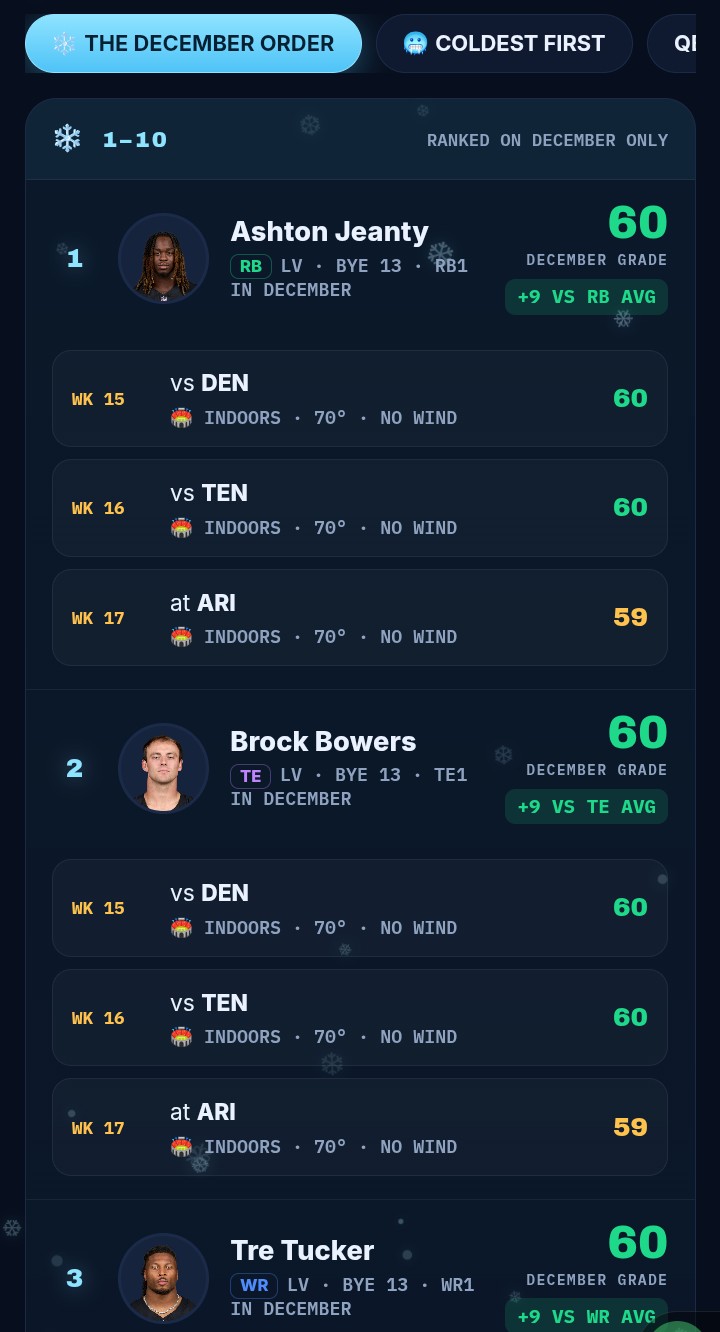
So we built the page that looks: The December Board.
What It Actually Grades
Every ranked player gets scored on the December he actually drafts into — not a generic strength-of-schedule number, but the specific buildings he visits in Weeks 15 through 17, measured against real December scoring history from our vault of every game since 2002.
Two numbers come back.
The Grade, 0 to 100. Fifty is a neutral December. It climbs when the stadiums he visits in the fantasy playoffs have historically scored above their own normal, and it falls based on the share of Decembers those buildings have spent below freezing or blowing 15+ mph. Indoors earns a bonus, because seventy degrees and no wind in December is a genuine edge and pretending otherwise is silly.
The December Rank. Where he sits on December alone, stripped of everything else.
The reason to separate those two numbers is that they disagree constantly, and the disagreement is the whole point.
The Tiebreaker Nobody Uses
Most draft-day tiebreakers are bad. "I like his tape." "He's on my favorite team." "The guy on the podcast said he's due."
Here's a better one. When two players sit in the same tier and you genuinely can't separate them — which happens on nearly every pick after round three — take the one with the better December.
It costs you nothing. You were flipping a coin anyway. But one of those players spends the fantasy playoffs indoors against soft defenses, and the other one goes to Buffalo in a wind advisory in Week 16 with your season riding on it. That's not a small edge, and it's free information sitting in plain sight.
Why Weather Belongs In The Math
Fantasy players treat weather as a Week 16 problem — something you check Sunday morning and grumble about. But weather isn't random noise. Certain buildings are cold and windy in December every single year, with a consistency you can plan around in August.
Wind is the one that gets underrated. Cold gets all the attention because it's the thing you feel, but a twenty mile-per-hour crosswind does more damage to a passing game — and to a kicker — than the temperature ever will. The December Board weighs both, and it separates the buildings that are genuinely hostile from the ones that just sound cold.
If you want the full picture behind those numbers, it lives in the Weather Book — every team's real record in cold, wind, heat and December, mined from 6,511 games. The situational cousin of it is Schedule Spots, which grades rest edges, short weeks, traps and letdowns against the same 25 years of history.
How To Actually Use It
Three ways, in order of how much they'll help you.
As a tiebreaker. Same tier, can't decide, take the better December. This is the highest-value, lowest-effort use and you should do it on every close pick.
As a fade signal. If a player is being drafted at a price that assumes a full season of production, and his December is brutal, you're paying for sixteen weeks and getting thirteen. That's a real discount you're not receiving.
As a late-round tilt. In the last few rounds you're throwing darts anyway. Throw the dart with the good December. A streamer who lights up in Week 16 is worth more than one who peaked in Week 4, because only one of those weeks is on your championship ledger.
You can sanity-check any of it against the player himself. Every NFL card now carries a zone breakdown and snap share — here's Ja'Marr Chase, Jahmyr Gibbs and Josh Allen — so a good December on a guy who barely plays is still a bad pick.
The Honest Caveats
Two of them, and we'd rather say them than have you find out later.
Teams change. A December grade assumes the offense that exists now still exists in Week 16, and injuries, trades and coaching changes all break that assumption. This is a tiebreaker, not a crystal ball.
And December schedules are a real signal, not a guarantee. A dome game can still be a dud and a windy road game can still go for thirty. What the board gives you is the better side of a coin flip, repeated across a whole draft. That's how edges actually work — not one magic pick, but being slightly right forty times.
Go Look Before You Draft
It takes about two minutes to scan and it will change at least three picks in your draft.
The December Board is here — every ranked player, graded on the weeks that actually decide your season.
The Rest Of The Draft Kit
The December Board is one input. Here's everything else worth having open on draft night:
- Draft Central — the hub for the whole 2026 kit
- The 2026 Draft Guide — strategy, tiers, sleepers, busts and a board that runs 335 deep
- The Big Board — every player ranked and tiered off the live market instead of hype
- The printable draft board — 10, 12 and 14-team versions plus labels for the wall
- The mock simulator — unlimited free reps from your exact slot
- Sleepers — whose opportunity is quietly growing
- Depth charts for all 32 teams — because half of all busts were never getting the touches
- The full 2026 schedule — byes and playoff weeks in one place
And once the season starts, the same thinking carries into the weekly calls: Start or Sit for the close ones, Boom or Bust for the range, Consistency for who you can trust, and the Free Agent Wire for the claims that win Octobers.
If you'd rather have the machine do it, import your roster from Yahoo, ESPN or Sleeper and run it through the Roster Doctor — it grades every man you own and sets your optimal lineup. Everything lives in the NFL fantasy and DFS hub.