The NFL Schedule Tells You Who Wins Before Anybody Snaps The Ball
Every week there are games where one team never had a chance, and it had nothing to do with talent. A team flies cross-country on four days rest to play a 1:00 ET kickoff with their body clock still at 10 in the morning. A team survives a war against a top-six opponent and then hosts a nobody the following Sunday, emotionally spent. A team is staring down a marquee matchup next week and has to get through a bad opponent first without looking ahead... (HERE)
Those are spots. Sharp bettors have been playing them for forty years, and almost nobody hands them to you in one place. So we built the page that does: NFL Schedule Spots.
What The Page Actually Does
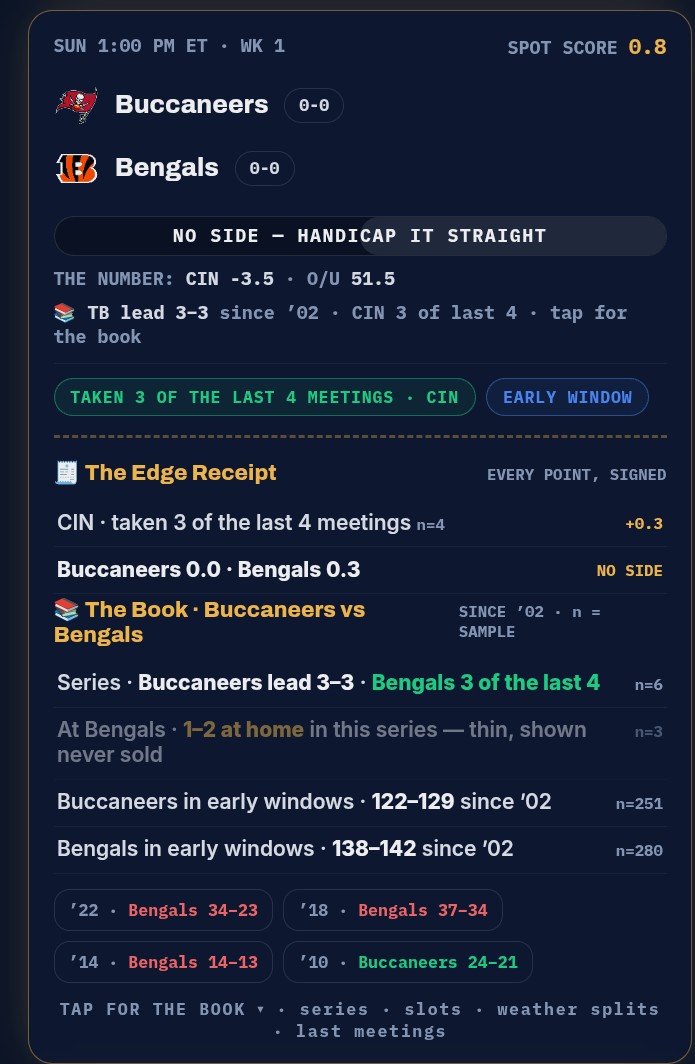
Every game on the schedule gets a card, and every card gets a Spot Score from 0 to 10. High score means the situation is screaming. Low score means the schedule is quiet and you should handicap the game straight up. The page tells you which is which instead of manufacturing an angle for all sixteen games, because most weeks most games don't have one.
Here's what the engine reads on every matchup:
Rest edges and short weeks. Days of rest for both teams, displayed right on the card and color-coded. Nine or more days is green. Under six is red. A team coming off a Thursday game into a Sunday road trip is not the same team that had ten days to heal.
Letdown spots. A team coming off a war with a top-six opponent walking into a lesser game. Emotional hangovers are real and they are measurable.
Lookahead traps. The reverse: a team with a marquee date circled next week that has to handle business first. Human beings peek at the calendar. Teams do too.
Board gap. How far apart the two teams sit on our house power board, updated weekly. A gap of eight or more spots gets flagged loud.
Division games, prime time, and the window. TNF, SNF, MNF, or an early kick all get tagged, because how a team performs at 1:00 ET is a different question than how they perform under the lights.
The Book: Every Game Since 2002
This is the part nobody else gives you. Tap any card and it opens The Book — the series history between those two teams pulled from our vault of every completed NFL game since 2002.
Not just the all-time record. The splits that actually matter:
- The series — who leads, and who has won the recent meetings
- Home record within the series — some teams simply own a building
- Prime time splits — how the visitor has fared against this opponent under the lights
- Warm-weather night games — evening kicks at 65 degrees and up, a real and separate animal
- Each team's own record in tonight's window since 2002, whether these two have met or not
- The last four meetings with final scores, game temperature, and whether it was a night game
The Part That Should Earn Your Trust
Every line in The Book carries its sample size. You see n=47 or n=6 right there next to the stat, because a trend built on six games is not a trend, it's a coincidence with good marketing.
And when the sample is too thin, we don't hide it. The line dims and says so: thin, shown never sold. Most sites bury the sample size precisely because most of their trends fall apart the moment you see it. Ours are printed next to the number.
Same honesty on the game itself. When the situational factors don't favor either side, the card says NO SIDE — HANDICAP IT STRAIGHT instead of inventing an edge to keep you clicking. A page that finds an angle in every game is selling you something.
Where The Spot Meets The Number
Each card carries the posted line and the total, and then does the thing that matters: it tells you whether the spot and the number agree, or whether the spot argues with the number.
That disagreement is the whole game. When the situation points one way and the market points the other, you've found something worth a second look. That's not a pick, it's a starting point, and it's a far more useful one than a stranger yelling LOCK OF THE WEEK at you.
Who This Is For
If you bet sides and totals, the spot is the context the number doesn't show you. If you play fantasy, the same situations move your lineup calls: a rested offense against a short-week defense is a different start-sit question than the matchup alone suggests. And if you play survivor or pick'em pools, traps and letdowns are exactly how good teams lose games you were counting on.
The schedule and lines come off the ESPN wire and cache once a day. The ranks come from our house power board. The Book is our own vault, finished games only, 2002 through today.
Check this week's board here: NFL Schedule Spots — every game, every angle, and the sample size behind all of it.
Pair it with the power rankings that feed the board gap, the injury report before you lock anything in, and the graded ledger where every call we make gets stamped in public, win or lose.